 |
 |
|
Hong Kong Cricket Association
Peter Hall “Fifty Years of Cricket in Hong Kong” |
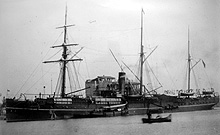 Sinking of the SS Bokhara |
|
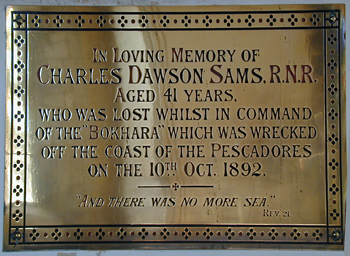
The Peninsular and Oriental Steam Navigation Line (P&O) Steam-ship (SS) Bokhara was a three masted steamer built at Greenock in 1873. On 21st June 1873, the Bokhara, on her maiden voyage, was stranded on an uncharted rock off Hong Kong, but was refloated without difficulty and was docked at Kowloon for repair. The ‘rock’ was subsequently charted and named the ‘Bokhara Rock’. Following this, authorities offered a reward of $10 to each Chinese fisherman who could point out any uncharted rock. The Bokhara sailed to Hong Kong under the Command of Charles Dawson Sams RNR in August 1892 from England with a crew of 143. Captain Sams was considered as one of the most promising of the younger commanders in the P&O Company’s service. A Fateful Journey
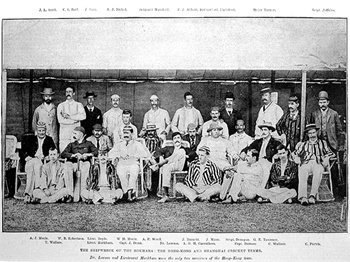
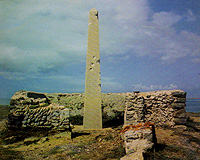
According to records maintained by the Hong Kong Marine Department, the SS Bokhara, under the command of Captain Sams, left Shanghai on 8th October 1892 with 148 persons embarked [among them thirteen members of the Hong Kong Cricket Team] and a cargo of silk, specie and ‘the mails’ bound for Hong Kong, Colombo and Bombay. It was not a full cargo, only weighing some 150 tons. The vessel was due at Hong Kong on 11th October 1892, a three-day journey of some 1600 miles. She sailed from Shanghai against the usual north-east monsoon and high seas astern and all seemed well. But on Sunday, the weather grew worse and by nightfall the barometer fell rapidly and the wind rose, indicating the approach of a typhoon. No warning had been received in those pre-wireless days and no SOS could be sent. Captain Sams gave orders for all precautions to be taken, the hatches being battened down and other steps taken to meet the oncoming storm. Al through Monday, 10th October the ship battled the fierce gale, but was steadily driven towards the north-west coast of Formosa (Taiwan). The sails were furled. The engines were set to dead slow and the ship brought to the wind on the port tack in a desperate bid to rescue the situation. The by-now tiring crew failed in their efforts laying beam on to the sea with her engines stopped, the Bokhara underwent a fearful battering. One by one the lifeboats and deck fittings were wrenched from their davits and either smashed or swept overboard as the Bokhara drifted across the Taiwan Straits. The Captain tried vainly to bring her head around, but she drove on helplessly. By Monday evening everyone was near giving up hope. In a last ditch effort to abate the heavy seas, Captain Sams ordered oil to be pumped overboard. For a brief while it appeared to have the desired effect, but the oil soon stopped as a result of blocked pipes. At about 9:0 that night, three monstrous waves broke in succession over the Bokhara. The engine room skylights were smashed, the engine fires were doused and the machinery flooded. It was almost midnight when land was spotted on the lea beam, not more than a few hundred yards away. While Captain Sams went below to warn the passengers, the engineers heroically attempted to restart the swamped engines. It was all to no avail. Within minutes, the Bokhara struck the reef protecting Sand Island (Pescadores Island) for the first time. At her striking the reef a second time, her starboard side was ripped wide open. In less than two minutes she sank in ten fathoms of water. One hundred and twenty-five persons were drowned and twenty-three were saved. Only two of the twenty-five passengers were saved - both members of the Hong Kong cricket team. Other survivors were the Chief Officer, Third and Forth Officers, two European Quartermaster and 18 ‘Asiatics’. The survivors were in a miserable condition and still precarious state when they were discovered by local fishermen, brandishing axes and knives, who appeared on the island once the storm had abated sometime on 12th October 1892. Dr. Lowson would recount later in vivid testimony, “First thing we saw next day was the Chinese coming ashore with axes and knives and for the second time we thought the end was near”. After salvaging what they could from the wreck, the local fishermen took the survivors to Peihou Island. The survivors were subsequently picked up by the Douglas Steamer Thales and then transferred to HMS Porpoise for disembarkment in Hong Kong. Reactions When the Bokhara failed to arrive in Hong Kong, the worst was feared and vessels set out in search. First news of the disaster began trickling through on Sunday 16th October, but it was not until 17th October that the full catastrophe was realised, when the following telegram was received by the P&O Co. from Captain Burr of the HMS Porpoise: Survivors (as stated but 18 natives) - 34 bodies recovered, 4 being women. Satow British Consul being responsible for burial and arranging for protection of the cargo saved”. The Passengers saved were Dr. Lowson and Lieutenant Markham, with five of the ship’s officers, Messers Prickett, Parry, Sweeny, Ward and Lewis Passengers missing were Major Turner, Captain Dunn, Captain Dawson, Lieutenant Doyle and Burnett, several other gentlemen, and four ladies. A Marine Board of Inquiry, addressed by Commander Rumsey RN (Retd), was quickly convened and, after two days of testimony, issued its findings on 22nd October 1892, which noted the following: Proper discipline appears to have been maintained on board. The conduct of the crew was, according to testimony of the officers, entirely satisfactory The Court has also before it the voluntary testimony of Dr Lowson, one of the two surviving passengers, to the gallant conduct of the Captain and Officers, in which testimony is supported by Lieutenant Markham, the other surviving passenger.
Memorials A stained glass window was set in the Cathedral of Hong Kong, it was removed and stored in crates just prior to the Japanese occupation of Hong Kong during World War II. Its whereabouts is now uncertain. |
|
|
 Finally: the loss of the