|



|
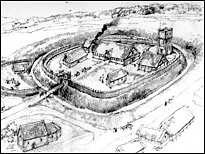
John Kliene 2002 - Reproduced by kind permission of Derek Batten & John Kliene
Introduction
In 1997 The Mount was purchased by Derek Batten a local county councilor and amateur archaeologist. Derek was keen to discover the history of The Mount and requested help from Channel 4’s ‘Time Team’. They responded with enthusiasm and spent three days in the Summer of 2000 investigating the site. The resulting programme, ‘The Man Who Bought a Castle’, was broadcast on
Since the making of the programme the author has been researching the medieval history of Alderton. It is now possible to trace the manorial descent. Click here to see an interactive "Now and Then" animation of the Mount History of the Castle and the Medieval Lords of Alderton There has been much debate over the age of Alderton’s castle. The archaeological work by Time Team has given us a good understanding of the span of occupation of the site but was inconclusive concerning its first construction, Stewart Ainsworth, a landscape archaeologist and member of Time Team, suggested that the castle may represent the truncated end of a Saxon Burgh (fortified settlement). Certainly examination of the landscape does not preclude this idea but so far there have been relatively few finds in Alderton and so no evidence of a large Saxon settlement. Archaeological finds from the castle give a span of occupation from Neolithic times through to the present day. The site is on high ground overlooking the Tove valley making it an ideal vantage point. There are abundant natural springs in Alderton. It is an ideal settlement site in many respects. The Romans Evidence of the Roman occupation is abundant throughout the area. Alderton is only 1 mile from Watling Street (A5) a major Roman thoroughfare and 4 miles from the important Roman town of
The Saxons Whilst a small number of Saxon pottery sherds have been found and a Saxon yard surface and post hole near the castle, so far there is insufficient evidence to support the idea of a Burgh. A small Saxon farmstead is more likely and we know from the Domesday Survey that Edmar and Edwin held the freehold of Aldriton. The
William I awarded the manor of Alderton to his half brother Robert Count of Mortain. Robert held 99 manors in Northamptonshire amongst his total of 793. The Sunday Times survey the ‘Richest of the rich since 1066’ places Robert the third richest man of the millennium. Did Robert construct the castle at Alderton? Certainly such ringwork castles were being hastily erected around the countryside immediately after the Norman conquest, powerful symbols of the new order. Interestingly the Domesday Survey of 1086 does not mention the castle at Alderton. Not all castles were recorded in the survey but such an impressive earth such a small settlement would surely have deserved mention. Aldriton - The arable land was eight caracutes. In demesne were two hides and half a virgate, and there were three caracutes with one servant; and three villeins and three bordars with two caracutes. There were twelve acres of meadow, and a wood three furlongs square. Besides the above, a thane held one hide on Aldriton on behalf of the earl. The arable land was two caracutes and there was one plough. It was valued at 10s yearly. The first documentary reference to the castle comes from a document, yet to be traced, in the Bodleian Library and is thought to date to 1170 AD during the reign of Henry II. This comes from a period when the King had a great interest in castles particularly those constructed without royal consent, referred to as adulterine castles. Henry was re-establishing the authority of the crown after years of unrest caused by the disputed succession to the throne between Stephen I and Matilda. The Anarchy The disputed succession following the death of Henry I caused civil war in the country with Henry’s preferred successor his daughter Matilda attempting to take the throne from Henry’s nephew Stephen I. This period of civil war resulted in the rapid construction of baronial castles across the country; more than 100 have been identified that were constructed between the years 1135 and 1152. By 1120 most castles were being constructed of stone but the earthwork and timber tradition did continue; these lesser fortifications were quicker, easier, and less costly to build, and were therefore attractive to those who did not have large financial resources, or those who needed defend their interests immediately. William of Warrenne Throughout the period of anarchy the manor of Alderton was held by William of Warrenne, 3rd Earl of Surrey. William supported Stephen. Could this be the man who ordered the construction of Alderton castle in order defend his manorial estate against the supporters of Matilda and the lawless Barons? William Bruere The manor passed from the Earls of Surrey to William Bruere (Briwere), Bishop of Exeter by the service of one knights fee about the year 1215. William was a powerful supporter of Richard I accompanying him on his Crusade and negotiating his release after his capture by the Emperor of Germany. On William’s death in 1226 the manorial estate passed to his son who paid 600 marks (£400) for his livery and relief. He survived only five years after which his five sisters and surviving relatives inherited the manor. The Sauvages By 1245 we know that Sir James le Sauvage held the castle and manor of Aldrinton which according to Baker ‘he demised to Sir John Lovell for 12 years, to be re-delivered at the expiration of the term in as good state and condition as when leased’. He did not live to see his manor returned for Sir James’s son, Thomas, sold the
Alderton castle at this time was no doubt used an administrative facility. It would have been managed small number of manorial officials (probably less than a dozen) involved in the collection of taxes, manorial dues and the settling of legal disputes. Certainly the castle not further developed and remained a wooden pallisaded earthwork; the Chaworths were occupied elsewhere. The Chaworths Pagan or Payn de Chaworth was appointed Captain of the English Armies by Edward I and was sent according to Baker ‘to annoy the welsh’. Pagan substantially developed the Norman
By a deed dated June 1306 at Stoke Bruere the manors of Aldrinton and Stoke Bruere were passed from Henry and Maud to Sir William de Combemartin. The Combemartins The family may have their origins at Combe Martin in
We cannot be sure amongst these families who may have resided at Alderton but it seems likely that Combemartins did, not at the castle but at the mediaeval manor house in Alderton which then existed and which is the subject of further research by the author. Of the other families, Oxenford, Cheshunt,
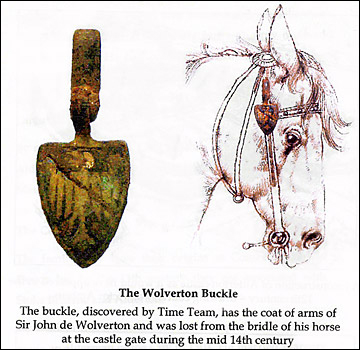
Alice de Combemartin’s third husband was Sir John Staunton later to be John de Hastings, Earl of Pembroke. In the Inquisition Post Mortem of Alice de Staunton dated 1364/5 the manor comprised ‘certain ruined structures’. Glenn Foard has interpreted this comment to imply that the castle was abandoned and its buildings are those referred in the IPM. This may well be the case since archaeological evidence from the Time Team dig suggests abandonment of the castle around the middle of the 14th century. The Wolverton Buckle
Castle Abandonment The exact date when the castle became disused cannot readily be determined but by the middle of the 14th Century there were numerous reasons for its demise. The manors of Stoke Bruerne and Alderton had been combined. The Black Death swept
Modern History Little is known of the castle during the Tudor Period. In Alderton the seat of power resided firmly at the Manor House which was substantially improved by William Gorges in 1582. During the English Civil War there was a skirmish at Alderton in November 1644 and musket balls of that period were found by Time Team. The castle may have been used as a military encampment but not of any consequence. In the 18th century Bridges refers to the Mount as a rifling ground, a practice area for local sporting gentry. Lead shot from this period has also been found at the site. Riden tells us that a stone walled village pound used to stand within the Mount although there is no trace of it today. Throughout the last two hundred years the castle has been used by the village as a recreational amenity and this tradition continues today with the site now privately owned but still a venue for outdoor theatre and special events. Tour of the Castle The castle covers an area of approximately 2 acres. It has been partly tree covered for many years and was not cleared of scrub and made accessible until its recent acquisition by Derek Batten. The site which is a listed
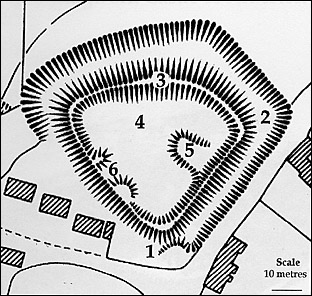
Modern Entrance - 1 Entry to the castle is gained through a gate on
The Moat - 2 The most impressive feature of Alderton’s castle is its moat. The current moat has been slowly infilled over the years by the natural erosion of the slopes. A trench was dug by Time Team across the moat to establish its original depth. This reached bedrock and the water table almost 3 metres below the current ground surface. The moat was cut into a natural limestone outcrop - a considerable task for the peasantry who must have been employed to dig it. The Rampart -3 From the inside of the Bailey it is possible to see a low narrow ridge running around the edge of the Bailey. This is the remains of the castle rampart which would have been surmounted by a wooden palisade. The Bailey - 4 Within the bailey a number of bumps in the ground can be seen. These represent the sites of buildings including stores, stables, kitchens, accommodation for the castle occupants, possibly a Great Hall and (it has been suggested) a wooden
Building Platform -5 One of the building platforms on the east side of the Bailey was excavated by Time Team and a large number of green glazed roof tiles were recovered. Post holes were present, so it is believed a timber framed building with a tiled roof once stood on this platform. Amongst the finds from the platform trench were a small mediaeval key and the tip of a dagger sheath (chape). Castle Gate - 6 Two small mounds on the south western side of the castle mark the original entrance. One of these was excavated by Time Team and it was in this trench that the Wolverton buckle was found. The archaeological evidence suggests two gate towers probably of wooden construction sat upon stone foundations. These would have flanked the castle gate which opened to a causeway crossing the moat. |





|

