|



|
Northampton & Country Independent December 1984 by Jack Gould “Chimp”
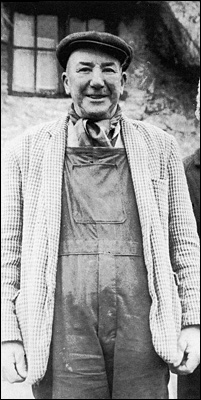
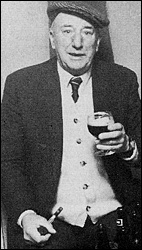
Such a one is Alfred Jesse Richardson, of Grafton Regis. Although an institution in that village few would identify him by these baptismal names because for reasons long lost he is known to all as “Chimp”. He was born at Oundle in 1907 but at the age of six months was brought to Bozenham Mill Farm, where his father was employed as a shepherd. Bozenham Mill stood on the River Tove between Ashton and Grafton certainly since the 13th century but was demolished in the 1950s and scarcely a trace of it exists today. The farm was one of three rented from the Duke of Grafton by “Master” Bliss, as he was termed, being something of a “gentleman” farmer. The others were Vale and Manor Farms. As a boy “Chimp” was brought up in the belief that all food was to be conserved and that there were to be no idle hands among the “labouring classes”. From the age of five he was engaged in tasks such as cleaning mangolds, using a sort of miniature bill-hook about a foot long with a spike projecting with which to pick up each root. He still owns one of these and I’m sure that to introduce a modern infant to such a weapon would lead to bloodshed. He also went crow scaring and collecting sparrow’s eggs, for which ”Master” Bliss would pay three old pence a score. Rats’ tails were also a source of profit, however small, since these creatures nibbled at the fringe of what was still near subsistence economy By the age of 14 he had finished his schooling at Ashton and graduated to being one of several ploughboys employed by “Master” Bliss. This may sound idyllic, but was little romance in slogging beside a team of horses across the heavy Northamptonshire clay-lands. During this time “Chimp’s” youthful brain taking in impressions of country matters now gone forever. Even then Bozenham Mill was in decline. A blacksmith’s shop and bakehouse contiguous to the mill still existed but both were out of use and the mill was only operated for odd sessions of grinding. Eel traps were still in situ and a sheep-dip adjacent was in regular use. It was apparently the custom to “accidentally” drown one animal from every flock so that the men who worked the dip were sure of some good meals of mutton after their labours. “Chimp” remembers fishing from the Mill House widows and how the mill-wheel was renewed for the last time by the father of Albert Shakeshaft, who still is resident at Chapel House, Ashton, and like his father before him was once landlord of the Crown Inn there. There was little metal-work in the operative parts of the mill mechanism for all the cogs were of wood and only the spindles made of iron. As a boy, among other farming duties, “Chimp” helped his father drive sheep and cattle to Northampton Market. They used a sapient dog who, when they reached the South Bridge was dispatched home alone. Having delivered their charges to the market the
Another episode which stays in “Chimp’s” memory from those early years was when a bull had to be taken for slaughter to
Father Richardson was a shepherd all his working days and in 1930 “Chimp” took up the same vocation at Grafton Lodge farm. This was in the ownership of the Martin family – the firm of Henry Martin then being a very large and prosperous building enterprise – and they also owned a considerable establishment at Church Farm, Piddington. Since they also had further grazing ground at Wootton, the young shepherd was constantly traversing the roads and lanes between these villages and
In these cross-country journeys he often traversed
He knew as individuals the 1,400 sheep in his care. He recalls the disappearance of one “yow” (as he termed it, meaning a ewe) from a field by Toll Gate Cottage and its mysterious re-appearance miles away at Yardley Gobion. One particular eccentric
Another busy time was shearing. It was done then by means of clippers activated by a hand-operated machine and the going rate was “shilling a sheep and find your own turner”. Horses also had their own little ways. “Chimp” recalls one known as Boxer which pulled a cart to take the farm workers from Grafton to Bozenham, when the water-meadows were flooded by the swollen River Tove. It was still dark when Boxer was plodding through the water and suddenly stopped. No amount of urging would get him to move and it was not until day-break that they understood why he had jibbed. One end of a wire fence had come adrift and had been swept by the flood across the road, so although hidden by water and darkness Boxer had sensed its presence and would have none of it. After six years of shepherding “Chimp” decided there were easier ways of making a living and went to work for J. S. Cowley and Son, a firm of builders and undertakers still flourishing at Stony Stratford. The outbreak of the Second World War resulted in his working on Government contracts at Whaddon and
In doing so he sacrificed the chance of a Civil Service pension but says he has no regrets. He certainly appears a happy man despite being plagued by shingles, a most discomforting complaint. He is full of anecdotes from the old days. For a number of years he was one of a quartet of stalwarts who “shouldered” the coffins of the locals on their last journey to the churchyard. Bowler hats were worn and grew ancient in the service. They were laid on the grass for the later stages of the ceremony, so that when one was trodden on the excuse was made that its colour made it indistinguishable from its background where it lay. Pre-occupation with mortality was then a characteristic of rural life – not like today when death is almost a dirty word - and “Chimp” has a number of stories on this theme. His mother once went with another woman to “lay out” an old man who was well into his nineties. They stripped off the bed-clothes to begin their task but got a nasty shock when the “corpse” sat up and intoned: “Cor - I AM cold!”
Other old villagers come back to life in “Chimp’s” reminiscences, from the time when Grafton was mostly peopled by country folk of the old school. One ancient man asked him to “put down” his cat when it was nearing its end. Following the custom of that day the moggy was popped into a weighted sack and dropped into the nearby
Another Grafton worthy was of the Nonconformist following and therefore averse to swearing in public. When his patience was sorely tried he was driven to use an expletive harking back to the days when malefactors met their end on a public gibbet and he would shout “What the gallus do you think you’re at?” Not so long ago you could walk into many country inns and find men such as “Chimp” talking of days gone by. Few of them had ever got more than a pittance from their labours but from their life and work they had distilled the wisdom of the fields and could make intelligent and entertaining conversation. They have no successors. The minute modern farming force are unlikely to cull anecdotes from the behaviour of such things as tractors and combine harvesters. |

|

