|



| This article is reproduced from a copy of The Northampton Magazine. It gives a somewhat stylised view of Ashton as it was in the period between the two World Wars. The issue number was not dated on the copy transcribed here, but from the reference to the church bells being rehung, the year of publication must be 1932. | ||||||||||||
|
The Northampton County Magazine
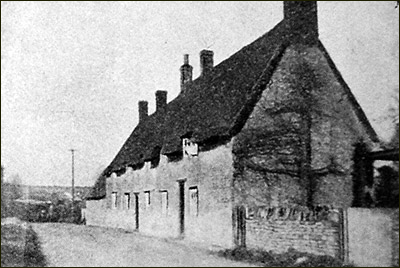
Our County Villages No. 40 : Ashton (near Northampton) by Miss Dorothy Macmillan Saltem remoto des, Pater, angulo At least O Father, ere the close of life The city-tired, travel-worn, world-sick soul might find in Ashton, near Northampton, an answer to that pious prayer. The village has changed but little with the passing years. Its old-world atmosphere still persists. The very walls and hedges, the cobble stones in the yards with their mossy interstices, all mutely proclaim an age-old endurance that time cannot weaken. Oil lamps still do duty as the sole means of illumination. Water is still drawn from wells by the strenuous use of the pump handle. Ducks and hens, their ranks augmented occasionally by a good-natured obese old sow, still meander in care-free liberty about the lanes.
The cottagers maintain that ingenuousness of mind with simplicity of soul, which is a marked feature of the rural population of our English Midlands. From birth till death, life flows softly as a brook in summer. Riches may be unknown; purses may be lean, and comforts few; but there abounds in almost every homestead the best wealth of all, the blessing of domestic happiness. Ashton lies in a saucer-shaped declivity, while the neighbouring villages, Stoke Bruerne, Roade and Hartwell stand high, proudly elevated. Nevertheless, on bleak days, when they shiver with cold, Ashton smiles in sheltered warmth. The pivot upon which our history swings is the church, dedicated to St Michael, a handsome edifice of which we are justly proud. There is, however, a deceptive appearance of largeness about the exterior, when viewed from the road, and one is arrested with surprise in consequence when crossing the threshold.
The earliest portion of the building is the north aisle, originally a small chapel, the private sanctuary no doubt of the Lou or Lupus or Wolfe family, lords of the manor of Ashton. The present windows date from about 1290, expressing the flowing lines and graceful curves of the Decorated period. The new chapel was added on the south side about 1830. In 1066, at the time of the Conquest, extant records show there was a chapel and priest at Hartwell. No mention is made, however, of priest or chapel in Ashton or Roade. Presumably there was none. May we not conjecture with a certain degree of accuracy that both Ashton and Roade received a chapel, possibly a mere temporary structure at first, about the time when the great religious revival swept through England in the reign of Henry I. At this time a new spirit of devotion stirred men's hearts. It penetrated into religious houses. It burned deep in the souls of the poor. There was a wholesale turning to God; an outpouring of Pentecostal Fire; and we read that men everywhere delighted to gather themselves together for prayer and meditation. The records reveal that at some time after the Conquest, the Hartwell family of that village, and the Wolfes of Essene or Ashton, decided to erect and endow a church at Rode (Roade). The Hartwells, having doubtless the greater substance, elected to provide two thirds of the endowment, the Wolfes giving one third. These two families had the power of electing a rector to take the services and to receive the money in proportion of two thirds and one third. The first rector was priest at Roade somewhere between the years 1093 and 1167. Eminently pious, weaned utterly from all taint of worldliness, this estimable divine gave generously to the Abbey of St James, Northampton. Not content with yielding up the whole of his stipend, he must give also some 40 acres of land, and the chapel at Hartwell, to the Abbot for the enrichment of his abbey. Henceforward, until the suppression of the monasteries, the Abbot of St James was rector of two parts of Roade Church, taking two thirds of the tithe. The Ashton portion is not mentioned for taxation, strange as it seems, until 1329. By the year 1329 the Wolfe family had died out in Ashton. The Hardreshulls were now lords of the manor.
That these gentlemen had considerable force of character - lords not only of the manor, but of their own dominant natures - we see from the conduct of Roger Hardreshull, appointed rector of his portion at Roade by his kinsman, Sir John Hardreshull. Roger then, exactly opposed by nature to his predecessor and first rector, Simon of Hartwell, reveals a rapacious and quarrelsome disposition. Instead of giving lavishly to the abbey of St James, he actually takes more money than was his due, and is in consequence summoned to Northampton to answer before the abbot for this laxity of conduct. His defence was that he was quite within his rights, for he was parson of Ashton and rector of a third of Roade Church, therefore the money was his by virtue of office. His spiritual father evidently does not see eye to eye with him here. True, he was entitled to his stipend, but why had he forcibly seized the abbot's goods and chattels in Ashton and Roade to the amount of £10? We can imagine the abbot silencing his volubility by the stern rebuke of his glance, by the extreme gravity of his countenance. We can also visualise Monsieur Hardreshull riding back to Roade after this interview, ascending the gentle gradient of the lonely highway, deep in thought, rebellious against the abbot's interference; his wrath riding with every mile, till the nag beneath him winces again and again under the sharp prick of his spurs. Fierce controversy ensued. Roger was not the man to be dictated to. In 1342 Sir John Hardreshull is called in to settle the dispute. He sides with his kinsman. At length it was agreed that the abbot should provide a parish chaplain for two years out of three, and should receive all the tithes in the village of Roade, and also of thirteen certain tenants in Ashton. Roger lost no time in breaking this agreement and the quarrel is renewed. In the year 1346, the abbot was obliged to lay the whole affair before the Court of Canterbury. There his rights were immediately confirmed and Roger, the vanquished belligerent, has to swallow his rancour with the best grace possible. Nevertheless, the dispute seems to have continued for many years. The abbot, rich and powerful, generally won the day. Perhaps it was on this account, more than on any other, that in 1516 Ashton definitely broke away from Roade and made a parish for herself. In 1925 the ecclesiastical parishes of Ashton and Hartwell were united. Between 1349 and 1370 the Hardreshull property in Ashton descended to the Colepeppers, who were lords of the manor at the time Ashton was made into a rectory. To return to the church. In the old Wolfe chapel, now the north aisle, is a wooden effigy, carved in oak, erected to the memory of Sir Philip le Lou or Lupus, who fought under Edward I in Scotland in 1301. The knight is attired in a suit of mail, covered by a surcoat, a garment worn to prevent the sun's rays striking too brightly on the armour beneath. Lying parallel is another effigy ascribed here to Sir John Hardreshull, who died in 1365. In the words of Lamb, he " Sleep'st a Marble Sleep." The figure, carved in alabaster, seven feet long, is a beautiful piece of statuary, much mutilated, and subject to that form of vandalism which never fails to rouse indignation in the beast of the antiquary, namely the act of carving initials on works of art in public buildings. Sir John is represented wearing armour in vogue in the days of Edward III. The lion couchant is in an excellent state of preservation.
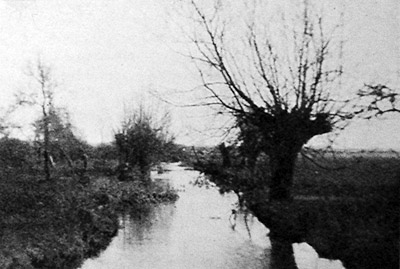
A peep inside the vestry reveals an old table tomb, which has a brass to the memory of one Robert Mariott, yeoman, of Ashton, 1580; he lived at the manor. On it are depicted his wife, nine sons and six daughters. An inscription beneath the figures describes Robert Mariott in this way: "In England bred, in Ashton dwelt (it does not say 'born'), an ancient married man." We cannot but admire his threefold pride: an Englishman, an Ashtonian, a venerable sire and husband. The complete lines are worthy of reproduction: Robert Mariott here doth lie, a yeoman bleste with goods, A direct descendant of the above Robert Mariott is alive in Ashton today, a grand old man of 85, in full possession of all his faculties. There is a Jacobean pulpit well worthy of attention. Of stained glass, however, there is a singular paucity. The centre light in the east window shows a representation of the Crucifixion. This is a memorial to the Rev. C. P. Winter, who held a soul stirring mission in Ashton this last century, and was erected in 1893. In the churchyard are the following epitaphs, almost obliterated: Sturgis, 1714 in east wall. The loss of time is much, Sturgis 1716, East end All you that doth this place pass by, This stone is defaced. Reading these epitaphs, Gray's immortal words came to mind: Yet even these bones from insult to protect, The next verse, too, is appropriate. The Manor or Moat House, very little larger than an ordinary farmhouse, is a severe, solidly built mansion of great antiquity. The arched entrance facing south is bricked in now. The old oak stairway, broad and shallow, rapidly falling into decay, is still used. There was a moat round the place crossed by a swing bridge. A decade ago the house was converted into tenement dwellings; several families now enjoy the spaciousness of these lofty rooms. So late as 1685 the country seats of the gentry were fortified. This moat with its swing bridge must have been used as a means of fortification against hostile attack. Rumour persistently proclaims the existence of a subterranean passage connecting Ashton manor with Roade Hyde, an ancient farmstead near the Northampton main road. In the fourteenth century manor houses were the centre of village life. In the vast straw-strewn hall, court has held, the lord of the land received the homage of his tenants, and executed justice. Sometimes he possessed criminal jurisdiction and the grim gallows stood without his doors. Tory by instinct, distrusting all innovation, cavalier by example and training, it is no difficult matter to conjecture which side the lord of the manor would favour during the social upheaval of the Civil War. One of the oldest, most picturesque dwellings in Ashton is Hill Cottage, formerly called the Church Cottage, once the home of the sexton. The windows overlook the graveyard. The living room presents and intriguing feature, a wall seat cut out of the stone itself, to the side of the present range - patently suggesting that the original hearth was a slab of freestone upon which turf fires would smoulder, the smoke escaping up the chimney hole above or curling lazily into the room, seeking vainly an outlet among the blackened beams of the low ceiling. Alas, the days of the clang of hammer upon anvil, and the cheery song of the farrier at work are no more in Ashton. The forge is forsaken, except perhaps on chilly eves when the snow flakes are falling, and the ghosts of past smithies reappear at the scene of their labours. The pound stood in the Manor Lane, behind Hill Cottage. I asked my informant, an octogenarian, one of the last living links with old Ashton, where was the ducking pond for the correction of quarrelsome women. His dim eyes lit up with a thousand twinkles, his face became wreathed in smiles, as he replied: "We used the Moat for that!" The earliest Meeting House for Dissenters was a Baptist chapel which stood near the Crown Inn. The building has completely disappeared. A Wesleyan chapel, erected in 1858, raises its modest head from a position of retirement in the west end of the village. With the advent of steam-power locomotion the peace of the hamlet was rudely shattered. Great engines plough their way through the very heart of Ashton; a mechanical pulsation, throbbing with noisy violence, night and day. In 1886 a brisk wind from the west blew sparks from an engine on to the dry thatch of cottage roofs. The conflagration that followed rendered many families homeless. Cheerless slates now replace the old-world thatch to the east of the railway. The Tove, tributary of the Ouse, laps a gentle course through the parish, a mile south of the hamlet. It winds round Bozenham Mill, amid open fields, and here anglers find a paradise
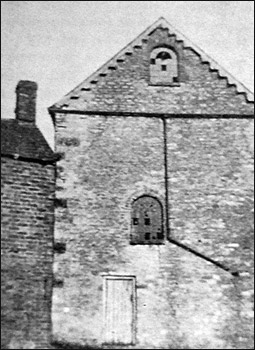
The mill is well worth a visit. There stands the great wheel ready to work but never used. The machinery id to be seen on the first floor, relic of a bygone age, when local corn was ground at the local mill, and country bread was in consequence all the sweeter. I walked back to the village, a distance of two miles, along a secluded lane, heavy of heart, wishing the old mill had not been so silent; wishing our voices had not awakened ghostly echoes of a time when all was noise and life and bustle there. Memory lingered about that gaunt, powerful wheel; the race below, quiet as a duck pond now; the crazy planks beneath our feet; the worn rungs of the ladders; the darkened windows and the soulless emptiness of the forsaken mill.
Last year the bells in the tower were recast and hung; today Ashton rings as rich a peal as any church in the district. So, not without regret, we leave the sequestered glen to its rural content; to the chime of Sabbath bells; to the fluid notes of thrush and blackbird; the hum of a million bees, the lowing of cattle, the rattle of harness and groan of rusty wheels beneath the load of rich, ripe hay. The organ in the parish church was installed about 1895 by two Northampton shoemakers who took up organ-building as a hobby. The Ashton organ was made partly from portions of old organs from two Northampton churches. But a great deal was new work. The two men made the wooden pipes from new wood and cast the metal pipes. The cost was about £70. |



|

