|



|
Employment in Grafton Estate villages
Within the area covered by the Grafton Estate, employment took many forms. Obviously, agriculture and forestry predominated, while the presence of the Grafton Hunt generated a whole set of necessary jobs: care of horses and hounds (the dogs had to be walked as regular exercise). See the section on The Grafton Hunt on for further details. Shooting was a popular sport, requiring the wildlife and its habitat to be maintained and giving employment to gamekeepers, beaters, etc. In an agricultural environment, manual labour in the fields accounted for most days of the week - even the year, while women were faced with the routine tasks of cooking, washing, cleaning and other domestic chores without any of the labour-saving devices we have now come to rely on. The average village would have a number of people whose work supported that of others and the life of the village in general. A quote from Stanley Dickens of Grimscote whose reminiscences are recorded elsewhere (click here to read them) sums it up: "Years ago the village claimed to have a shop and post office, outdoor beerhouse, carpenter and coffinmaker, gravedigger, blacksmith and cobbler, Parish Constable, first class stockmen and craftsmen and shepherd." To that list we could add trades like baker, miller and wheelright. Holiday periods such as we know today were rare, trips to places like the sea even rarer, especially for people living in an area of England which is about as far from the sea as one can get in any given direction. Church festivals, agricultural shows and travelling attractions provided temporary respite from the pattern of daily toil, and there was a pub in most (but by no means all) villages. This section looks at the various sources of employment for men and women, and while it is not a comprehensive summary, it gives a flavour of the kind of work men, women and children were doing around a hundred years ago in the rural economy. FARM WORKERS
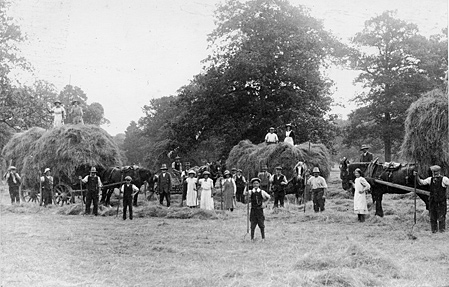
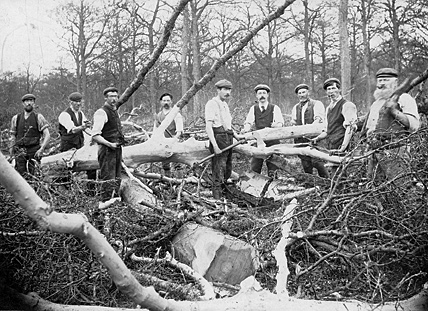
Agriculture was a major source of employment, but the hours were long and the wages not very high. There was a major downturn in agriculture in the late nineteenth century as a result of repeated poor harvests and the decision to import grain from America and Canada. Nearly every village on the Grafton Estate saw a fall in population as people left to seek work in towns and new industries (see the Brief History pages on the individual village sections). Another slump in the 1920s and 1930s saw a repeat of the same process. Accounts and memories of Yardley Gobion relate how the farms there employed a large number of villagers. Young girls from the village found work in the farmhouses as maids, whose job it would be to clean, do the open fires, black-lead the range, and do the washing in the outside wash-house. Other typical farm employment would be for milkmaids, herdmen, farm labourers and field workers. At Elms Farm they made butter in the dairy. Farms offered employment all year round because, apart from the steam engine and the introduction of a tractor, all work was done by men and horses. The Elms had a tack room, a saddle room, stables and sheds for the cart. There were high carts, sprung carts, goat carts and a governess cart. The farmers and their wives would go by horse and cart - which would be loaded with eggs, butter, rabbits and cockerels - to Northampton to sell the produce. Cattle were walked from Yardley to Courteenhall, where after a night's rest in a field they would be moved on to the cattle market at Northampton. TIMBER WORKERS Hartwell was once a thriving centre of the timber industry. Historically centred in Salcey Forest, it was natural that timber should have a prominent place in the lives of the villagers. Some of the older buildings were located in the forest itself and were probably the homes of the forest rangers. Being part of the Grafton Estate, there were also strong royal connections. Apart from routine things like tree felling, there were other tasks such as stripping the bark from the trees, or sawing the trunks in saw-pits using a two-handed saw: one man on top, the other in the pit.
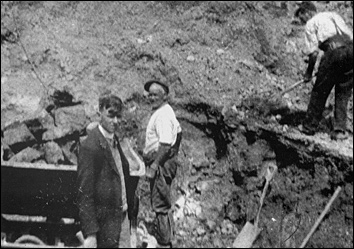
A fuller account of the Hartwell timber trade is given Hartwell. Click here to read the feature on the Whattons. QUARRYING AND BRICKMAKING Northamptonshire has major deposits of ironstone, and in the nineteenth century these began to be exploited as the Industrial Revolution transformed Britain and the demand for iron and steel grew. Railways were built across the western section of the county in the hope of providing access to places like South Wales which had a flourishing steel industry. New employment opportunities came to villages in the Blisworth area.
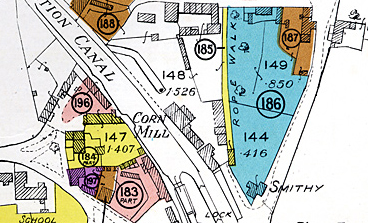
The other major geological deposits in Northamptonshire are limestone and clay. Part of the county sits on the Oxford Clay belt - a type of clay with high carbon content which speeds the firing process and thus increases output. Although major brickmaking industries grew up elsewhere on the fringes of the county, such as Bletchley in Buckinghamshire, Stewartby in Bedfordshire and Fletton near Peterborough (formerly in Northamptonshire, now in Cambridgeshire) small scale brickmaking took place in many villages across the Grafton Estate, such as Greens Norton, Stoke Bruerne and Alderton. ROPE MAKING One unusual form of employment was at Stoke Bruerne, where there was a rope walk located behind the cottages by the side of the canal. Ropes were made by hand, and so a narrow strip of land was set aside for this purpose.
The strands of rope were anchored to a post while the twisting went on, and the rope-maker backed further away down the walk as the rope grew in length. SERVICE
Most of the menfolk in the Greens Norton area in the early part of the last century were farm labourers, although some were employed as grooms and stable lads by the local gentry (more commonly called the "Toffs"!) who were hunting folk, Greens Norton being in Grafton Hunt country. During the summer most of the horses were put out to grass, and many of the stable workers were laid off. However, there was always need for extra hands at harvest time. The big houses also needed domestics, so many girls went into service. One lady gives a personal and poignant testimony as follows: "At the age of 14 mother took me to answer an advertisement for a kitchen maid at a large house in the next village. it was slavery; up at 6.30 to black-lead a large range and scrub the kitchen floor before the cook came down. She wore awful glasses, which she looked over if angry. Wages were two shillings and sixpence a week; there were days when nothing went right. The Colonel died and I married in the same year, being let a cottage on the estate provided I went up to work at sixpence per hour. War came, so the staff left. Only the old parlour maid stayed. When she died I took over, till my husband died. Then I said I could not live in the house any longer and gave the old lady at the age of 95 years a choice of coming to the little lodge, which was empty, with me, or else going to a nursing home. My job ended when she died in her 99th year; ending my 50 years of service." LACEMAKING
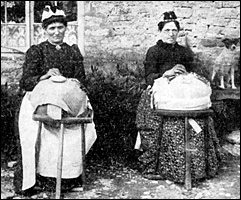
In many ways, lacemaking was the definitive "cottage industry". Before the invention and adoption of the lace-making machines which were to make Nottingham the centre of the lace industry, it was the women of Bedfordshire, Buckinghamshire and Northamptonshire who made the high grade lace worn by ladies of quality in high society. Lace schools passed on the skills of the craft to the next generation.
By the 1930s there were only about half a dozen women in Greens Norton making pillow lace, whereas at the turn of the century nearly every cottage had its pillow - after all, even if what the lace dealers paid the cottagers for the lace was a fraction of what they charged the eventual purchasers, for the women and children of the cottages it was still an additional source of income. One woman born in Yardley Gobion in 1907 recalls how she saw many women sitting at their cottage doorsteps, making lace.
In the darker evenings of winter the work still went on. To increase the light given out by candles, large water-filled glass spheres were used, to concentrate the light from the candles onto the pillow. |

|

