|



Transcribed from a facsimile of the original, and reproduced here in abridged form with kind permission. All rights reserved.
The Life & Experiences of a Farmer’s Fourth Son
by S.C.B. Dickens
The Ride to and from School – Horses, the Roads and Other Travellers With two brothers I drove by horse and trap to
Lord Penryn’s racehorse Rubio was stabled there at the time, being used to pull a vehicle to meet passengers at the station. Later he won the Grand National race at Aintree,
Several boys rode horses to school from the local villages. There was very little movement on the road except for farm carts and an occasional tramp. Large granite stones were carted and tipped at intervals on the road verges and broken up manually to the required size with a hammer by one man, usually an elderly one, for repairing the road, and used on the wheel tracks only. The journey was about three and a half miles, sometimes we would change horses and ride each other’s mounts, which would mean going home by another route or bridle way across fields. I was very fond of taking on a youngster before it was broken to harness and trap. During those days I became a very good horseman and rider, joining the Grafton Hunt on weekends and holidays. On certain days I would meet a man carrying a basket on his head, balancing it as he walked along, with bloaters (cured herrings) to sell in the villages at a penny-halfpenny each. Some days he would be pushing a light truck to collect rags and bones and rabbit skins for a few pence to sell to a wholesale merchant. At one time an old man and his wife would go round the villages selling dried fish and home-made toffee wrapped in newspaper. He drove a donkey and costermonger’s cart, and when they were both riding, their posteriors would partly overhang the wheels. One day he had tied up his donkey to a gate and gone off to sell their wares, when some boys – looking for a bit of fun – took out the donkey, put the shafts through the gate, and fastening the donkey in the shafts the opposite side. What happened on their return I must leave for your imagination….. The Workhouse, the Poor Law, Rates & Taxes On
Out of School – Work, Fun, Games, Water and Coal When we were not at school we would be perhaps driving three horses at plough, sweeping up front yard, or cleaning out henroosts and nest boxes. One of us might be driving cattle or sheep to market, when a private deal was made, “luck money” was passed to the boy when payment was made, to be saved and not spent. In a field on the farm with many hills, slopes and hollows, we had a lot of fun. We tied two sack barrows together in such a way that one would sit and ride on one with the handles fastened to the other under the first stay or cross-piece. The rider would be holding the handles of the leading barrow and be able to steer in any direction: this would be summer amusement to take the place of tobogganing in snow during the winter months. A Great Dane dog was harnessed to pull back the sack barrows to the summit again. Before piped water was installed in the farmhouse, soft water from an underground well had to be pumped and carried upstairs after being heated in a copper for washing and baths. A smaller amount was always available in a side boiler of a large kitchen range heated by any amount of coal purchased by the truckload from the railway – about 15 tons. Farm men could purchase a ton delivered free at 18 shillings from the truck at the same time, usually at a slack period. In the nursery room with a firegrate and a fire in winter we three boys after bathing were allowed to romp around in our dressing gowns for a while before getting into bed at
Visits to Relatives [There follows a section describing visits to relatives. Once he went to
When I was twelve years old I went to stay with a farmer relative, as I had often done before. He had a foal belonging to a very lame mare: the foal was an exceptionally good one but its mother was too lame and it was intended to enter it for Thame Show – a large agricultural event in Oxfordshire. Twice every day I led the foal out in various directions and environments alone, and eventually I was able to make it stand and behave, so to the Show it went, winning three firsts and a second prize. Afterwards I became more fond of horses, and never happier than when riding or dealing with young horses. This happened to have a big effect on my future years.
Altogether there were 25 men and boys, none reaching one pound a week. I remember one man with twleve children only having twelve shillings. Perhaps one or two eldest might be getting a little crow scaring; the ploughboys had 3/6 [three shillings and sixpence] a week. The milkers and carters had a little more, but nevertheless by today’s standards they were all grossly underpaid. Poultry for eggs were kept on free range at the various farm buildings. The eggs were collected by the family living there, and picked up on a certain day of the week to be sold. An uncle would be in charge of the farm’s management.
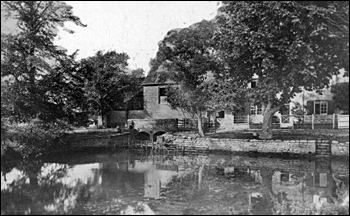
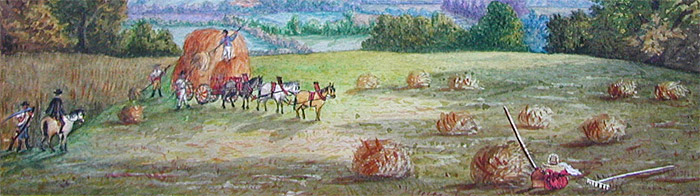
After much rain the floodgates had to be opened when water would rush through gratings, sifting out eels and other large fish – these were elevated into a cesspit by the rush of water, and would be great fun getting them out early in the morning before the mill started. There was a portable and powerful engine available if there was too much or too little water to drive the mill. In wet weather we were taught how to dress large mill stones and mend Hessian sacks. Cricket and football were only indulged in at school, or after 6 pm at the end of the day at home. Only work of necessity was done on a Sunday, and no horses were allowed to be worked on Sunday. Confirmation At 14 years my brother and I were confirmed at Kislingbury in April. The floodwater was up to the church door, so we had to be carried on pick-a-back from the horse-drawn vehicle. I remember when we arrived back to the farm Diamond – a Shire mare – had presented her lovely foal under the walnut tree. She bred one most years. The Dalscote wheatstack fire At that time my father farmed land at Dalscote and “Scurf”. Two large wheat stacks were burnt down. It was thought a hen had laid her eggs in a hole between them and an old man smoking a pipe leaning in to get the eggs started the fire. This was on a Friday. On Saturday morning after taking a cob to be shod at Pattishall, I rode on to Dalscote to see the result of the fire. I could not reach the stirrups, so I rode with my feet in the leathers. I shall never forget seeing the wheat grains popping in the ashes. The ricks were due for threshing in the Spring and we hope they were well insured. Catching Sparrows The Rev W.A. Howes was rector of Cold Higham and farmer; he was also a sportsman. His son Richard was fond of shooting and other country sports. After he left home the Rector gave my brothers and me a set of sparrow nets, on condition we took to the Rectory the first score of sparrows we caught. We could catch them in the Rectory gardens, ricks and buildings. If any other birds got in the nets we were to let them go. In winter sparrows would roost in ricks, cottages that were thatched, and ivy; and in summer in September, flocks of them would roost in thick hedgerows. In Buckinghamshire in the Vale of Aylesbury a proper party would have three pairs of nets working large hedgerows, two sets one side, and a bashing pole with a set of nets on the opposite side to get the odd bird sneaking out that side. A good bag of 150 a night would be caught and could provide a good meal if properly prepared and cooked. Sparrows were a real pest at harvest time, pecking out the grain. Apart from what they ate, the "shaltering" was great in the shocks. Rabbit Hunting with Ferrets As we got older and able to keep ferrets, we were able to catch rabbits by putting ferrets down the holes, driving out rabbits into nets placed over the bolt holes. Later on when we were capable of using a shotgun, the rabbit had a sporting chance of getting away. Sometimes a rabbit would be killed or bundled up to the end of a hole without an exit. To find it, a strong ferret with a collar and line would be set to work to find the rabbit. Having done so we must follow the line in the hole by digging with a narrow spade. Sometimes we might be lucky and find several there, and often good rabbits, much better than shot ones. Now rabbit pests are kept down by gassing. The Farm at Finmere – the Yearly Pattern of Arable and Livestock Farming About 1907 my father took a farm to rent at Finmere in Oxfordshire – about 220 acres. My third brother managed that with my elder sister to keep house : and father’s supervision - a journey once a week and back next day – about fourteen miles. Production and produce as at Grimscote : milk, rearing, and corn growing and sheep. To keep a farm in good condition and in good heart a four-course system was adopted to suit the type of soil and its fertility. A dressing of sixteen loads of rotted farmyard manure to the acre, placed in heaps, six yards apart: six to the load and six yards between the rows. This is spread as soon as possible by manual labour, an inch or so deeper ploughed than the last time a year before. A man with a good pair of shire horses turning out at 7 am with half an hour for lunch which he takes with him, and back in the stable at 3 pm, would plough an acre a day. On returning to the stable the horses would be allowed a small amount of water from the trough usually near to the stable, tied up to the manger and rack, and unharnessed with good hard hay in the rack to eat. The horseman would go home to his dinner to a farm cottage and back in an hour. The horses would then be allowed free access to water and receive their ration of crushed oats, bran and split beans, mixed with sifted chaff in small feeds to avoid dust and bolting their feed. A good ploughman ploughing in a straight furrow would cover up all the manure, standing up every furrow slice on edge so as to drain the soil and give it full access to the elements of the winter weather. Assuming the land is reasonably clean of twitch or couch grass, mangolds, kohl rabi, or kale could be grown with the minimum of cultivations, otherwise a second ploughing must be undertaken. Other methods were used to grow good and heavy crops of roots. After thorough cultivation to stitch or ridge up with a plough with a mouldboard each side the beam, making hoeing and singling much easier. Swedes should not be drilled before the middle of June, while turnips in July for quality. A special drill to be used on ridges. During the summer root crops would need to be horse-hoed and hand-hoed in early stages until roots became big and covered the ground. Mangolds would be harvested in October, clamped and used after end of January, other roots some of which would be carted and used before February, but most would be eaten by sheep on the arable land. The swedes would be pulled up and stacked in heaps about sixteen yards apart, covered with a small amount of straw with soil on top to be protected from very frosty weather. When feeding Swedes to sheep we used to cut them up in small slices and feed them in troughs after a feed of concentrated mixture, and racks of good hay ad lib. Some farmers would let sheep graze swedes but our small acreage would not be so wasteful. About a hundred sheep were fattened during the winter. A week or two before Christmas a score or so would be selected for special treatment in view to entering them for the Xmas Fat Stock Shows. Matching, lightly trimming and eventually weighing 64 to 72 pounds estimated dressed carcass weight. Prize winners commanded a good price and if possible we got a high class butcher to take the main bulk in the New Year, weekly as he wanted them delivered to suit his requirements, at a price just above the weekly market price. This method saved time at market, also the commission and penning, also less stress to the animals. In that case the grading was done on the carcasses at the abattoirs or private slaughterhouses. On the arable land sheep were controlled in hurdles or wire netting and stakes, moving on to a new pen or fold each day, so as to avoid the land becoming too fertile and crop going down. After that treatment an excellent crop of spring rabi was assured – up to twenty four sacks (twelve stone) to the acre in 1939, providing the cultivations are carried out correctly and seed planted at the latest 25th March or better as early in February as possible. The next crop would be spring barley, drilled in a nice seed bed as early in February as the condition of the land would allow, and later undersown with a mixture of ryegrass and broad red clover, to crop next year to produce an excellent 3-ton to the acre of good hay and a second crop in August for sheep and young stock. Finally the land is in good heart and condition for a good crop of wheat. In 1940 a crop of Bevans Golden Archer produced twelve sacks to the acre and sold for seed at £14 a quarter – about twice the value of the land it was grown on – to Watts & Sons of Banbury. It was sold the next year at half the price. Milk and Butter It was the practice before the First World War on this farm to milk eight or ten cows by hand and set the milk in large leaden trays, skimming off the cream each end of the day, pouring it with a vat adding a small quantity of salt and saltpetre. After twice skimming, the milk was heated and fed to calves or pigs. Later a separator, a machine operated by hand, took out the cream after milking in one operation each milking time. The milk was then fed without heating. Butter was churned once a week in winter and twice in summer. The churning was done by the cowman under supervision. He received a pint of beer also for milking on a Sunday. His name was “Beck” – William Beck Trusler – he worked here all his life on this farm, had no family, killed and ate one pig each year, and died in 1934; he had a wife. At Cuddington Mills my mother’s birthplace, their separator and churning was driven by pulley and shaft from the mill. That was on a bigger scale milking about 30 cows. Later, a larger number of cows were milked, and raw milk was delivered to Nestle’s milk factory in Aylesbury daily. The men and boys had to be early to work as the milkcart had to be away by 8.30 am and driven seven and a half miles and back by 11.30. After breakfast these men worked on the land until milking time at 3.30, hoeing or other jobs according to the time of year. Killing and Curing Pigs In November farmers and workers usually killed a pig, and perhaps if a big family which was not unusual, another in March for their own consumption. It was a specialist butcher’s job. After killing it was singed by burning wheat straw over one side and turning it over and repeating, being very careful not to scorch the skin. It would then be scrubbed with cold water and odd hairs shaven off and scraped thoroughly. Finally the pig would be lying on its back on clean straw when the entrails and offal would be removed, carefully washed, and carried with a rolled-up bag (Hessian) under its shoulders by three men to be hung up in a convenient place sometimes in the living room of a cottage or dairy in the farmhouse. The pig weighing about 300 pounds would be hung up by its head in order to increase the weight, and improve the shape of the hams and make the head lighter. The cutting up was done in such a way so as to make large flitches of bacon and hams, keeping the lean meat to a minimum. The hams and bacon are then pickled in a special recipe of salt, sugar and spices : 3 – 4 weeks for hams and 3 weeks for bacon flitches. After being washed and air-dried it could be stored in a chest of very dry material such as malt culms, dried brewers grains or even wood ashes, until required. Lard was made by rendering down the leaf and any surplus fat. Pork pies and sausages from odd lean meat. Pies exchanged with others who might be making at other periods. Catapults Before we were allowed a shotgun, we used our skills with home-made catapults which became very popular, but not to be used near buildings. Small round stones were commonly used, but special ammunition was made from old lead in the glazing of windows. This was melted down in an iron spoon, and poured into a bullet mould. This was a wet day job and the lead was from old demolished windows. It was a dangerous practice and not recommended these days. Haymaking Before haymaking machines were introduced, grass for hay was cut with scythes. I can well remember half a dozen men moving five feet swathes following each other across a field. It was very hard work and the grass needed to be long and the scythes very sharp. The men consumed oceans of beer with no ill effects. Should anyone’s poultry or pets found straying into the long grass making it difficult to mow, the men if finding the owners would demand a quantity of beer. The grass was then turned with wooden rakes after being dried one side, if a heavy crop it would be shaken up with two-tined hay forks. Assuming the weather is dry and going to be fine, a horse-rake would put it into rows so as to allow a wagon to pass between. Two men would be on either side to pitch it up to a loader on the wagon. There was a special way of putting it onto the load to bind it in so it would not shake off when moving. If it had to travel far when complete, a rope would make it secure.
If hay is put into a stack without plenty of sunshine, it would continue to sink by overheating, necessitating moving or cutting to the middle to let out the heat. Overheated material has no food value. Learning a Trade In 1908 with two brothers on the farm I left school and decided to go out into the world to learn a trade as near to farming as possible. I had relatives who had done the same very successfully. Farming during that period was not everything to be desired, although I loved it and was prepared to to work hard and hungry for more experience. Apprenticeship was the most certain way of getting a good foundation in training in those days. After my father had made enquiries, I decided to learn the butcher’s trade. This involved a visit by both parties to a solicitor, and a contract on my part to serve an apprenticeship for three years at one shilling, two shillings and three shillings per week respectively, and to swear I would not set up in business in opposition within so many miles afterwards. I was to receive my board and lodgings, and a premium of £20 was paid. The First World War After serving my apprenticeship and two years working in
[The author goes on to relate at length his experiences in the First World War: how he trained till 1915, being promoted first to corporal the to full sergeant; how the regiment went to Kings Lynn, Much Hadham in Hertfordshire and the Purfleet in Essex for firing practice, as a result of which he was sent to Bisley for an instructor’s course on musketry and achieved a first class certificate. On being informed that the cavalry regiment was to have bicycles instead of horses, he requested and was granted a transfer to the 3rd Reserve of Cavalry at
1919 – The Grafton Estate
My second eldest brother who had been assistant to my father during the war had become engaged to be married and was looking for a suitable farm. My father who was not a very fit man asked me to return home to replace my bother who later married and took a farm locally. This I decided to do, determined to make a success of it if possible, for the benefit of all concerned. My experience of butchering would be very valuable at home and market, also the management of labour “slightly modified” would be useful. During the year 1919 a portion of Glebe land owned by our rector was being offered for sale. My father was tenant and it was bought in June. Again in October the Duke of Grafton was selling the whole of the Grafton Estate, which included the Dickens farm at Grimscote. The fields were now allotted so that the farm was now in a ring fence and most fields had access to running water from our own springs – a great asset in comparison to ponds. The pressure of farmers to grow and grow was now over, as the war had come to an end. The ships were assured of a safe voyage and a slump was beginning to be felt in some quarters. However, the farm had been farmed as well as available labour would allow, so the offer to buy was accepted and a percentage paid as requested. The narrative of the author's account goes on to relate the rest of his life on the farm, his marriage, the changes in country life, his retirement, etc, and other events until the the death of his wife in 1979 For a final echo of the period he decsribes so vividly see the feature on Country Wisdom |
|

