|



|
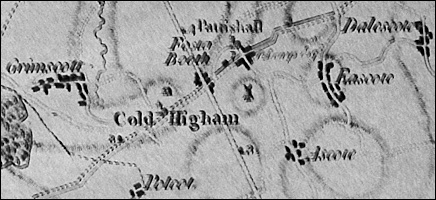
Adapted from The History & Antiquities of Northamptonshire 1791 by John Bridges and The History & Antiquities of the County of Northampton by George Baker 1822-4
A Brief History of Grimscote Grimscote is an ancient manor dating back to the time of the Norman conquest. Unfortunately, it was never a parish, because the church to serve the village was built at nearby Cold Higham. The statistical boundary lines between Cold Higham and Grimscote are therefore difficult to draw, since Grimscote always appears to have been the larger settlement, yet the ecclesiastical parish is that of Cold Higham, and both have latterly fallen within the wider area of Greens Norton. The situation is probably best described by Baker: "The largest extent of this lordship is computed at a mile and a half. It contains about five and forty houses, including thirty two in the liberty of Grimescote, which is at present supposed to be a member of Cold Higham; tho' anciently they were names indifferently used for each other, and the township of Cold-Higham now lies within the Manor of Grimescote. Eight of these houses, which stand in all Grimescote, are set apart for the poor."
As Grimscote village has so often been considered as part of Cold Higham, statistical data such as census figures cannot easily be disaggregated from those for the parish as a whole. The composite picture however is an interesting one. In common with almost every village on the former Grafton Estate, the early part of the 19th century saw a rise in population, followed by a decline in later years. Where Grimscote and Cold Higham differ from most other villages, however, is that this decline became permanent. The parish was not one of those where development took place in the latter part of the last century. In the absence of permitted development and the trend towards smaller families, the population is down to half what it was at its peak in 1841, even though the number of houses remained fairly constant at around 70 for most of the 20th century.
At the time of the Domesday Survey in 1086, Grimscote was held by the Earl of Moreton, and then passed to the Whilton lords. The estate must have been sub-infeuded, for by 1315 there were four lords of Higham, Potcote and Grimscote - Robert de Daventre, John de Grimescote, Richard Foxele and John de Patishull. In the early 15th century the Daventre family conveyed their portion - along with the advowson of the church of Cold Higham - to William de la Pole. This transaction subsequently became the subject of legal argument, with the de Daventres being accused of fraudulently witholding some of the lands the de la Poles thought they were due. The de la Poles succeeded in their case, though the lands and manors again became the subject of legal manoevering with the next owners, the Langleys. (Read about the Langley Cartulary). The lands and titles were subsequently acquired by Sir Richard Empson, and then sold to the Earl of Pomfret, with whom they remained. However, by the time of the 5th earl, the estate was no longer considered to be manorial, and the only recognised lord of the manor at the time of inclosure in 1812 was the Duke of Grafton, who had inherited lands in the area via the honor of Grafton. Bridges reports that "In this lordship the family of Greene appear to have had also very considerable possessions, which from them descended to Sir Nicholas Vaux, were afterwards in the hands of William Parr, Marquess of Northampton, then of Queen Catherine, and are now part of the estate of his Grace the Duke of Grafton".
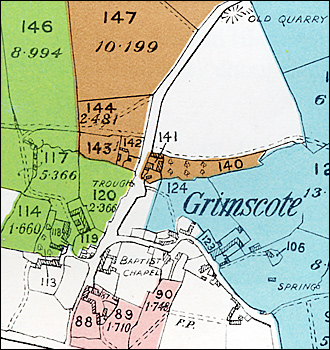
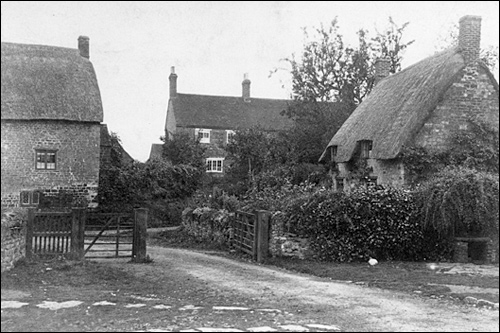
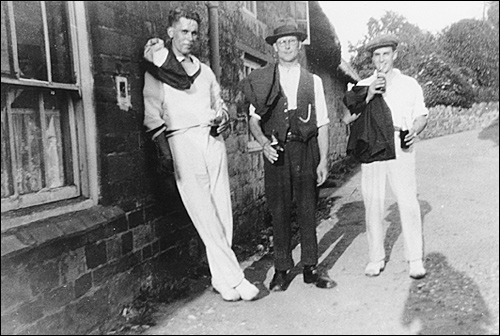
Being in a rural area, Grimscote was very firmly in Grafton Hunt territory, and on one occasion was host to double royalty (click here to read the story). The main occupation, however, was agriculture. We are fortunate that a very special account has survived to give us a picture of life in Grimscote at the turn of the 20th century. Stanley Dickens, fourth son of the C.W.C. Dickens who was the Duke of Grafton's tenant at Manor Farm Grimscote (marked blue in the map above), did a hand-written autobiography of his life, and part of this account has been transcribe. Click here to read this special feature. For the rest, see the pictures below for a glimpse of life in Grimscote in the past.
A last word from Stanley Dickens in 1978 on how village life changed in the years after the Grafton Sale and the decline of the village: "Most residents by now had changed from farm workers to industrialists and town workers - each morning a car 'or two' for transport. Neighbouring villages have a shop and a public house. This parish is without either. Building is very restricted. Years ago the village claimed to have a shop and post office, outdoor beerhouse, carpenter, coffin maker, gravedigger, blacksmiths, cobbler, Pariish Constable, first class stockmen and craftsmen and shepherd." |





|

