|



|
Adapted from The History of the County of Northampton Vol.V - Cleley Hundred (ed. Philip Riden)
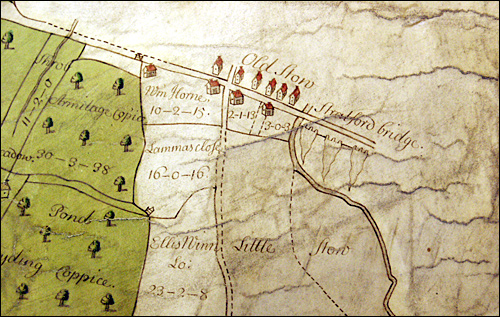
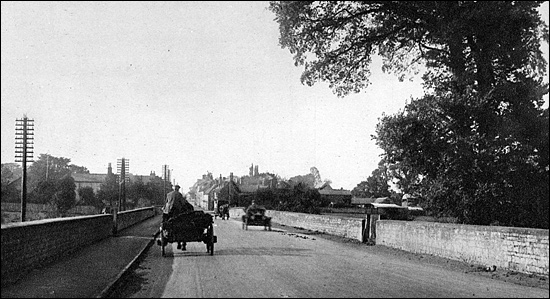
A Brief History of Old Stratford At first glance it might seem strange that Old Stratford has to some extent remained in the shadows of its close neighbour Stony Stratford, when both have similar origins. They are linked across the River Ouse by a bridge which also carries the old A5 trunk road, previously known as Watling Street - one of the two great roads from London to the North. In addition, Old Stratford also had the crossroads junction on Watling Street where two roads went off in opposite directions to the county towns of Buckingham and Northampton - the latter road the main road from London to Northampton. One might have expected therefore that Old Stratford would have been home to the huge number of coaching inns and hostelries which are a key part of Stony Stratford's history, rather than the four establishments it actually did have; but then, almost everything about Old Stratford runs contrary to expectations, starting with its name and parish status. "Old Stratford" as a name might suggest an ancient borough which gave way to a newer more thriving off-spring. In fact, the name Old Stratford does not seem to date back much further than the 15th century. Before that it was known as "West Stratford" or "For Stratford" On the map of 1608 (shown below) Stratford Bridge is clearly marked, but the name of the settlement on the northern bank is given as "Old Stow". A toll gate is also shown across the road at the opposite end of the village. The right to these tolls from Old Stratford were a right of Queen Catherine's settlement and passed in turn to the Dukes of Grafton who leased them to various people over the years till an Act of Parliament in 1837 rescinded the right in return for a single settlement payment.
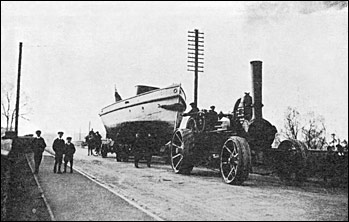
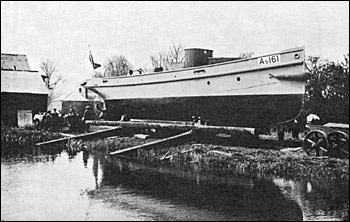
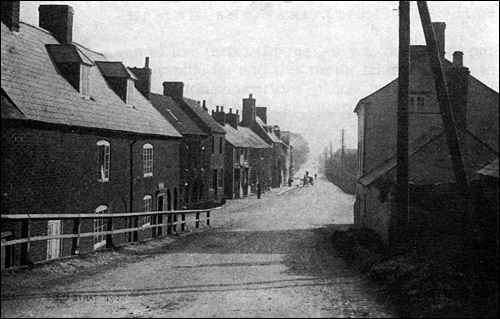
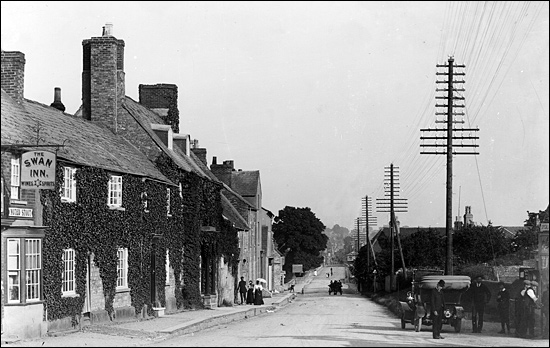
Another significant part of Old Stratford's history is that it did not become a civil parish until 1951. For centuries it was mostly divided between the manors of Passenham, Cosgrove and even Furtho - a tiny hamlet whose story is told elsewhere. Old Stratford also had no field system of its own - only the crofts which lay behind the houses along Watling Street. Beyond those were the common fields of Passenham, Cosgrove and Furtho. This fragmentation of the settlement into a component part of three other parishes means that it is difficult to establish clear population data for Old Stratford since it has to be disaggregated from other data. What statistics are available show that in 1674 there were 17 households; in 1839 there were 39 and the population stood at about 175 - hardly major growth, considering its location on two major routes at a time when the coaching trade was at its height. What development there was seems to have been largely small-scale ribbon development along Watling Street, rather than along the roads to Deanshanger (for Buckingham) and Cosgrove (for Northampton). Nor was there much in the way of commercial development. There were four inns in Old Stratford, the oldest and largest being The Saracen's Head, probably the first house on the left after the river as shown in the map above. A potash kiln was working in 1714, but burned down in 1744. A new kiln operated from 1758 till 1772. In 1827 there was a mill powered by steam as well as the wind. Things improved a little with the opening of the Buckingham arm of the Grand Junction Canal. The route ran from Cosgrove, through Old Stratford just north of the crossroads, and on through Deanshanger to Buckingham. The canal wharf on the east side of the village saw a large amount of activity as coal arrived and hay and straw were sent to London. Even more spectacular were the launchings of ocean-going boats built by the firm of Edward Hayes in Stony Stratford. Townsfolk and villagers could enjoy the spectacle of steam engines hauling boats on trailers through Stony Stratford, across the Ouse bridge and through Old Stratford to a slipway, where they were launched sideways into the canal before making their way down to London to have their superstructure fitted.
Later in the 19th century, new forms of transport came to Old Stratford when the Wolverton & Stony Stratford Tram Company opened an extension of its line in 1888. The new line passed over the Ouse bridge and then turned left at the Old Stratford crossroads before making its way to Deanshanger. Because the tramcars needed an easier turn at the corner than the crossroads afforded, the road had to be realigned. Sadly, the service was all too short-lived. After only two years of operation the service north of Stony Stratford ceased and the tracks were taken up. No photos exist of the tramcars running through Old Stratford; for a view of them, see the section on Passenham and Deanshanger.
In the period between the two World Wars, there was some modest development in Old Stratford, to the east and west of Watling Street. As motor transport grew in volume and the crossroads in Old Stratford got busier, more houses were demolished to widen the junction.
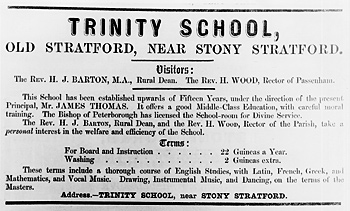
There was no state education in Old Stratford until the latter half of the last century. Children from the village were eligible to attend the National Schools which had been set up in Cosgrove and Deanshanger, but most of them probably went to schools in Stony Stratford which were closer, although they were technically in a different county. A private school known as the Belvedere Academy (or Belvedere House) was opened in the 1830s in the premises of the old Saracen's Head inn, which had for a while been a private house. The school lasted till the late 1840s. It was reopened in 1857 by a Reverend John Thomas, and continued under the headship of his son James. Its name changed to Trinity House in 1860. It continued till the late 1880s, but did not survive the death of James Thomas and became a private house again in 1894.
In 1875 a rector of Furtho described Old Stratford as "a sadly neglected place without church or school" and thus it remained for nearly another hundred years. Larger scale development did come after the Second World War, and Old Stratford finally achieved the status of civil parish in 1951, when the same status was withdrawn from Furtho, and the sections of Old Stratford which had for so long been part of Furtho, Passenham and Cosgrove were finally fused into a new civic entity. The canal had gone the way of the tramway, and land was released for development. Houses multiplied and at last the village had its own school in 1966. Hopes were entertained that a parish church might also be built, but despite representations to the rural dean, the diocese decided to restore the delapidated church at Passenham rather than build a new church at Old Stratford, so although civil status had been established, ecclesiastically the parish was still part of Passenham. By 1970, the population of Old Stratford had passed the 1000 mark, and the new city of Milton Keynes was being planned only ten miles or so away. However, the changes which came were improvements in traffic flow not civic development. The A5 - Watling Street - was diverted east of Old Stratford to a new roundabout north of the village. The line of the old canal was severed, as was the old road to Cosgrove. A new road westwards to Buckingham was laid, bypassing the village. All of this meant that the old crossroads hardly functioned as such any more, underlining the fact that despite the apparent advantages of its location, throughout its history Old Stratford has been a place people passed through rather than stayed, and for so many years without a manor, council, church or school to call its own, there was no effective point of focus to assist the community to establish a separate identity and spark key progress. By the time the identity was established, major change was happening elsewhere. |
|||||||||||||||

|

