|



|
Adapted from The History of the County of Northampton Vol.V - Cleley Hundred (ed. Philip Riden)
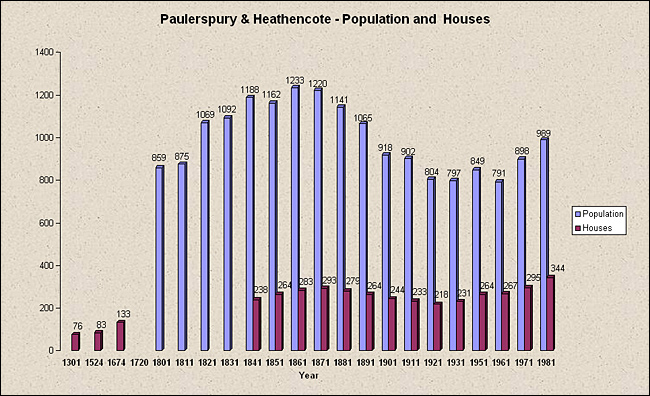
A Brief History of Paulerspury In the coming years, part of Paulerspury's history may well be thrown into the national spotlight with the focus falling on the year AD60, and the investigations as to whether or not the valley near Cuttle Mill on the east of the A5 (the former Roman road of Watling Street) was the site of the final battle in Boudica's rebellion against the Romans. The claim was first made some years ago, but was repeated in the recent BBC series "Battlefield Britain", and a local group is now conducting further researches on "Boudica's Battlefield". Though Paulerspury village lies to the south of Watling Street, the parish itself extends north of the road, up to the River Tove, and also fringes the southern parts of Towcester and the Pomfret/Hesketh estate at Easton Neston. In the Middle Ages, the parish was made up of three main manors: Paulerspury, Heathencote and Plumpton Pury (though the latter was a parcel of the manor of Moor End in Potterspury). Though there was a move in 1657 to separate Heathencote from Paulerspury, it was never carried out, and the two remained as one parish for all ecclesiastical and civil purposes. The population and housing data for the two cannot therefore easily be disaggregated. In common with most villages on the Grafton Estate, Paulerspury witnessed strong growth in the first half of the nineteenth century, as agriculture boomed after the inclosures. Like most of the rest it did not escape the downturn in the latter part of the century, but unlike many others this downward trend was not temporarily reversed in the Edwardian period, but continued in the early part of the next century, till it levelled out and then was reversed by latter-day development. By 1981, however, the population was still less than it had been in 1821.
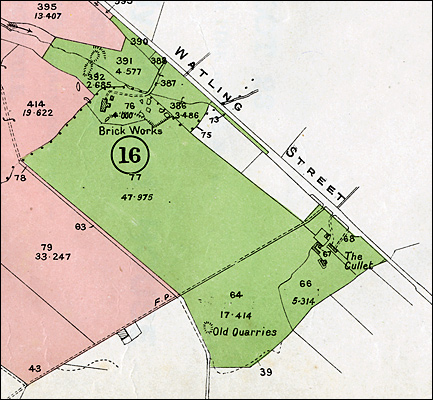
The manor of Paulerspury was held freely in 1086 by a woman called "Gitda" - a variant of the Old English name "Gytha, but was transferred to Willam de Peveril and became part of the honor of Peveril, but only for a short while: it was forfeited and annexed to the Crown in 1199, where it has remained ever since. The next lords were the de Paveleys, from whom the village takes its name. In the mid-14th century it passed to the St. John family, and it remained with them until it was sold to Henry VIII in 1541 and was made part of the honor of Grafton, along with the other manors mentioned above, and an additional manor known as Ashton Pury, which had separated from the one in Plumpton Pury. The four manors did not all remain in the honor for long. In 1547 Henry granted the manor of Paulerspury to Sir Nicholas Throckmorton. From there it passed to the Hales family in 1644 and Lord Bathurst in 1683. It was repeatedly mortgaged, and parts had been sold off. In 1772 the then Lord Bathurst was made an earl, and the manor remained with the Bathursts till 1805, when it was sold to Robert Shedden. The Sheddons owned the manor till 1920, when it was sold to the sitting tenant Thomas Rhoddis. He in turn sold it on within a few years to Edgar Eales, who was described as lord of the manor up to the start of the Second World War in 1939. Despite the alienation of the main estate and the dismemberment of it, some of the numerous freeholds in the parish were acquired by the Grafton estate in subsequent centuries. By 1728, when the 2nd Duke's surveyors were assessing the Grafton Estate in Paulerspury, the Duke owned 893 acres, compared with 951 belonging to other people including the Pomfrets of Easton Neston. Apart from the purchase of a farm in Alderton from the Horton family in the 1720s (part of the farm lay in Paulerspury), no further changes to the size of the honor estate in Paulerspury took place until the inclosure of 1821, when the 4th Duke exchanged lands in Paulerspury and Heathencote with the 3rd Earl of Pomfret, in exchange for land in Alderton. Over the next ten years, the Duke bought up lands from the previous and now dismembered manor of Paulerspury to take his holdings in Paulerspury up to about 940 acres. The only later adjustment came in 1866 when he exchanged with the vicar of Potterspury lands in that parish and Paulerspury. Things remained unchanged till the Grafton Estate sale of 1919, when Manor Farm and some smaller holdings were sold. The rest went up for auction the following year. A mill known as Twygrist Mill was recorded in 1086, situated on the Tove at the north end of the parish near Cappenham Bridge. It had a somewhat chequered career, being allowed in the 1540s to go to decay; being the subject of a dispute between lesses in the 1570s; and then being restored to vigour. In the early part of the 18th century its name was changed to Twickett's Mill and it was part of the Bathurst holdings. Sold to a Mr Padbury, a mealman of Paulerspury, in 1778, it was rebuilt over the next three years, before being sold to the 3rd Earl of Pomfret in 1799. The mill passed through various tenants in the 19th century, but by 1899 the site had been cleared. In 1425 there were two watermills on the manor - named as Gristmill and "Buttemilne" - which appears to be a scribe's error for what later became known as Cuttle Mill. Like Twygrist Mill, it was found to be ruinous in 1550, but from there its fortunes rose. Sir Arthur Throckmorton had the leat and dam scoured in 1659, and by 1728 there was a windmill near the water mill, which was at the time in the hands of William Hopcraft. A century later they were in the possession of Ann Sheppard, widow of the miller William Sheppard. By the 1840s the windmill had become the Old Windmill Inn, and the water mill was owned by William Chapman. His son John Franklin Chapman took the mill in 1866 and installed steam-power by 1885. A succession of tenants followed, until in the period after the Second World War some of the mill buildings were converted to a private residence, while others were used as a light engineering works. Nothing remains of the windmill. Remains of a pottery kiln dating from the 17th century were found in 1973. There was a potash kiln in Paulerspury mortgaged by Lord Bathurst in 1744, and Estate records mention a potash kiln at Heathencote in 1757. However, the more important and enduring trade was that of brickmaking, which was carried on in Heathencote and Paulerspury for over two hundred years from the late seventeenth century onwards. Brick kilns are recorded at Paulerspury and Heathencote Green, but in1859 Henry Clements established a new brickyard on the Grafton Estate at Meanfallow, not far from the earlier kilns on the Mordaunts' land. It was near the Gullet, on the southern edge of the parish - technically in Whittlebury, but much closer to Paulerspury. In effect, it was the successor to the Estate's earlier kiln at Old Copse in Passenham, which was sold in 1855 when Whittlewood Forest was disafforested. It was always kept in hand, though Clements had another works at Greens Norton. Meanfallow was refurbished after Clements' death in 1890, and supplied a wide range of bricks and tiles to a range of customers. The clientele was local - despite being close to Watling Street, it was some distance to the nearest railway. By 1915, however, the only large account was with the foundry at Deanhanger run by E.H.Roberts Ltd, and after the First World War the firm was virtually the only customer. The yard was included in the same lot as Gullet Farm in the Estate sale of 1920, and seems to have closed by 1924. By 1939 it was being let to the district council as a refuse tip.
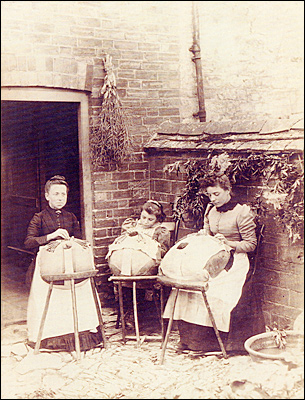
Stone quarrying was another long-lived trade, connected for many years with the Lepper family, at least eight of whom worked as masons in the period from 1741 and 1855. From the 1840s until his death in 1870, Thomas Lepper was described as a bricklayer, mason and builder, though there is no evidence that he or his son William made bricks. Thomas opened the Brickmakers Arms in Pury End in about 1850. It passed into other hands, but William Lepper continued the family building business which was still trading in 1955. In the 1820s, stonepits were also worked in the former Berry Hill Field near Pury End. In 1890 the tenancy was held by Henry Swan, and this passed to The Pell family. The quarries ceased operation in the middle of the last century, but were reopened in the 1970s. For some years friction has continued between the council and the owners, first Amey Roadstone and then D.A. Bird, over quarrying, the resulting pressure on the village from lorry traffic using the quarries, and the use of the site for backfilling with inert material. Paulerspury was one of the foremost centres for making pillow lace. There was a lace-buyer named Thomas Ratcliffe in the late 18th century, and for much of the following period the trade was dominated by the lace dealers Elizabeth Rose and her son Edward, with at least two other lace dealers - Mary Smith and William Cross - active in the village. With the death of Edward Rose in the 1870s the trade declined for want of a regular market, as his widow had no interest in continuing the business. Surprisingly, perhaps, the trade was revived from an unexpected source and on an unexpected basis. Isabella Sams was the daughter of the Rev. Barwick Sams, rector of Grafton Regis. She was a keen amateur artist. See her full story. When she married the rector of Paulerspury, J.B. Harrison, she found on arrival in her new parish that the large open parish with no resident squire was in stark contrast to the small, tight-knit community in which she had been raised. The large parish was over-populated and poor, and many of the residents depended on local charities for their bread, coal and clothing. She considered that a revival of the lacemaking trade might go some way towards alleviating the problems, and she bought from Mrs Rose her late husband's collection of parchment patterns which were the basis of lace design. Others were commissioned or collected from abroad during the Harrisons' holidays there. The Harrisons subsidised the revival of the craft with an injection of cash, and this meant that the lacemakers were now paid for the lace when it was finished, rather than when it was sold.
Mrs Harrison sold the lace at cost price and funded the delivery costs too, and so the whole operation was run on a charitable rather than a commercial basis. Nonetheless, she estimated that it generated about six to seven hundred pounds worth of income annually for many years. The moral authority created by this operation and her position enabled her to enlist support from neighbouring gentry, clergy and farmers. An exhibition was mounted in Northampton in 1891, was opened by Princess Mary of Cambridge and attended by the future Queen Mary. A second exhibition followed - this time at the Victoria & Albert Museum. It was estimated that there were between 130 and 180 people in Paulerspury making lace - including someone in almost every cottage. As a result of the 1891 exhibition, the Midland Lace Association was founded, with the aim of re-establishing the craft in a wider area across Northamptonshire, Buckinghamshire and Bedfordshire. The project foundered however on two things. Firstly, when Mrs Harrison left Paulerspury in 1910 after her husband's death, the movement lost its key player. Secondly, the competition from cheaper machine-made lace was too severe. The numbers of lacemakers declined to about 100 people in the 1920s, and were negligible by 1931. Mrs Harrison could take justifiable pride in her efforts: she had eased poverty in the village and had transformed the trade, but in the end commercial competiton was too much. Two people were still making lace in the village in 1955 and one in the 1970s, but the glory days of the cottage craft were long gone. Paulerspury had the usual range of village trades and crafts. There was a framework knitter there in 1777, and in the 19th century the village had a post office and several public houses. The carrier trade was quite prominent, with journeys going to Northampton, Stony Stratford and Towcester. A horse-drawn service to Towcester survived up to the Second World War.
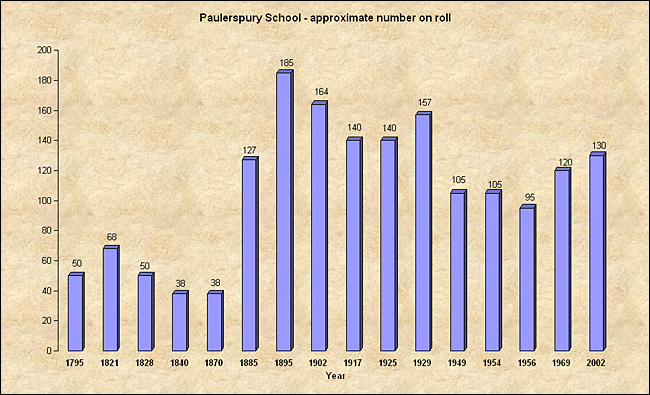
Between 1931 and 1952, George Edwards, having had a bicycle business in the village in the early years of the century, ran a motor omnibus service between Paulerspury and Northampton. In the 1920s, Kate Emery opened "refreshment rooms" at Cuttle Mill, and ten years later she was joined by the Bungalow Cafe and the Venture Cafe and Filling Station, also on Watling Street. Possibly the most distinctive feature of village life in the first part of the last century was the siting in the High Street of the Grafton Hunt Kennels, which provided a valuable source of local employment. Details and pictures of the kennels can be found in the Hunt section. In 1977 part of the site was taken over by the Rolls Royce Enthusiasts' Club. The advowson of Paulerspury church descended with the manor of Paulerspury until it was sold by Lord Bathurst in 1748. It passed through three hands before being conveyed in 1750 to New College, Oxford, where it remained until 1984, when the living was united with that of Whittlebury to become the parish of Whttlebury with Paulerspury. The patronage then alternated between the college and the Crown. The history of religious life in Paulerspury is marked by two prominent strands: the strong tradition of non-conformity in the area and the recurrent arguments arising from relationships between the resident clergyman, officialdom and the wider community.Paulerspury was a rich living and generated considerable tithe income. In the early 17th century a row broke out over the latter when Sir Arthur Throckmorton was said to have appropriated it for his own use after the resignation of the rector in 1625. Litigation and a series of short-term and sometimes dubious incumbents ensued. Things settled down after the advowson was acquired by New College, and all the incumbents from 1750 to 1938 were members of the college. the two most prominent figures in the 19th century were William Newbolt 1843-1878 and John Harrison 1878-1910, mentioned above. Both assisted the Church from their own private means, but Newbolt's time was marked rather more by friction with the local community. An ardent Anglican, he personally funded a new school, but his insistence that it be run as an Anglican church school did not sit well with the sizeable pecentage of non-conformists in the parish, and the Independents opened a day school of their own. Paulerspury school has been one of the longer-lived and more flourishing village schools in the area, as the graph below indicates.
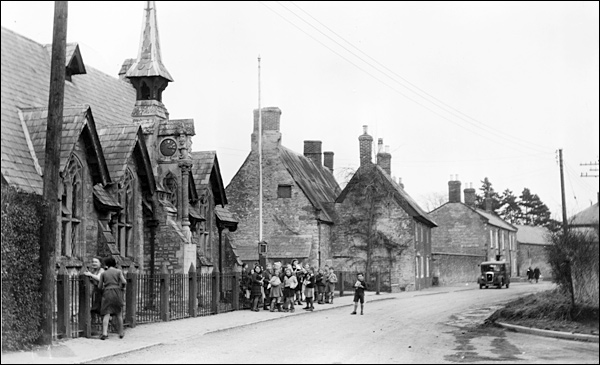
A school existed in Paulerspury in the 1745, and even as early as the 1720s charitable bequests were being made for the eduvation of six poor boys of the parish. Edmund Carey, father of the Baptist Missionary Dr. Willam Carey, was parish clerk and schoolmaster from 1767 to 1816. After his death the school was rebuilt in 1819, with funding assistance from the Duke of Grafton, the Earl of Pomfret and others. Numbers rose, though those attending the Sunday school outnumbered those attending the day school by a ratio of something like 3:1, probably because no fees were charged for the latter. By the 1850s numbers had fallen. There was another private day school in the village, run by a man named Thomas Watts, but thus far no Dissenting day school, though the methodists had a Sunday school. A new school was built in 1861, funded entirely by the Rector, William Newbolt, who also had his own arms and those of New College Oxford placed on the gable ends of the building. The school became a private Anglican establishment, open only to children whose parents attended the parish church and who themselves attended Sunday school. Whatever the rights and wrongs of this, it was hardly a conciliatory act in a parish will so many non-conformists, and the inevitable consequences ensued: the Independents opened a day school of their own in 1863, open to all on a non-sectarian basis, and funded by John Scrivener on a site donated by Elizabeth Newman. By 1870 the church school (i.e. Newbolt's) had only 28 boys and 10 girls on the books. Things were resolved in 1878 by a conjunction of several events: the introduction of a compulsory element to education in 1876, the deaths of the Independent school's main sponsors and the subsequent closure of the school in 1877, pressure from the Education Department on Newbolt and his parisioners to extend the church school which he continued to regard as his private property, and the death of Newbolt in April 1878. The new rector, J.B. Harrison, was much more conciliatory, placed the school under government inspection, and extended it in 1879. The old schoolroom and master's cottage were pulled down and a new one built at Harrison's expense.
The new order of things tranformed the school under a series of headmasters. Fees were abolished in 1891; attendance - which had been a problem throughout the century - improved rapidly; the school received favourable inspection reports. Though there was a fall in numbers, reflecting the general population trend, the school had an influx of pupils when Grafton Regis school was closed in 1934. Improvements were needed to the buiding, and these were carried out in the early 1930s. Unlike Ashton and Hartwell, Paulerspury had few evacuee children in the Second World War. Further alterations and extensions were made in 1967-8, by which time new housebuilding in the village and the arrival of a number of young families secured the future of the school, though the issue of closure had never arisen. |
||||||||||||||||
|

