|



| Northamptonshire Past & Present Vol. I by Wimersley Bush Tales of Paulerspury from a Paulerspury Character
The late Mr. B.J. Tomlin, some of whose reminiscences are printed below, was a Paulerspury man with a great interest in the past history of his native village as well as of all that was going on around him. He was a cripple and his disability prevented him receiving little but the barest elements of education, with the advantages for us that his writing often echoes his native dialect, and that neither his memory was atrophied nor his mind adulterated with the printed page. What he has given us is the pure product either of village tradition or of his own acute observation and memory.
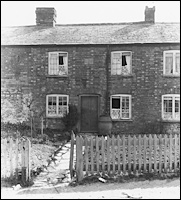
It was in 1935 that I made his acquaintance and asked him to write down what he knew and could remember of old Paulerspury. This he did, sending me the result from time to time with covering letters telling me something of his own life and circumstances. A severe illness at the age of two had left him with both legs paralysed. "I never walked since" he said, "so by that reason my Father and Mother worked hard and bought a little compact field at Cuttle Mill and left it for my life, so that I could keep a pony to get about to get a living." (He used to sell groceries and other goods in the villages around). "I look at it" he continued, as a kind of Paradice preciously to me. It used to bring me in besides keep my pony, £4 a year, and some times £6, so it was very valuable to me. "Then when they altered the Watling Street, they taken a piece of my field to cut it straight. It was quite agrieft to me. The field was totally spiled. It is now such a little three corner bit left that no one will mow it, neither by hand nor machine. My father given £170 for the field, and the Council only given me £48. It need never have been tuched at all. There is three-quarters of a mile wast ground on the other side the road, sevn-and-half yards wide, and would have cut a straight road right into Towcester, now its ten times crucked more than it was before, and who will mak up the loss of money to me? This is wats causing my illness. It need not have been tuched if the survayor had hunderstood is work." This alteration in the road took place in 1928, and, indeed, poor Tomlin never got over the shock it caused him. He was one of the parish overseers in 1898, but did not hold office for more than a year. It gave him an insight into parish administration, but an interest in village affairs, parish boundaries, old rights of way, sites of toll-gates and other ancient land marks long since disappeared, is a common trait of the intelligent countryman. When, in old age, he gave up his pony, Tomlin propelled himself about in a three-wheeled chair, deriving great benefit from the fresh air and sunshine. When I visited him, his pony harness was still hanging from a hook on his cottage wall. He was sitting bolt upright by the table in a windsor chair. He was clean-shaven with blunt features and very bright round eyes, like those of a bird. His sister was living with him and looked after him. OLD PAULERSPURY
For nearly a hundred years a great peace descended on the famous highway, all but its local traffic stolen by the main line of the London and North-Western Railway. With the advent of the motor car, all the medieval murders and coaching accidents of earlier centuries paled into insignificance before the carnage and destruction wrought by the new invention, which so far as long-distance traffic was concerned brought the Watling Street into its own again. B.J. Tomlin never became reconciled either to the improvements in the road itself or to the tragedies which were so constantly enacted only a few hundred yards from his home. "Since the alteration" he wrote to me, "there has been six people killed in just over a mile. The fast traffic is a Horrow to every body on the Road." CUTTLE MILL "Cuttle Mill is a mile further along the Watling Street Road in the parish of Paulerspury. There used to be a wind mill, a very old fashioned blok mill, on the spot of ground where the bonglow now stands, and the road to it used to go close by the door, and the coaches used to run along the hill lower. The mill was squarly built of boards. Joseph Lucas was wagoner and lived in one of the cottages and Mr. Turvy in the other cottage. He was miller, and all ownd by Mr. John Chapman. There was a steam and water mill a little further down the road in the valley, and three horse loads of flour used to go out continuously, and close by was a Public House, the Plow Inn, were the coaches used to change horses. There used to be another Public House on the other side of the Road, a few yards further up. Where Coach horses used to change. The field afterwards was owned by Esq. Shedding, Lord of the Manor of Paulerspury about 60 years ago. THE BENEFIT CLUB FESTIVAL "There used to be a Sick Club called the Cuttle Mill Club, and on Whitmonday they use annaly to have a Club holliday and the members about 400 in all, marched, each one carring a club staff with a knob on the top painted red and yellow, and three coloured ribbons on the top, (the staves was five feet long) and paraded the village and march to Church and had a service. When over, the Church bells struck up, and they marched back to Cuttle Mill public house headed by the Village Brass Band, and had there dinner. After dinner the Band playd through the rest of the day - the band which consisted as follows: Thomas Watson, Reuben Rodis, Walter Rois, Joseph Rodis, Harry Chapman, William Chapman and Thomas Chapman, Thomas Tite, William Lepper, Joseph Frost, Harry Savige, and Thomas Bignall the drummer. "They stood before the Public House and played for dancing; there were many hundreds dancing up and down the middle of the Watling Street Road. When anything come along the road the Policeman shouted for them to stop. They left off dancing and playing the band, when it had passed they began again. So they kept on till 9 o'clock in the evening. After playing the National Anthem they started home, playing: "I won't go Home till Morning." Thus ended a happy day. These were the happey days of Cuttle Mill, not as they are now, all dred and fear. "Mr. John Chapman had a sale, and sold the steam and water mill and wind mill and the public house and two cottages on Cuttle Mill Hill which are now standing, and a little compacked grass field. {i.e. the one purchased by Mr. Job Tomlin for his son]. Mr. John Chapman sold all his possessions and taken his wife and family to America and there he spent all his money. "After all this lot of property was sold at Cuttle Mill, the Club was removed to the Old School where Doctor Carey's1. father used at one time to be master. They had as usual a grand Club Holliday every Whitsontide in a field near Plumpton End lent by Mr. Stevan Blunt of Plumpark. The Band and Club members paraded the village, then went to a large barn and had a Club Dinner. "Thus ended the Cuttle Mill Holliday. The traffic is a horrow now to every one that goes along the Watling Street." TIME WORK AND PIECE WORK "We come now to Paulerspury Hill. This years ago had no house or building on it. After the house and buildings was built by the workmen of the Duke of Grafton, Mr. Linnell was the first tenant farmer that lived there. Before there were machinery as there is now, agrecultural work used to be done by hand. In hay time Mr. Linnell used four men, which they called a team-Mr. Job. Tomlin [the writer's father], John Sturgess, William Smith, and a man they called Webbey. They used to have to walk right to Twiford Meadows2. to mow. Mr. Linnell went to his men that was mowing. He said: 'I can allway tell wheather you men are working day work or piece work. When I hear you wet your syths, if you are doing day work your wetstones goes as though it says: 'Three roods and hardly that, three roods and hardly that," but vif you are mowing piece work, the wetstone goes: 'a acre and a half and a little above, a acre and a half and a little above." 1.The famous Baptist Missionary 2.Twiford marks the site of the old ford at the point where the Northampton to Stony Stratford road crosses the river Tove below Stoke Bruerne - it is between three and four miles from Paulerspury. Having first met B.J. Tomlin in the spring it was clear from his letters as the year went on that his health was beginning to seriously fail. "There is a lot to write yet if I am able to write it all," he wrote in July, "I hope I shall. The fine weather makes a lot of difference, but I feel so weak and low spirited, any thing that excites me I feel as though I should cry….. I can't scarcely walk not even with crutches," and on December 9th - "I an so poorly just now, I can't write what I want." That was the last letter I had from him. He was then about seventy years of age. On a bitter night in January, 1936, with snow on the ground, Miss Tomlin was taken ill. She called to her brother, but by the time he was able to get to her, she was dead. That was at one o'clock in the morning. He struggled to the door of his cottage, and crawled out on his hands and knees into the snow-storm. He reached the gate of the nearest house and collapsed. At length they found him, lying in the snow, and took him home. The doctor came at once, but could do little for him, and at eleven o'clock on the following night sent him in an ambulance the ten miles to Northampton hospital. He died in the lift on the way up to the ward. A few days later he and his sister were buried in the same grave in the cemetery of the Congregational Chapel at Paulerspury. MR. FROST In this number are memories of old Paulerspury supplied in 1937 by Mr. William John Frost, at the age of 76. "My father has had a long connection with the church and rectory," he writes, "my grand father was gardener when the Rev. Kerrich was Rector, and for some time under the Rev. W.H. Newbolt. My father worked there as a boy in the Rev. Kerrich's time. He went back to take charge in 1860 and worked there till his retirement in 1904. I myself went to work there as a boy in 1873 and retired in 1929. I served under four Rectors and completed fifty-five years and nine months service. I was people's warden for twelve years, bell ringer for twenty-nine years, and in the choir for sixty-one years." We also give a spirited account of Syresham by Mrs. B. Friday, extracted from a series of letters to Mr. C.D. Linnell, son of the Rev. J.E. Linnell, native of Silverstone and author of Old Oak. Village life was an exuberant affair in those days, and needed no London committees and councils to keep things going, if, indeed, they are necessary now, which we venture to doubt. In fact, if such things had existed then, their efforts would probably have been in the direction of restraint rather than encouragement. We were a pugnacious turbulent lot in South Northamptonshire and not dependent on the wireless for our fights. Physical strength and endurance allied to sharpness of wit were the qualities most admired. Now for Mr. Frost's account:- VILLAGE COMBATS "One of the notable characters of the village was a man named William Smith who went by the name of 'Perk.' From all accounts he was a bit of a dare-devil. He was landlord of the Barley Mow. He was game for anything. One of the games they used to indulge in, and in which he was proficient, was 'kick-shins.' They used to clasp each other by the shoulders, watch their opportunity and see who could fetch the other down first. Rather brutal I should think. Another foolhardy thing he did for a wager. He went up the church tower, got over the battlements and clambered along a narrow ledge while clinging to the battlement. He used to brew his own beer. One day, when brewing, he had got the water in the copper and had just put the hops in but they had not sunk, when he got hear of a prize fight about to start in a field close to. Away he went to see this fight. It lasted over an hour. When he went back the copper had boiled dry and he saw his beer running down the street. That did not trouble him: he said he had seen one of the best fights he had seen for a long time. He too was a great poacher. It was his boast he had kept count of several hundred hares. He was always game for a fight. FEATS OF STRENGTH AND ENDURANCE Some of the men of the village were muscular. They used to delight in trying their strength. I knew two men (my father was one of them) carried two sacks of beans tied together the length of a large barn, weight - 38 stones. I should think they had more strength than sense. Paulerspury, like the majority of country villages, is purely agricultural, but what a change in the method from the time I can first remember and now! When I was a boy all was done by hand. Take hay time for instance, all was done by scythe and we had some real good ones too, with it. I have known some of them to average cutting an acre per day the whole of hay time. That took s bit of doing! I well remember one man in particular, named Thomas Rogers. He was a lumbering strong man. He started in a field of two acres, early in the morning of course, and he mowed the whole of that field before he came out of it in one day. He finished it about nine o'clock at night. When the first mowing machine was introduced we thought wonders would never cease! Women would use the sickle as well as the men. I wonder how many of the present generation would be able to use a sickle- not many I think! I have seen some of them roll the corn round when cutting with a sickle and make a sheaf with three handsful all day. Hours used to be long, generally from five in the morning till eight or nine in the evening during harvest. The old labourers certainly had their nose to the grindstone, but they were a happy and contented lot on the whole. TALES OF WHITTLEBURY FOREST Large tracts of Northamptonshire were occupied for centuries by the Royal Forests of Rockingham, Whittlebury (or Whittlewood), and Salcey, administered under the forest laws by local officers of the Crown. "A fierce upstanding race were the forest folk," wrote the Rev. J.E. Linnell in his account of Silverstone in Whittlebury Forest a century ago, and the wild and independent character of the villages in the areas, so vividly described in his pages, has to some extent been preserved to the present day. Rockingham and Salcey were disafforested at the end of the 18th century, Whittlebury, not until 1853. This forest covered about 5,000 acres in the south of the County and included the village of Paulerspury, where, as in Silverstone, for centuries there had been no "big house" to exercise its sway over the inhabitants, though the influence of the Dukes of Grafton, who lived three miles away at Wakefield in the parish of Potterspury, was a powerful element in the life of the neighbourhood. POACHING
Poaching was naturally rife from the earliest times in the royal forests, and in the book Old Oak, the late Rev. J. Linnell tells some good stories and one tragic one about deer poachers in Whittlebury Forest. The memory of these things lingered on and in 1937, Mr. John Frost of Paulerspury whose lively descriptions of village fights we printed in our last issue, had something also to tell us incidentally about deer-stealing.
"A notorious poacher named William Wootton who lived in Pury End and who went by the nickname of 'Shoulder,' and fro whom a warrant was renewed for about thirty years, was a great deer-stealer. He heard one night the searchers were in the village after venison. He had the carcases in his house at the time. His wife soon saw a way out of the difficulty. She undressed and when to bed with the three carcases. When the house was searched, she said: 'Lay still my dears, these naughty men won't hurt you.' I have heard my grandfather vouch for the truth of this. I knew the cottage well myself. Some of the old hands were pretty desperate in those days. I have heard my father say there was hardly a week when he was a boy but there were search parties about for something or other.
Rabbit poaching was also a profitable game, as Mrs. Friday of Syresham tells us, also writing in 1937:- "About a century ago," continues Mr. Frost, "a notable character named Robert Howard was shot somewhere near Abthorpe. At the time it was a common practice to break into farmers' premises and steal corn. From what I have heard my father say that was what he was after. He attacked the owner of the farm with a short crowbar and undoubtedly would have killed him, so in defence of his father's life the farmer's son shot him. There was a difficulty in getting him home at the time. His mother, an old lady, evidently one of the muscular ones, said: "If I had been as young as I have been I would have carried him home in my apron. BODY SNATCHING "One incident which may have some interest was in connection with the burial of the man Howard. At that time (in the eighteen thirties) there was a scare of body snatching. When anyone was buried there were watchers for a fortnight at night, to see the graves were not disturbed. My grandfather and another were watching Robert Howard's grave one night when they had the scare of their lives. At that time there was only one porch to the church on the south side; that was their shelter. They used to patrol the churchyard at intervals. On going on their round this particular night they thought someone had come to fetch the body. On making investigations they found a white horse had got in from an adjoining filed and was standing by the grave. They were both armed with shot guns and had made their minds to use them. I should like to have seen their faces." Talking of body-snatchers, the late Dr. A. Linnell of Paulerspury, a beloved worthy of south Northamptonshire, told the present writer the following story. When he was an apprentice, as the medical students used to then be called, at Northampton general Infirmary (now the Hospital) between seventy and eighty years ago, there was a great difficulty in obtaining bodies for dissection. One day a friendless tramp died in the Infirmary. Somebody's palm was duly oiled, the body was out on one side and the coffin filled with stones. One or two apprentices, Linnell being one of them, attended the funeral, and as the coffin was being lowered into the grave, a stone rattled. The curate who was conducting the service stopped at the sound and turned as white as a sheet, but, to the great relief of those who were 'in the know,' after a short pause, continued his task as if nothing had happened. THE HUNGRY FORTIES In the hungry forties things were pretty desperate, from what I have heard. I have heard my father say they were glad to get barley bread then. Some did not stop at anything. I myself have heard some of then boast of what they had done. One old gentleman, long since dead, told how he and another (Job and James Henson) had stolen a sheep on the farm where he worked. Another man (Thomas Poynter)* who I knew well, stole one from a farm at Heathencote. He hid part of the carcase under a broad plank which crossed the brook on the footway to Towcester. This was found by a dog when the farmer and others were searching, a watch was kept and when the man went to fetch it he was arrested. He was tried and had a term of penal servitude. He was transported to Jamaica for a considerable time. I asked him what he did there. He said his principal work was lime burning. He said he got on well for rum. On the anniversary of his release he always used to celebrate. He always used to reckon on having a gallon of beer to himself and would not allow anyone to touch it. *This Poynter must have been the man, who as a lad, knocked the nose off the fine 17th century monument to Sir Arthur Throckmorton in Paulerspury church with the church key, as related by Dr. Alfred Linnell (quoted above) in The Musters Book. (N.R.S. VII.) THE VILLAGE POUND One interesting reminder of old village life I can well remember was the Village Pound. This was situated at the lower end of the street opposite the Post Office. It was a large and very strong wooden structure. I have heard an amusing incident told by my father. An old man named Edward Williams had a sow which used to run loose and she was often pounded. He evidently got tired of paying what he called "pin-money" to get her out. On the last occasion she was pounded, when he went to release her he nailed a welt (he was a shoemaker) on a stick, and before he let her out he went in and gave her a tremendous thrashing to such an extent he thought she would have savaged him. He said to the custodian or "pin-lock" as they were called, "I will pay this once, I don't think I shall have to pay for her again." I have heard say she was never pounded again. As many as forty people tried to get her in, but no, as soon as she got in the vicinity of the place she was between their legs and threw them in all directions. THE STOCKS The Village Stocks were in the main street, opposite the Barley Mow. It is a pity they were allowed to go derelict. I can remember them well when I was a boy. It is not many years since the post went. BEATING THE BOUNDS One ceremony that has been discontinued is the old one of the beating the bounds. Or "sessioning." This was done away with just after the last Ordnance Survey. It always had to be done when a new Rector came to the rectory. The last time, was when the Rev. J.B. Harrison came in 1878. the proceeding was to dig three holes at intervals in the boundary line of the parish. Then someone would be taken unawares, set on his head in one of the holes and chastised lightly with the spade - it was great fun. CURIOUS CHARACTERS One queer old gentleman I knew well - he was a hedge cutter named Benjamin Hinds - was going to work one morning when a violent snow-storm made him turn back home. When he reached home (it would not be late then) he found his wife in bed. He made no more ado, he went upstairs and began to get into bed with his boot-legs and heavy boots covered with dirt and snow. His wife said, "Whatever are you doing, man?" He said, "I'm going to see if I can get my living laying abed, same as you do." He was a queer fish. One of his children he never spoke a word to till she was six months old and then it was: 'Have a gooseberry?' The next story concerns the man who was transported for sheep-stealing. On going home one night he was surprised to find his wife had got the pig killed. He said: 'Hullo! wench, killed the hug?' She said: 'Yes, I'd had no mate for two days and I would not go without any longer.' 'Ah! Well, ne'er mind, gie me some.'" Mate: The old pronunciation of "meat," meaning food. In earlier times there was a grimmer punishment than transportation for sheep and deer stealing. My old friend Mr. Jack Brown of Cosgrove once pointed out to me an oak-tree standing back from the high road on the county boundary between Northamptonshire and Buckinghamshire, close to the lodge gate of Thornton Hall. "This is Cranley Oak," he said "where they used to hang sheep and deer-stealers, and they used to say they used to put a stake through 'em and bury 'em by the side of the road." A little documentary evidence in support of this tale would be acceptable. It is possible, however, that the tree may have been on or near the site of the private gallows of the lord of the manor in the Middle Ages. These traditions get handed down orally from generation to generation and scepticism may sometimes lead us as far astray as over-credulity. LACE-MAKING Fifty or sixty years ago it was a common sight on a summer's evening in our villages, to see women in their black dresses and white aprons sitting outside their cottage-doors, working busily at their lace pillows.1 Now the craft has almost completely disappeared, but even then it was a dying industry, partly kept alive by the efforts of charitable ladies who privately, or through Lace associations, would organise the buying of lace from the makers and its sale to more or less wealthy clients. Mrs. John Butler Harrison, wife of the rector of Paulerspury, and Mrs. Chettle of Potterspury, whose husband farmed on the Duke of Grafton's estate, were very active in their own neighbourhood, while Mrs. De Bless of great Billing and Miss Phyllis Wake of Courteenhall (as she was), kept the craft alive in Hackleton, Horton and Piddington for several years down to 1914. The Midland Lace Association worked on a larger scale in the area round Northampton, and came to an end at about the same time, largely, I was given to understand, through some desperate friction between the ladies who ran it, though what was at the bottom of the trouble I never heard. In 1935, Mr. Frost wrote the following account of lace-making in Paulerspury at the turn of the century:- Some of the laces made were most lovely. I seen some of them with as many as four hundred bobbins on their pillow; all the spare ones not wanted at the time were tied up in bundles till wanted. It seems wonderful how they knew when they were wanted. All sorts of lovely things were made, panels for ladies' dresses, embroidery for altar hangings, and other things too numerous to remember. Lace is still made, but in a small way in comparison to what it was thirty years ago. Most of the skilled workers of that time have gone." Pillow lace always used to form one of the largest classes of exhibits at the Northamptonshire Home Arts and Industries Association exhibition, held annually by turns at Northampton, Daventry, Towcester, Kettering and Wellingborough, down to about 1910, and very lovely it was in the recollection of the present writer. Mr. Frost's account is supplemented by Mrs. Friday of Syresham, writing at about the same time. "Pillow lace making was a good trade [at Syresham] and many men worked at it with the women at home; as the agricultural wage was very low, they could earn more at lace-making. A man with the name of Somerton was the last in the village to give up making lace. Children were taught the art as early as six years of age. At seven years of age a girl named Whitlock was set down to her day's work and was not allowed any time to herself till she had finished it. There were several lace school and old Bet at one of them was very strict, but to those who liked to learn to read, she was very good and taught them a little. The pupils paid 3d. for the week and some went for 2 or 3 years. There was a great interest taken in their lace pillows, clean cloths to keep it spotless. The pins that ran down the right hand side were called foot pins and were threaded with tiny coloured beads almost to the point, leaving just the very point to stick in the parchment as the pattern they worked upon was called. There was much jealousy as to who had the best bobbins - a pretty sight they were. Bone, with names in all colours and wooden with names, and sweethearts would always give a bobbin with his name and glistening bead jingle to it, and it was greatly prized. This village was full of lace makers at that time, point linen, lisle worsted and cotton lace besides a more common called thread lace. |

|

