|



|
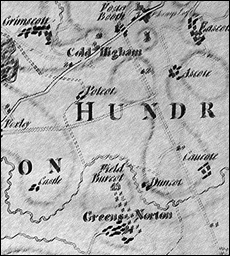
Adapted from The History & Antiquities of Northamptonshire 1791 by John Bridges and The History & Antiquities of the County of Northampton by George Baker 1822-4
A Brief History of Potcote Potcote is one of a number of small settlements in the area (such as Duncote, Grimscote, Field Burcote, Eastcote) with the suffix -cote. There is documentary evidence for it once having been a manor. (Click to read about the Langley Cartulary). The manor of Grimscote (and possibly Potcote) passed from the Langleys to Sir Richard Empson, and from him to the Earls of Pomfret. The Greene family holdings in the area (and possibly the land if not the title of the manor of Potcote) passed to the Parr family - one of whose offspring was Catherine Parr, Henry VIII's last wife - and thus to the Crown. The manor of Potcote is not mentioned as part of the honor of Grafton in 1542, though that of Greens Norton is. The Greenes' former holdings thus became part of Catherine de Braganza's settlement from Charles II and thus passed in time to the Dukes of Grafton. Certainly Baker writes in 1824 that the principal proprietor of Cold Higham was the Duke of Grafton, who had 1120 acres, including Potcote.
Potcote was never a parish in the civil or the ecclesiastical sense, and even as a settlement it has very little recorded history attached to it. For the duration of its time as a section of the Grafton Estate, it was considered as part of Grimscote and Cold Higham. Survey and rental data in both 1757 and 1831 for Cold Higham mention Potcote holdings under the name of the Wakefield family, the one for 1757 indicates that a Thomas Taylor also had a holding there but that the land was of poor quality. Land in Potcote is also included in the data for Greens Norton, which was a former royal manor and the largest settlement in the immediate locality. Bridges, in his History of Northamptonshire of 1791, records "Within the limits of Greens Norton is a farm-house called Potcot, standing in the grounds which take their name from the house. A considerable part of these grounds is in the parish of Cold Higham." What may have happened at Potcote is that the hamlet declined and was amalgamated into a neighbouring settlement, with the original name surviving as the name of a farm or a field. The survey entries talk about "Potcote Ground", and by the time of the Grafton Estate Sale of 1919, the area was being sold as two lots called Potcote Farm and Lower Potcote Farm, the latter being described as being in the parishes of Greens Norton and Cold Higham. Across Britain, especially in places like Norfolk, one can observe the process whereby hamlets shrink and eventually disappear; the roads to them become lanes or tracks; and the name of the former village lives on by being attached to a nearby farm. This seems to have happened at Potcote, and a similar process can be seen happening elsewhere on the Estate, particularly at Furtho. |
|

