|



|
Adapted from The History of the County of Northampton Vol.V - Wymersley Hundred A Brief History of Quinton Quinton, also at times spelt variously as Quintone, Quenton, Queyneton, Quynton and Queenton, was at the time of the Domesday Book of 1086 held by Countess Judith who also held the manor of Yardley Hastings. The overlordship of this estate passed with the honor of Peverel to the House of Lancaster - the fee being held by the Preston family of Preston Deanery until 1428 and the death of the last of the line. From 1464 till 1641 the manor was in the possession of the Dyve family, till it was sold to the Langhams and then again in 1721 to the Earl of Halifax. It remained with the Montagues till about 1787, and then passed to the Gunnings, who are the present owners. Though the manor of Quinton was part of the honor of Grafton when that was created in 1542, by 1660 it had - like other holdings on the fringe of the honor - been lost along with the neighbouring manors in Rothersthorpe, Hardingstone and Courteenhall. The Dukes of Grafton seem to have had only one rental property in Quinton between 1757 and 1762 and this was then exchanged with Lord Halifax for some of his holdings in Hartwell.
Though Quinton occupied a site just north of Salcey Forest, the main occupation seems to have been agriculture rather than forestry. In the mid-20th century there was still mixed farming - pasture alongside wheat and barley, though there was some intensive poultry rearing at Quinton Green, as detailed in the section on Quinton Green Farm - seen here as the small cluster of buildings south of Quinton and just north of Salcey Forest.
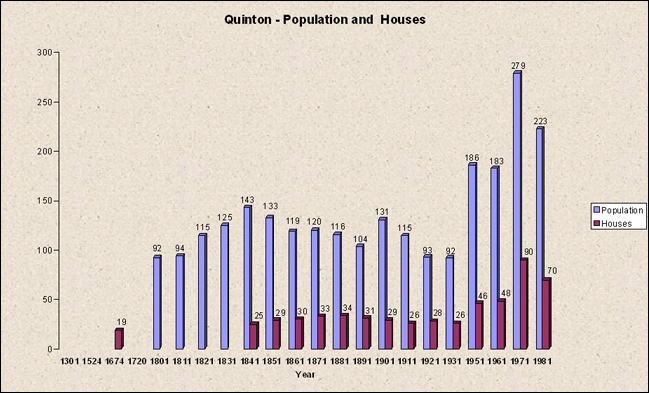
The development of the village mirrors a pattern familiar to many similar settlements across the former Grafton Estate - population increases in the early part of the 19th century as agriculture boomed, followed by a decline in the 1880s and 1890s which mirrored the downturn in agriculture and the population shifts away from rural villages and towards industrial towns. The return of agricultural depression in the 1920s and 1930s brought further falls in population, which were dramatically reversed after the Second World War when new development and house building came to many villages. Despite the two falls in population shown above, the village seems to have remained fairly stable in size for the best part of a hundred years between 1841 and 1941. With extensive building programmes currently taking place in nearby Wootton, the fringe of Northampton is making steady encroachments, and it must be a matter for conjecture as to how much longer Quinton will remain a rural village. |

|

