|



Sturgess Family Memories
Memories of J.E. Sturgess Myrtle Cottage Roade Born at Roade
My first recollections were my father taking the smallest boys to church each Sunday morning as soon as you could toddle and bumping you on a seat and daring you to move. On Sunday evenings he would take you for a walk while the others went to church, always the same way - “Money-hole way” (which it is still called today but I don’t know why as we always looked but couldn’t find any money) and from there up the lane to see John Lucas who kept the Fox & Hounds public house which is now the “Doctor’s House”. My mother having died when I was 4 years old we had a cousin come to take care of us. She was a good woman and when we did anything wrong we had to repeat this little verse, and having to say it so many times, I have never forgotten it – it was this: Birds in their little nest agree Sunday School was a great feature at 10am. and 2pm, which if you did not attend you did not go to Summer Party in the Vicarage Grounds or to the Xmas Tree which if you had no Prize you always had a Bun and Orange to take home. German Bands German Bands were a great attraction and we were told they were spies. Dancing Bears A Dancing Bear was a great wonder in [the] charge of 2 very big quaint-looking Poles. We were told they slept in
Plough Monday Plough Monday was a great day for the locals who, with the Mummers, paraded the village led by a very small and active little man - “Smokey Smith”, who was the greatest wit and dancer of the party and plenty of refreshment was provided by Mrs. Skears at the White Hart public house. One of the usual treats was most evenings a visit to the Post Office to see Jack Goods start off with the Mail Van at 6pm. Sometimes the old horse would start and sometimes it wouldn’t for a time at least. Also about the same time on Wednesday & Saturday Mr. Skears would come flying round the corner by Blacksmith Jones with his carrier van with old Toby a marvellous horse standing over 17 hands with great flat feet which you could hear flop flop flop coming up the hill by the New Inn and turning up White Hart yard at full speed when there would be 2 of Skears’s boys waiting to take him out and give him a hot mash always mixed in with a quart of old ale, he was supposed to have done the journey from the White Hart at Cotton End Northampton in 20 minutes. Queen
Queen
Village Feast Another great holiday was Feast Week which began on the Sunday following the Ram Fair at
It was a merry time at the Feast especially when a cricket match was played between a baker and a tailor, the baker using his peel for a bat and the tailor his sleeve board. Of course there was always plenty to drink about at this time, which was good strong ale at 5 pints a shilling for beer if you had it outside, and Mrs. Skears would give the boy who fetched it ½pt. while she filled the jar. Messrs. Roddis
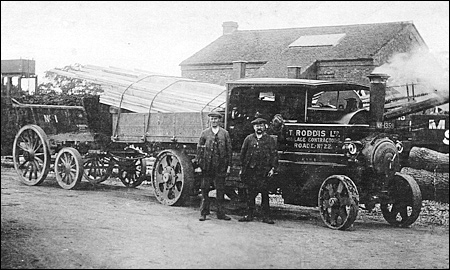
Roddis’ yard was always a big source of enjoyment, who was a large proprietor of steam-engine, thrashing and ploughing machinery, which included from 15 to 20 sets of tackle and employed quite a lot of people, but the biggest event was when they had a set of very large New-Compound Ploughing Engines made by McFarrens of Leeds which came to Roade Station by rails and Jack Young the foreman took the men to get up steam and drive through the village to the yard. They were indeed fine engines Messrs. Allchins of
Tradesmen There were some good tradesmen in the village 2 wheelwrights and carpenters, builders, blacksmiths etc. 2 hand sewn shoemakers who made all leather boots 15/- a pair, 2 tailors who all employed men. Also timber merchants, 1 pit sawyer who sawn large logs of timber 5’ and 6’ diameter into 1” boards, one man in the pit and one on the top of the log. Wife Beating It was the custom when a man beat his wife the other men would tie straw all round his house for people to see. If a man went with another's wife he was turned out of the village by a crowd drumming with tin cans, old buckets, or anything that made a noise. I do remember one of these cases.
One great treat on Race Days which was held in spring and autumn was to go up to the
At these races some well known jockeys used to ride such as Tommy Foates, Sammy Foates, Tod Sloan and the great Fred Archer, the greatest of all jockeys.
About this time I was sent to the old Grammar school at Courteenhall for a year or two, but not being very brilliant I soon had to leave and go to work. This was a great school: the venerable-looking master with his long white whiskers was indeed a real gentleman and turned out a great many good men in the County. He was supposed to be a great Latin Scholar. I am glad to say the old school is today practically the same as it was in those days and the photograph of the late Mr. W.T. Haskins still hangs on the wall. Railway Slip
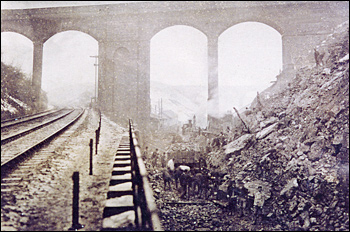
The Great Slip in Roade Cutting caused a great sensation as it occurred on a Saturday evening just as the
Church Institute In 1883 the Duke of Grafton gave a plot of ground in the centre of the village for a Church Institute to be built, to be used as a Sunday School and for the other Church purposes, and it was built and opened early in 1885. Sir Hereward and Lady Wake of Courteenhall did much to help with subscriptions and other ways. New Railway About 1893-4 a new single railway was constructed for the
"Peggy" Westley A wedding of much interest took place at
Motor Cars The first motorcar that came into the village was owned by Mr. W.A. Stimpson of Messrs. Stimpson Bros. of
Graham White The greatest of all sights was on April 27th 1910 when Graham White, competing for the £10,000 Daily Mail Prize for the first to fly from
Limestone Quarries Roade had always been noted for its limestone which ran from East to West on the South of the village it employed quite a few men, and most of it was sent to Hunsbury Hill furnace to mix with the ironstone from Blisworth district. It also was for burnt lime and the harder stone for building as most of the older part of the village was built of stone and belonged to the Dukes of Grafton who were Lords of the Manor. The old village Pound is still in existence but as garden ground as it was sold at the Grafton Estate Sale with some adjoining cottages. As to work, in those days everyone worked hard and the tradesmen’s pay was as I first remember 4½d, a hired labourer 3d per hour. I myself went to work at 15 for Messrs. Henry Martin of
I am very thankful I have had my share of the Good Old Days. Job Evans Sturgess. Dec. 8th 1880 – May 13th 1972 |
|||||||


|

