|



|
Reproduced from the September 1930 copy of The Northampton County Magazine
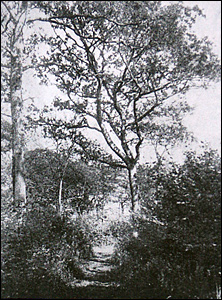
The Open Air by A.E.Tyrell (Hon. Secretary, Photo Section, Northants Natural History Society) "There's beauty all around our paths, if but our watchful eyes These are days of bustle and speed. By the aid of modern transport we travel greater distances and cover more ground, but do we see things to the best advantage and get the maximum enjoyment? For the purpose of portraying interesting scenes and the close acquaintance with the beauties of nature, less speedy means of transit than the motor car are to be advocated. He who travels on foot is most likely to note the beauty spots and secure the best bag of photographic pictures. It is a joy to travel rather than to arrive. We left in a crowded bus, and when we did arrive at our starting point for a walk were glad to alight, for then there was freedom and ease, and we could jog along in leisurely gait to our heart's content. It was one of those byroads which wind between two main roads, the Ordnance map classifies it as " not more than fourteen feet wide." I have always called it Hyde Lane. A short walk brings you to the bridge over the main line of the L.M.S. Railway known as Roade Cutting. Here you have an excellent view of this feat on railway engineering, and you can pick out the original line to Rugby. As you gaze and contemplate the achievement amidst the rusticity of the surroundings, the quietness of the scene is broken by the sudden rush and hissing of a passing express speeding on the iron road from London to the North, and you recall the occasion when as a passenger you sat in comfort and wondered at the weird noises.
Hyde Lane turns to the right and wends its tortuous way to Blisworth, but straight ahead is the Hide, now a farmhouse, formerly the Manor House and belonging to the Augustinian Abbey of St James' at Duston. A picturesque and historic building with its steep gables and roof of tiles and thatch and a quaint window, but alas in a poor state of repair.
Through the farmyard we followed a narrow trail single file, for on either side were regiments of very tall thistles, and the air was filled with numerous butterflies and moths which fluttered to and fro in the brilliant sunshine. We hugged the hedgerows, gay with white roses. The creamy white flowers of the elderberry promised rich dark purple fruit. The corn stems seemed healthy and the loaded ears - green tinted gold - bid well for a good harvest. Cornfields have endless pictures. They have their own music and their own birds - the corn bunting - and animals - the harvest mouse; but when the reaper tears the golden veil from all the secrets of the creatures which have found in the corn a summer paradise, Harvest Home is shorn of its glory, but it is a festival.
The heat of the open road spurred us on until we reached the thatched cottage where our creature needs were met in a shady garden festooned with crimson rambler. The churchyard was a pageant of roses, a symbol of peace, but the air above thrilled with the noise of aeroplanes, for as fortune would have it we were in time to witness the last lap of the all-England flight for the King's Cup. Many planes swept over Blisworth at a very low altitude and gave us opportunities of obtaining records. With an hour or two to spare, the lovely evening lured us to the banks of the canal where the sinking sun mirrored in the still waters the forms of silent fishermen, and the overhanging willows were silhouetted against the golden sky. With respect to Hyde, the Rev. Maze W. Gregory, the Curate in Charge of Roade, wrote in 1862: "It is commonly reported that there is a subterranean passage from Hyde to Ashton, about a mile and a half away. It is said that a few years ago someone found the entrance at the Ashton end, and went in about a quarter of a mile, and was then afraid to go any further, but though I hear the story over and over again, I cannot find out who he was, nor van I get any clue to another account that some ducks or geese were put in at the Ashton end and came out at Roade." |


|

