|



|
Down on the Farm
The definition of a grove aptly explains the name of Mr. and Mrs. Reg Davy’s farm at Shutlanger, for we stood on the hill there and viewed the
According to Bridges, in 1791 we have “Shittlehanger, an hamlet of 60 houses, containing about 280 inhabitants, … formerly a place famous for shooting at butts, of which the marks are still remaining”. In 1874 Whellan names Shutlanger and lists the tenant of the Grove as Joseph Gallard Franklin, who farmed there until 1904 under the Duke of Grafton, whose family had owned these estates since the days of Henry VIII,
After 1904 Shutlanger Grove suffered from breaking up of the estate and from the depression of the 20s: the good heart went out of the land and neglect took over. But since 1930, when Mr. Davy’s father bought the farm, to quote T. B. Franklin in 1944: “The present tenant and his sons, by continuous hard work, have restored the farm to its old fertility and vigour”. After a disastrous fire in the 30s Mr. Davy sold the farm on a life lease to Hesketh Estates who completely restored it. His son succeeded as tenant in 1957.
When Reg Davy took me on a tour of his 452 acres I saw evidence of this hard work, as in the seven miles of hedges he has himself laid – he is a prize-winning hedge-cutter – and the 400 sturdy lambs whose mothers he had been dagging all morning. Mule mashams and Suffolks were grazing river meadows, for the River Tove and its brooks wash the boundary line on there sides of the farm before joining the Ouse and running out to the
In a wet season these meadows are under water – indeed in Mr. Franklin’s days the river was dammed at its bridges and the meadows flooded for about a fortnight in February to obtain early bite. The explanation was that the goodness of the arable land drained into the brook, and by tapping it he gained not only his own wasting goodness but also that of all his neighbours upstream. This richness came from the cotton cake, corn and roots fed to the cattle in yards and carted out as manure to put fertility back into the land. Mr. Davy’s 17 year old student farm worker was doing this job when I was there, but with a mechanised fork and the muck had never known cotton cake or mangolds. Some of the 200 cattle mainly Herefords, are wintered here but many of the yards are now used to store the harvest of 140 acres of corn and the break crop of 24 acres of potatoes. This year 27 acres of oilseed rape had joined the rotation. It was thick and heavy with promise. The soil types are varied, including blue clay, rich loam and fertile alluvial soil in the meadows. Mr. Davy uses a chisel plough in the autumn to assist drainage and to save manhours, relying on the winter weather to help make a tilth. A splendid field of winter wheat proved the method. With only his son Robert and a student to work a farm this size and diversity, it is essential that Mr. Davy’s enterprise be fully mechanised. I saw a fine array of farm implements under sheds, like the 14ft. cut Clayson combine with a detachable head a sprayer with a 30ft. boom, the sophisticated potato planter, lifter and sorter and the up-to-date haymaking machinery. Mr. Davy’s interests are not restricted to his immediate labours. He would have liked an academic career and has attended extra-mural classes in political economy, but as in so many instances, circumstances dictated farming. He gained great satisfaction from his committee work for the N.F.U., having twice been chairman of the Towcester branch and representing it for more than 20 years on the Executive Committee for Northamptonshire. Farmingwise he most enjoys buying and selling for, as he says, “the rest is 98% hard work”. He has “got over” disliking jobs- even dagging sheep! When I asked his views on today’s crisis in agriculture he thought we could only sit out the present situation, but agreed with the general consensus of opinion that we shall shortly have a mountain of grain and no livestock. He could not suggest how small, all-livestock farmers might see it through. Mr. Davy considered that his farm “ticked” through a blending of old conservation and youthful enthusiasm. When I visited Grove Farm elder son Robert was on holiday reconnoitring farming in
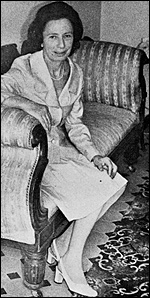
For many years Mrs. Davy reared turkeys, chickens, pigs and cade lambs – just like every other farmer’s wife – but in common with the rest of us she has surrendered to economic facts: all work and no pay is no fun in any walk of life. I enjoyed my day at Shutlanger Grove, the fine farmstead, and Mr. and Mrs. Davy’s generous hospitality, but above all my walk in the river meadows. Sun shone and water sparkled: it was peaceful and secluded with only Alderton village before on the skyline. Larks and plovers got up before us and settled again. Mallard flew high above. The only sounds were a peewits cry and quiet munch of cattle around us. As Stanley Baldwin expressed it: “These things strike down into the very depths of our nature, and touch chords that go back to the beginning of tie and the human race, but the are chords that every year of our life sound a deeper note in our innermost being.”
Chronicle & Echo September 30. 1998 Farmer Reginald Davy gathered his first harvest when the First World War was drawing to a close. Eight decades later he is still going strong, and this month celebrates bringing in a crop to top the lot, with 80 harvests under his belt. At the age of eight Mr. Davy rode the middle horse pulling the corn-binder as he helped a team of men bundle the sheaves of corn on a farm in Warwickshire. Now aged 88, Mr Davy still helps out on the family’s land at Grove Farm, Shutlanger. With his son he farms more than 700 acres. Over his 80 years of farming he has certainly seen a lot of changes. He said: “ Harvesting is so much easier now with all the machinery. The first time I helped I had to make sure the horses moved at the right speed so the binder picked up the corn in the right way. “We had a team of five or six men and in 1918 we were helped by German prisoners of war. We had to pick up all the sheaves of corn and carry them back to the sheds. Later, in the winter, we’d have to thrash the corn by hand. “Now you can harvest with just two men and the combine does all the binding and thrashing as it harvests. “I’ve never driven the combine, I leave that to my son. I’m ready for a rest after 80 years but always seem to be kept busy on the farm, especially during harvest when I make sure the machinery is kept running by fetching parts. “I’ve seen a lot of changes over the years. Farming is declining at the moment, but I’ve never seen it as bad as it was during the 1930s when farmers went bankrupt left, right and centre. “ My father, myself and my son have worked this farm for the last 68 years and it’s nice to see the far has survived the bad times.” |



|

