|



|
Text and pictures from a booklet by Alexander Chancellor, and reproduced with his kind permission.
Stoke Park
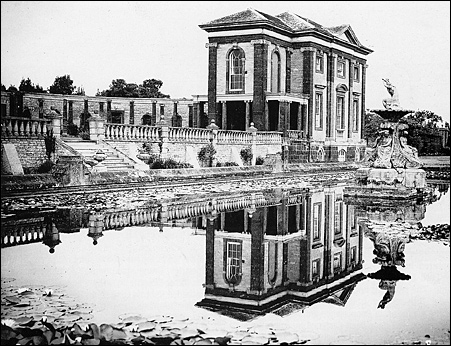
Stoke Park was the first English country house to display the typical Palladian plan of a central block with balancing pavilions linked to it by colonnades or screen walls (Palladio was the great 16th-century Italian architect). What was to become an almost standardised type in the 18th-century in England appeared here in Northamptonshire some eighty years before Lord Burlington and his architects revived the cult of Palladio. The pavilions and the colonnades are all that survive of the 17th-century house and they constitute a landmark in the evolution of Renaissance architecture in this country. They may well have been designed by Inigo Jones. Stoke Bruerne became Crown property when the Longueville family surrendered it by forced exchange to Henry VIII. Charles I granted the park and manor house to Sir Francis Crane, director and founder of the Mortlake tapestry works. Crane was made Secretary to Charles I when Prince of
Bridges’ original diary, however, states unequivocally that the design was by Jones; a further reason for believing this is that in 1630 there was no-one else in England capable of designing such a house, since it was Jones who was responsible for introducing into England the Palladian style of architecture, which he had studied in
In the late 18th-century, this was replaced by a new, more simple Georgian facade and at the same time alterations were made to the pavilions: large Venetian windows were let into the south walls and the arrangement of the roofs was simplified. Until then, the West Pavilion had been a library; it was now converted into a ballroom. The East Pavilion was built as a Chapel and so it remained.
In 1886 the whole central building burned down, following which the Vernon family, to whom it had descended by marriage, decided to erect a large, uncompromisingly Victorian edifice, not on the site of the original house but to the rear of the East pavilion, which was incorporated into it to make a wing of the new house. Finally, however, the whole estate was sold to a firm of timber merchants in 1938. During the war, the house was occupied by the army, and after 1945 remained empty and deserted. Vandalism and decay took their toll and by 1954, when the estate was broken up and the buildings and one-time gardens acquired by the uncle of the present owner, final collapse was only a few years distant. Fortunately, a generous grant from the Ministry of Works on the recommendation of the Historic Buildings Council, made it possible to repair the fabric of both pavilions and colonnade. The Victorian house was demolished and the East pavilion converted into a dwelling, a procedure which took two years to complete.
The gardens, which had become a waste of brambles and thistles, inevitably took longer to develop. It has not been possible to reconstruct them as they must have been in the 18th-century but it is worth noting that originally access to the park was directly down the flight of steps between the two pavilions; the present terrace was constructed at the turn of the present century to accommodate the ornamental pond which was formerly at Harefield Hall, Uxbridge, and is said to have been brought stone by stone to Stoke Bruerne by canal.
|



|

