|



|
The Northampton County Magazine
Nine Men’s Morris
Nine Holes, or Nine Men’s Morris, was a favourite game with farm boys when a couple of them could they together. They were notorious for indulging in it, if they could, when sent to work or watch in the field. When birds scaring, or cattle keeping, two would be almost sure to get together, the “board” would be hastily cut in the turf, stones selected or pegs cut, and birds and seeds and beasts and crops would be forgotten, until perhaps master suddenly appeared. In due time the game was transferred to a board with lines and holes for indoor play; and when children went to school, and had sand trays, or slate pencils, it was played in the sand, or on the slate, marks taking the place of coloured pegs or stones. There are nine junctions where the men are to be placed. They are exactly in the position of the nine spaces made for Noughts and Crosses. Noughts and Crosses is Nine Holes transferred to a slate.
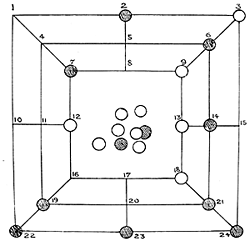
In time adults wanted something more difficult, and this eventuated in the game played on a larger design. There are twenty-four positions to be occupied; and necessarily the game and the movement are more complicated. It is said to be a deeper game than Draughts. In Northamptonshire this game is known as Peg Merill and Merry Hole. The game is played with eleven men aside usually, though there is a variation with only nine men aside. This arose, probably very late through confusion with the game of Nine Holes. The object of the player is to capture one, White, places a man on any other of the 24 positions on the board. The second player, Black, then places a man on any one of the other positions. They thus play alternately, each player striving to get three of his men in a row. As soon as he does that he captures, takes away , whichever one of his opponent’s men he chooses. This capture is called a mill. The captured men are put in the centre of the board, the pound. It will be seen that the object of each player must be as much to prevent the opponent getting a mill as getting one himself. When all the twenty-two men have been played, "moves" commence. Commencing with White the players alternatively move one of their men into any unoccupied position adjoining. The effort is still to get mills and thus weaken the opponent. It may happen that when it comes to his turn to move a player is unable because no adjacent position is vacant. This is a position analogous to stalemate in chess, but in Peg Meryll it wins the game with honour. Gradually the number of men in play diminishes. As soon as either player is reduced to five men he has the privilege of “hopping,” that is of removing any one of his men to any vacant position, near or otherwise. His opponent has not this privilege until he, too, is reduced to five men. Hints: It may not always advisable to get a mill when opportunity offers; and it is not always good play to prevent the opponent obtaining a mill. When a player is reduced to five men and commences “hopping” he has for the time being an immense advantage and can frequently wipe out the advantage his opponent has secured. |
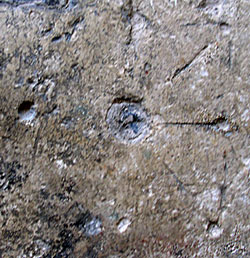 The game was originally played in the open, the lines being cut generally in the turf, and stones of two colours, light and dark, being used instead of pegs. The design was afterwards scratched on stone, recumbent grave stones for choice, or even the door step of the church. Thus very occasionally an ancient stone is found, perhaps imbedded in the wall, with the curious markings which have been, only recently, understood.
 The game is played exactly as Nine Holes was played. There are two players. One commenced by putting his peg or stone on one of the nine positions. Transferred to paper or slate one player commences by putting a cross or X in one of the nine spaces. The opponent follows by putting a nought or O in another space. Then player number one puts another X, and so they play alternately. The object of the player is to get a row of three X’s or three O’s first.
|
