|



|
1 Two crosses, probably for John and Alice de Wydeville, c. 1300.
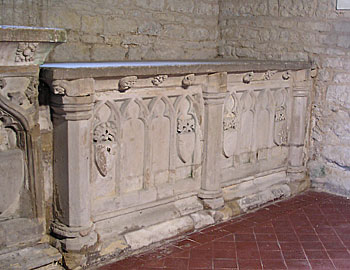
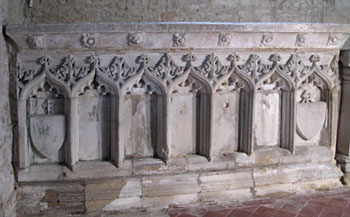
An altar-tomb of freestone, 85 cm high, with a smooth cover slab 1·92 x 0·92 m, on which are incised two crosses side by side, the heads consisting of four arms each terminating in a fleur-de lys, linked by four cusps, with smaller fleur-de-lys at the diagonal points, the stems rising from three steps. The slab projects over the side of the tomb chest, with the underside chamfered, on which are relief carvings. Along the surviving side are successively a face, rose, ballflower; ballflower, square leaf, ballflower. The side of the chest is divided into two panels, each with an arcade of four pointed shallow niches; the center two in each panel are blank, the outer two each with a shield hanging from a leafy sprig. No trace of the paint remains on the shields or in the blank niches. Three further blank niches, collected from the concealed side and ends of the tomb, have been set on each end of the reredos in the east wall of the chancel. There is no exact parallel for the design of the cross-heads (e.g. in C. Boutell, Christian Monuments in England and Wales, 1854, which illustrates a very large number) but the general style, together with the use of ballflower, suggests a date of around 1300. A plausible attribution for this double tomb is Sir John de Wydeville, last mentioned in 1297, and his wife Alice, daughter of Henry de passenham. 2. Armed figure, for John de Wydeville, c. 1397
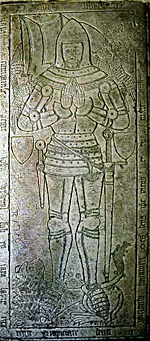
An altar-tomb of freestone, 86 cm high, supporting a slab of alabaster 14cm thick, 2·08 x 0·91 m. In this is deeply incised the figure of an armed man, his head resting on a crested great helm, supported by two angels, his feet against a lion, two small shields on either side of his body, and a marginal inscription in Gothic minuscule. The lines of the incising have been filled with black pitch compound; the shields, and the scroll attached to the crest, must once have been painted, but no trace remain. The entire surface is much defaced with scratches. The slab projects over the side of the tomb chest, with the underside chamfered, on which are relief carvings, alternately square flowers and loins' heads, some with leaves sprouting from their mouths. There are considerable traces of gilding and red colouring on these carvings. The visible side of the tomb chest is divided into seven deep ogival niches, with blank shields hanging from leafy sprigs in the outer two, and the remains of attachments for figures of angels or weepers in the remaining five. A further nine niches, slightly reduced in height, salvaged from the concealed side and ends of the tomb, are positioned as a reredos on the east wall of the chancel.
The slab is discussed and illustrated by F.A. Greenhill. (in Incised Effigal Slabs (1976), I, pp23, 158, 164, 323; II, pl. 70b) who suggests it is a work of Thomas Prentys and Robert Sutton, and finds it 'almost exactly paralleled, even to the sculptured detail on its beveled underside, by another of similar appearance at Clevedon, Somerset (? Thomas Lovell, c.1415)'. Prentys and Sutton operated from Chellaston, Derbyshire, and are known from a surviving contrct for an alabaster tomb at Lowick, dated 1419. Another slab which Geenhill suggests might be theirs is at Nosely, Leics., to Margaret Blaket, 1406 (ibid., pl. 141a). The Clevedon slab (illustrated in R. Paul, Incised and Sepulchral Slabs of N.W. Somersetshire (1882), pl. XXII) is badly worn, but clearly of very similar design, save only that the helmet and crest are the opposite way round. Fr. Jerome Bertram |
 The inscription reads:
|
