|
ELEPHANTS IN SALCEY FOREST
Sunday Dispatch June 22nd. 1941
MINISTRY SAY ‘NO’ TO TWO ELEPHANTS
They Were Offered Free
The Ministry of Supply has no “Form XYZ” for “Elephants, enrolment of,” and so two of these animals, worth £3,000, which have been offered free to do hauling may have to be shot.
The offer was made by Mr. Ralph Marshall, London theatrical agent and owner of the elephants, who is being called up for the R.A.F.
He told the Sunday Dispatch yesterday that a Ministry expert would be travelling to-morrow to a farm at Duston, Northampton, to test the animals. A log had been cut ready for the elephants to show their skill.
But the Ministry stated that “for technical reasons” they could not avail themselves of the offer.
May Be Shot
Mr. Marshall has spent a fortnight asking every zoo he could find to take the animals. He is seeking a further fortnight’s leave in the hope of placing them; otherwise they must be shot.
Mannekin and Molly, the elephants, are young. The bigger is only 7ft. tall, and the other 5ft. They have done stage work in “Tropical Revue,” and can do simple tricks.
But they eat three-quarters of a ton of hay a week, and cost about £5 a week to keep.
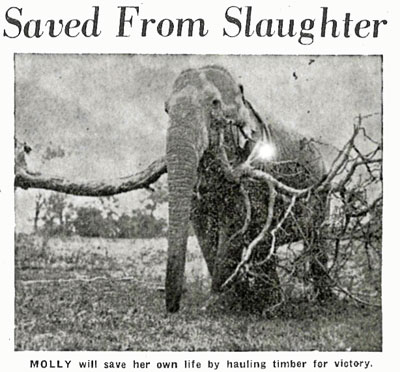
WORK FOUND IN THE FOREST
The elephants Molly and Mannekin had travelled with Doorlay’s Tropical Express Revue, but owing to the war found themselves out of work.
Fossett’s Circus used to “over winter” their circus at Hopping Hill in Northampton, and it was here that two elephants were left in 1941. As animal foodstuffs grew short of supply, and the elephants had big appetites, it was feared they would have to be killed.
Mr. Ralph Marshall their owner joined the Royal Air Force and the fate of his elephants seemed sealed - unless someone found them work in a timber camp.
All seemed very black until a transport officer of the Home-Grown Timber Department, who had been used to elephants when he worked in forestry in Thailand, heard of their plight and arranged for them to be brought to Salcey Forest.
Salcey Forest was an ideal place for camouflaging strategic buildings during the Second World War. Jim Clarke who worked for the Forestry Commission had a small saw-mill in the forest, and was using a small tractor and trailer to clear the timber ready for concrete platforms which were to be laid ready for new building construction for 72 M.U. Royal Air Force.
The older elephant, Molly had done timber work in India and could pull a two-ton log with ease. If the butt caught a stump she lifted it clear with her trunk, and when she got to the ride she knelt to push them into a neat pile. The pair worked hard but they couldn't be hurried and time-keeping just didn’t interest them. Feeding presented no difficulties during the summer months as they got all their food from the forest.
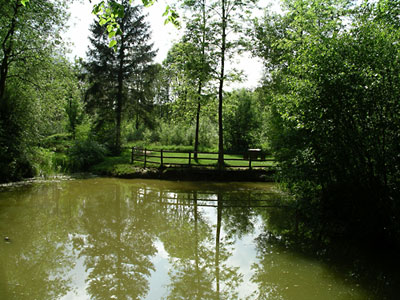
Their Singhalese mahout, Khanadas Karunadasa (who was known as Kay) came with Molly and Mannekin to work in Salcey Forest. Each evening Kay would take them to be bathed in a pond that has become known as, Elephant Pond. After their bath they would retire to their temporary home in Lime Walk.
It seems Molly and Mannekin only worked in Salcey Forest for a few weeks, as Mr. Marshall found a home for them at Chester Zoo
|
|
Elephant Pond, Salcey Forest
|
UNSIGNED LETTERS FROM CHESTER ZOO
28th August 1941
A.C.2. Marshall, R.D. 1383755
CLK/SD. Hut 30, No.1. Site,
Molesworth, Brington,
Huntingdon.
Dear Sir
You will be pleased to hear that the two elephants and their keeper arrived safely this morning.
Mr. Mottershead will write to you as soon as he gets them fixed up.
Yours faithfully
5th September 1941
A.C.2. Marshall, R.D.
Dear Mr. Marshall
I am very sorry I have been so long in writing you but I have been terribly busy.
I asked my secretary to write and inform you of the safe arrival of the elephants. They settled down and look very fit. Since their arrival, the weather having been very nice, they have been living a more or less natural life in a very large orchard we have plenty of undergrowth.
Karunadasa I am pleased to say has settled down very well. He is living in the Zoo with the rest of the staff. I took him over as from Thursday, the 28th August, and we paid him from that date.
I think my secretary also told you that I went to Northampton to make arrangements for them with the Railway Company, and I think everything passed off smoothly. I have just received word from them that the charge for bringing the animals is £9 10s 0d which I think is very reasonable. As they require immediate settlement, I am sending them a cheque today.
I do not know whether you have had any offer re selling these animals, but if you ever did consider this, I wonder if you would give us the first option. You see I feel now that when the time comes for them to return to you, we shall certainly have to fill their place.
With many thanks for your part in this matter.
Yours sincerely
CHESTER’S FIRST ELEPHANTS
Chester Zoo’s first elephants were two Asian cows Molly and Manniken. One was eight and the other ten years old when they arrived towards the end of 1941.
An old garage became the zoo’s first elephant house, but the animals were not confined to this. During fine weather they spent most of their time in either the orchard, near the polar bears, or in the field, near the Malayan sun bears. The zoo immediately set up an Elephant Fund to assist towards their upkeep and to contribute to their purchase in the event of their owner deciding to sell them. A similar fund exists for the elephants to this day (2001).
Molly was eventually purchased, but unfortunately Manniken was in such poor condition that she died soon after arrival at the zoo. Molly had been with Kay since he was ten years old. He had trained her in Ceylon and the two were inseparable. During the summer months she gave rides around the zoo to children and adults every day except Friday, her day off. During the winter months she was kept in her stable.
After the end of the Second World War George Mottershead set about building a new Elephant House, constructed largely from anti-tank blocks, pill boxes and concrete slabs. The new house was officially opened on 15 August 1949.
Molly began suffering from arthritis in the summer of 1953. From that time onwards she was only taken outside for exercise. Sunray treatment had little effect and on 24 April 1954 she was euthanised.
|