|



|
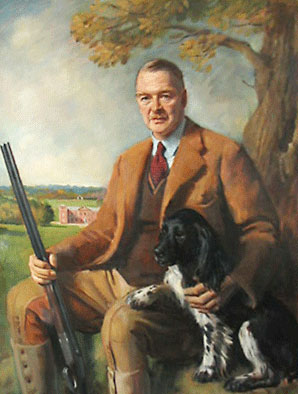
10th Duke of Grafton 1936-1970 Charles Alfred Euston FitzRoy, who in 1936 succeeded his cousin as tenth holder of the title, was the son of the rev. Lord Charles Edward FitzRoy, from 1883 until his death in 1911 at the early age of 53, Rector of Euston and sometimes Chaplain both to Queen Victoria and Edward VII. As his mother [the Hon. Ismay Mary FitzRoy] was the eldest daughter of the 3rd Baron Southampton, his Grace can claim to be doubly born a FitzRoy. In him the two main family strains met and were united. The possibility of his succession could not have been forseen. The dukedom being vacated three times in eighteen years, the 7th Duke outliving his eldest son, and the 8th Duke his son and heir, Viscount Ipswich. Payment of the successive death duties consequent on these swift changes in the dukedom meant great inroads being made into the FitzRoy fortune. Though the 7th Duke died worth a million pounds, meeting the charges necessited the greater part of the Wakefield Lodge estate being sold. The Lodge itself was bought by Lord Hillingdon. Of the Northamptonshire property which once extended to 30,000 acres all that was left was the Manor House at Grafton Regis and about 600 acres of adjoining land. His Grace in turn was forced to sell 2,500 acres of the Euston estate, reducing it to some 12,500 acres. The Duke had a most varied and interesting career, leavened with parctical experience as a farmer and cattle-breeder. It was his good fortune to be born and brought up at Euston Rectory, so that he got to know every stick and stone on the estate which ulitimately he was to inherit. His ambition was for a military career, and he passed out of Sandhurst the year before his father died, receiving a comission in the Royal Welsh Fusiliers. On the troopship that took him to India - he was to join the 2nd Battalion of the regiment at Quetta - he had in his charge a mixed draft to be distributed over the various Indian stations. The 2nd Battalion was quartered at Dorchester when the first World war broke out, and it was among the first of the troops to embark for France. The young officer shared in the retreat from Mons and in the equally memorable advance to the line of the Aisne. Then a fresh outbreak of sinus trouble, for which when he was at Wellington College he had several times been operated upon, put him out of action for some months. On being discharged from hospital he was appointed Instructor to a military training school at Hornsea, Yorkshire, and in 1916 he became A.D.C. to Lord Buxton, Governor-General of South Africa, and later Comptroller of the Household. His four years in the Dominion count as amongst the most pleasant in his life. He was married to Lord Buxton's second daughter, Doreen, future mother of his two sons, Hugh and Oliver and his daughter Anne. At Quetta he developed a flair for big game hunting and in his new position he was to win many trophies. In 1920, having returned from South Africa with Lord Buxton, he retired from the Army and took up farming. He started up a stud of Suffolk horses, sired by his first purchase, a notable old Suffolk stallion called "Sudbourn Arabi". Lady Doreen having died in 1923, he married, a year later, her first-cousin Lucy daughter of Lady Barnes who was Lord Buxton's sister. Within seven years of coming into the title, his Grace was fated to lose his second wife. In 1944 he married Mrs. Currie, a Naval Lieutenant-Commander's widow. It was obvious that if he were to continue living in Euston Hall, drastic alteratons sooner or later, would have to be made, and in the spring of 1950 orders were given to pull down part of Euston Hall. He was succeeded by his son Hugh Denis Charles FitzRoy. |
|
