|



|
The History of H.M.S. Grafton
The first four Grafton's were all ships of the line. These were wooden sailing ships with 70-74 guns, weighing between 1000 and 1650 tons and formed the main fighting ships of the fleet. The first ship was completed in 1679 and was named after the Duke of Grafton, beginning close links between the duke and the ship that continue to this day. In 1690 the 27-year-old Duke took command of the ship that had been named after him.
Two years later, in 1709, the second Grafton was built. The variety of tasks she became involved in reflects the tangled nature of European power politics during the eighteenth century and the frequent wars. The year 1718 saw Grafton in the Mediterranean, now on the side of the French, defending Sicily from Spanish invasion forces. At the Battle of Cape Passero, that year, Grafton and three other ships blocked a 45 strong Spanish fleet whilst waiting for the bulk of the British fleet to catch up. Only nineteen Spanish ships escaped the subsequent battle. Later cruises included the Baltic in 1725 to support Denmark against Russia, the Mediterranean in 1731, in alliance with the Spanish against the French, and four years later to Lisbon, to deter a Spanish invasion of Portugal. Her final deployment was to the West Indies, before being paid off in 1744. The third Grafton was commissioned in 1755. The next two summers were spent in North American waters, fighting France. In 1757 the fleet was severely damaged in a hurricane. Two ships were lost; Grafton was dismasted and lost her rudder when she ran aground. After repairs she was sent to the Indian Ocean, wherein 1759 she fought in the Battle of Porto Novo. This was a victory against the French fleet that helped to consolidate a strong British strategic and trading post in India. HMS Grafton served in the Far East for another five years. During this time it took part in the capture of Pondicherry in India and Manila in the Philippines.
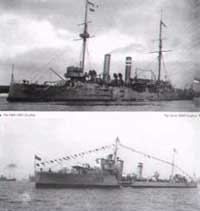
There was a lack of HMS Graftons for nearly 80 years and the fourth Grafton reflected the revolutionary changes in the Royal Navy of this time. No longer was it a navy of wood and sail. The Fifth HMS Grafton, an ‘Edgar’ class cruiser, was launched in 1892. She was the first Grafton to be made of steel and was powered by coal fired steam turbines. She has two 9.2 inch and ten 6 inch guns and was five times heavier than any of her predecessors. She joined the fleet at a time when the Royal Navy and the British Empire ware both at their peaks of power and influence. Her first duty was the China Fleet where she served for four years until 1900, and in 1902,after a refit, she joined the pacific station as flagship for three years. Grafton was then based as a gunnery training ship in Portsmouth in the years prior to the First World War. On the very first day of the war, in September 1914, she captured a German steamer in the Mull of Kintyre and spent the rest of the year patrolling the North Sea and Atlantic. In 1915 she was refitted in the Mediterranean and spent six months supporting the ill-fated landings in the Dardanelles. For the remainder of the war she operated in the eastern Mediterranean and Red Sea. In June 1917, whilst on passage to Malta, Grafton was torpedoed, but fortunately only sustained minor damage. Her final task was in the Black Sea where she was involved in the evacuation of royalist Russian refugees, following the communist successes in the civil war that followed the Russian Revolution. Grafton returned to Portsmouth in December 1919 and was scrapped the following year.
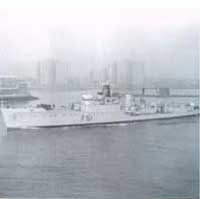
The seventh Grafton was the first never to be involved in military conflict. She was a Type 14 anti-submarine frigate, completed in 1957 and was allocated to the Londonderry squadron the following year. She spent the next ten years operating in the North Atlantic, conducting anti-submarine patrols at the height of the cold war. She also carried out fishery protection duties in Icelandic waters, during the dispute over fishing rights that became known as the ‘Cod War’. In 1967 Grafton paid off and she was scrapped in 1971.
|
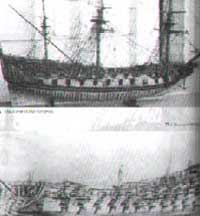 The ships that have borne the name of HMS Grafton have a long and distinguished history. They have served throughout the world, from the Atlantic to the Pacific. With the exception of a break of eighty years in the nineteenth century there has been a semi-continuous line of Grafton's and they reflect the many changes that have taken place to the Royal Navy during this time.
 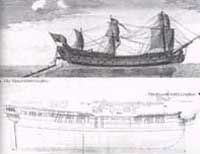 One of HMS Grafton's first engagements was the battle of Beachy Head, in June of 1690. This was a rare French naval victory, but was to be avenged many times by the first Grafton and her successors. Many of the ship’s battle honours were won by the first Grafton, beginning with the Battle of Barfleur in 1692, off the French coast, when the French navy was roundly defeated by Anglo-Dutch forces leading to Royal Naval supremacy. Ten years later the Grafton took part in the capture of the largest Spanish treasure fleet ever to reach Europe at the Battle of Vigo Bay, which also led to the destruction of the combined Spanish and French fleets. In 1704 Grafton was involved in two major actions to begin British naval supremacy in the Mediterranean. The first was the capture of the strategically important port of Gibraltar and the second was the naval Battle of Venez Malaga, which ensured possession of the Rock. After its part in such important naval victories, it is sad to recount that the Grafton was captured by three French ships whilst she was escorting a convoy in the Channel.
  Five years after the third Grafton was scrapped, the next was launched in the presence of King George III in 1772. In 1778 she sailed for the West Indies, where she was involved in several bruising encounters with the French fleet off Grenada, St Kitts and Martinique. She was damaged in each engagement and returned to Britain in 1780, where she was laid up until 1792. She then became a floating barracks in Portsmouth, where she remained throughout the Napoleonic wars, before being scrapped in 1816.
  The sixth HMS Grafton was the shortest lived of the Grafton’s, but achieved much in the space of four years. She was commissioned as a ‘G’ class destroyer in 1936 and joined the Mediterranean fleet as part of the First Destroyer Flotilla. From autumn 1936 to late 1938, during the Spanish Civil War, she operated extensively off the Spanish coast, evacuating refugees and undertaking ‘neutrality patrols’. With the outbreak of the Second World War in September 1939, Grafton moved to Devonport and spent the remainder of the year escorting shipping in the Western Approaches. Her next move was to Harwich, operating in the North Sea. Following Germany’s successful assault on the main British and French forces in Belgium and NE France Grafton was dispatched to the channel and by 25 May 1940 was shelling German positions off Calais. As the land situation deteriorated, Grafton was sent to assist the evacuation of troops from Dunkirk. On the 27 May she ferried 860 men to Dover and returned to following day, picking up another 800. On passage back to England Grafton stopped to assist with the rescue of survivors from another destroyer that had been sunk, but whilst doing so was herself torpedoed by a U-boat. Despite being packed with troops only 4 people were killed and other vessels took on the remaining troops and ship’s company. Grafton was scuttled by gunfire.
|

