|



Ella M. Harrison
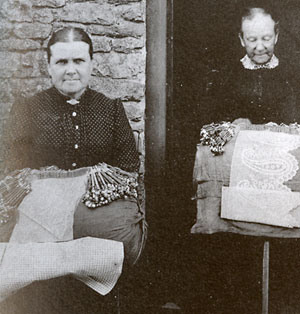
Paulerspury was one of the most successful of the lacemaking villages. That this was so and why so much is known about it is that Mrs. Ella Harrison made it her business to revive the industry and after she left the village she wrote an account of what she had found and done there. This hand-written account, together with hundreds of other items belonging to Mrs. Harrison, has been donated to Northampton Museums by her daughter, Mrs. Aldred. This collection includes some of the best Bucks Point lace of this period, prickings, notes and photographs dated and annotated by Mrs. Harrison herself. Mrs. Harrison was married to the Rector of Paulerspury, When they arrived there in 1878 she found considerable poverty. On discovering the tradition of fine Bucks Point lacemaking in the village she revived it. She rescued the old prickings from the widow of Mr. Rose the Lace Dealer, sought help from Betsy Gibbings and Julia Reed, expert lacemakers, and encouraged other women in this village and Greens Norton to get their pillows out again. Mrs. Harrison was a vigorous campaigner for 'the Cause' as she called her 'beloved industry'. She wrote often to the papers, gave evidence to Mr. Alan Cole for his 1891 Report on the State of the Lace Industry in the East Midlands and co-operated with other patrons to keep the local industry in the public eye. It is unlikely that she made lace herself. Mrs. Roberts of Spratton acknowledged her work, amongst others, in a letter to the press in 1897. 'So far back as 1880 Mrs. Harrison of Paulers Pury began to take an interest in it (the lace industry). She sold a large quantity to the Ladies Work Society in Sloane Street, and in 1883 received an order from HRH the Princess Louise and the Duchess Of Edinburgh. In 1883 she furnished the Princess Christian, by special request, with notes and statistics of the Bucks lace industry for an article HRH was writing in Murray's Magazine, and this article brought the lacemakers into notice, and furnished them with fresh orders. In 1891 Mrs. Harrison joined the Lace Association, and took an active interest in the formation of County Council lace classes for the various villages of Northamptonshire'. Mrs. Harrison was one of the founder members of the Midland Lace Association in 1891 and worked with it but it is clear from her own account of her work that her Paulerspury Bucks Point Industry remained separate from the MLA until she left the area in 1910. Mrs. Ella Harrison's own account of her work in Paulerpury Before my marriage I lived in the historical but remote little village of Grafton Regis, Northamptonshire, where my father was Rector and in his fortunate spot there was no lack of employment and no distress, the little village being the property of the then Duke of Grafton (Charles Augustus) best and kindest of landlords and one who made the well-being of the cottager his special care. There was no lace-making in Grafton, but the larger and poorer villages of the county and before the Elementary Education was passed, ''lace school'' for quite little children abounded. These ''schools'' were rather cruel institutions, under the stern rule of an old dame. Little girls of 4 and 5 and 6 years old had to sit for hours at a time on wooden benches with their lace pillows on stands in front of them, sticking in their pins, twisting their thread from the bobbins and often getting a sharp rap over the knuckles if they made a mistake or lingered over their tasks. I may mention that the first pattern learnt by these children was the ''Fan'', a tiny edging of 24 bobbins, teaching the two most important stitches of the ''point-grounds'' laces. These schools were eventually, and to the joy of philanthropists, finally swept away by the coming into operation of the ''Elementary Education Act'' (I believe about 1877). I well remember the first official visit made by the newly appointed Government Inspectors to the little parish school at Grafton and the terror the unexpected appearance of Mr. Curry and Mr. F.H. Myers (the poet) caused both to scholars and the teacher, perfectly urbane and courteous as both gentlemen were, both of them if I remember had taken high honour degrees at Cambridge. After my marriage I lived at PaulersPury where my husband was Rector. 3 miles distant from Grafton and unlike the latter village in the condition of its inhabitants. The population was large and families were larger! There was no resident squire and with the exception of my husband and 3 or 4 farmers no one of means. Compared with the acreage there were too many labourers, who in some cases had to walk two miles or so to their work (bicycles had not become universal) and in the depth of winter had no work at all. Some of the school children came some distance from the outlying cottages and the hamlet of Heathencote, sometimes with only bread and dripping for their dinner. During the worst of the winter I used to make a copper-full of oxhead soup and serve it out to the children between school hours at our back door. Years before PaulersPury and the near village of Green's Norton had been centres of the lace-making industry. From there came many pieces of fine Point Ground, supplied for Queen Victoria's trousseau, and I have now in my possession a parasol cover, a bonnet veil and a pair of mittens, duplicates of which were made for the Queen. In former years, a certain Mr. Rose, lace-buyer by profession had for a long time his headquarters in PaulerPury. He employed all the really good workers there and roundabout and travelled to many parts of England, selling his wares and I imagine there are even now a few of the ladies of the old resident families of the Midlands whose forbears have not bought and treasured up one or two specimens of 'Rose's lace'. At the time of which I am writing Mr. Rose was dead and his widow was living alone in PaulersPury. When my husband first had the idea of reviving the lucrative industry I took counsel with several old and skilled workers who since Mr. Rose's death had almost ceased work, having no regular market for their laces. These old ladies confided to me that Mrs. Rose had never been partial to the lace-making as her husbands buying and selling took him too much from home. They also whispered me that Mrs. Rose had in her cottage 'a wunnerful show of parchments', it being her husband's custom to have these in his own safe-keeping, giving them out and recalling as his orders were given and completed. So one day I paid Mrs. Rose a call of ceremony to enquire for her health and also to get a look at these treasures. In the course of conversation I remarked I was interested in all old things and therefore would she let me have a glimpse of theses relics. She answered rather scornfully that I 'might and welcome' and added that she had no room in her house for such rubbish and was thinking of boiling them all down for glue. Imagine my horror but kept my presence of mind and, feeling instinctively that if I seemed too eager and offered her a large price she would out of perversity boil these (to me) most valuable relics all the quicker, I said as carefully as I could 'Don't do that Mrs. Rose. I'll give you 5/- for them and be grateful to you.' So out of a big and battered cardboard box she produced poor Mr. Rose's dusty and discoloured collection and said I 'could have them and good riddance'. So I gathered them up in my skirt (we wore long dresses in those days) and scurried home to my husband rejoicing. Then a certain Miss Betsy Gibbings, whose address was Pudding Bag Lane, Paulerspury, and who tool her place in after many years as the most noted of all the Midland lacemakers, was called into council. A young married woman, Mrs. Julia Reed (who afterwards displayed a really marvellous talent for pricking, copying and even designing fans, flounces, handkerchief borders, sleeves etc.) was also pressed into service. Many of the older women got out their pillows, chose their patterns, wound their bobbins and the Industry was started. Later on Miss. Gibbings was sought far and wide, as a teacher of lace classes, and went even so far as Herefordshire to give lessons, and Julia Reed was also overwhelmed with orders as an exceptionally skilled 'pricker' and designer. I never had any difficulty from lack of funds. My husband gave me all I needed and I was able to keep the workers supplied with parchments (this was an expensive business!0 and if, as often happens an order necessitating some months labour was put in hand, I would be able to pay for each as it was completed, and this was, as you may believe, a very satisfactory arrangement for the workers. After our London Exhibition and another 'show' at Northampton orders poured in and I was kept very busy as I always packed and posted all the lace parcels myself and received the money for the same. I sold the laces at cost price and also paid any postal expenses for the workers. I left Paulerspury for good in 1910 and for many years before that date £600 - £700 yearly passed through my hands into the village. The finest piece of work ever designed and worked out by us was a fan in point ground for Queen Alexandra.
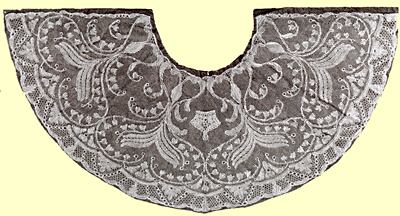
The design was clusters of lilies of the valley surmounted by the letter A and the imperial crown. A similar piece of work was latter made for Princess Ena and a wedding present from Sir George Shedden of Spring Hill, Isle of Wight. My daughter's wedding veil was also made and presented to her by many lacemakers in Paulerspury and Greens Norton. I had many kind friends devoted to the 'Cause', notably Mrs. Chettle, wife of a gentleman farmer in the neighbouring village of Potterspury. But nevertheless she and I lived usually in a state of friendly antagonism; I being of the opinion that all laces except those copied from Brussels or Venice etc. were beneath contempt and she holding that 'Torchon' should be made by our younger and less clever workers, this lace being easily and quickly made and much in demand for trimming fine lingerie. Mrs. Chettle was a busy woman of many interests but never grudged spending money or time in the service of our beloved Industry. Miss Alice Dryden of Cannons Ashby, Lady Knightley of Fawsley, Miss Phyllis Wake, daughter of Sir Hereward Wake of Courteenhall, Mrs. Wilson of Preston Deanery were among my best helpers in the County. Also Miss Channer who when quite a young girl wrote a very comprehensive little book on 'Lacemaking in the Midlands' and who now has a lace school in Abington Street Northampton. (This dates this account to the late 1920s.) Mrs. Moffat, Goodrich Court, proved a true friend from my first somewhat difficult year. She sent me good customers and engaged my trusty hench-woman Betsy Gibbings to hold children's classes in the hall of her beautiful home in Herefordshire. Speaking of early days I believe I made first big strides when Princess Mary of Cambridge consented to open an exhibition at Northampton where my laces were a very important exhibit. She came accompanied by the Duke of Teck, Princess May , our present queen, one of the young Princes and last but not least a most imposing person Maria, Marchioness of Aylesbury. Her Majesty was then a very young girl, and I think I never saw a prettier couple than the brother and sister as they hung over my stall and eagerly examined the exhibits. I even recollect that the Princess wore a little white tulle bonnet with strings as was the fashion in those days, and which set off to great advantage her lovely fair colouring. I don't think she ever forgot my laces, for years after I supplied fine edgings and entre deux (insertions) for baby clothes, and at the time of the Coronation wider laces were for her use through Neville and Rossiter. At an Exhibition of Home Arts at the Albert Hall, by the express wish of Queen Alexandra, I gave a demonstration of our lace, by a Paulerspury worker of course. For this: I chose the pretties and youthfullest of my girls and she sat in a prominent position in the hall manipulating a pattern of some hundred bobbins, and both she and the lace pillow attracted much attention. Alas, this was not all to the good, for my village maid was so excited and elated by the compliments she received and by the few gracious words addressed to her by the Queen herself, that on her return home and for some weeks after, she found it impossible to bring her mind down to everyday matters but spent her time wandering up and down the village street, paying visits to her contemporaries and describing what her majesty had worn and what she had said to her! I may add that this visit was arranged by Lady Luke of Passenham (nee St. John) and in whose home in Portman Square we stayed for the occasion. En voyage there was a ludicrous happening. When at Euston Station we climbed into our hansome and the porter had slammed the door and shouted our address to the driver and our steed had started. My companion turned wondering eyes to me and remarked, 'These London horses do be clever, Ma'am they run of themselves'. She had not seen our cabman in the rear! I don't remember if our County Council ever gave money help towards the holding of lace classes in our village school, but I do remember that at the request of the Duke of Grafton, I actually made a speech pleading for the giving of grant for this purpose. The Duke was chairman of the meeting. I was horribly frightened, as I had never spoken in public before, but in a few moments I forgot everything except my 'cause', and made, I was told afterwards, an impassioned appeal for my lacemakers and their children in which I described the former as ' the most self-respecting, the most industrious and the most talented class in all the rural population of England' and this indeed is what they are.'
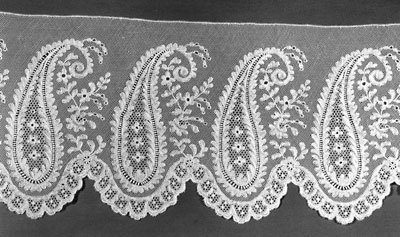
The Paisley Pear Lace made in c. 1901 from a design dating from 1850 - 1860 may have been the widest lace to have been made in Paulespury. (Text courtesy of Northampton Museums) Lace making is still carried on today in Grafton Regis. Obituary Northampton Independent |
|
