Ghosts in Park Close – 1943
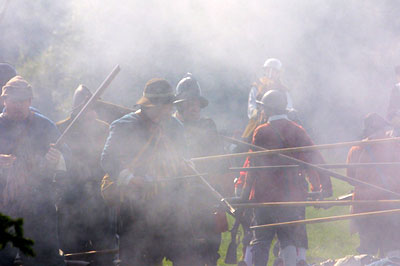
The great events in English history had moved away from Grafton Regis, but in December 1943 national issues made themselves felt even in this rural community.
Britain had been at war with Germany for four years, and rationing had become a way of life, but the women of Grafton were doing their best to make sure that the festive season was still a happy time for their families.
On the night of December 23 1943, the streets of Grafton Regis would have been silent and dark. The blackout was complete, not a chink of light escaped from the darkened windows, but inside the cottages the villagers would have been gathered snug and warm.
Meanwhile, in a field called Park Close not far from the village six farm labourers – four brothers O’Donnell and their two mates – were spending another cramped and cold night in a caravan. With most able-bodied men serving in the forces, the land still needed working on. Older men assisted by prisoners of war, displaced Europeans, Land Army girls and men from neutral Ireland, carried out the work.
Far from home, in a strange land without loved ones, the six men must have felt very isolated, especially at Christmas time.
Their only bit of Christmas cheer would be their weekly pay packets brought by their supervisor from the War Agricultural Committee on the following morning. The supervisor was based at Northampton and on this particular morning he set off in his green Ford van taking pay packets with him to various farms in the Roade area.
He arrived at Grafton Regis at 9.30am, where the Irishmen were supposed to be draining a field adjacent to the farm buildings.
As he drove past the caravan it looked deserted – so he went straight on to the field, where the men should have been working.
But there was no sign of them there, and when the farmer said he had not seen them that morning the supervisor became concerned and drove back to the caravan. Inside he found six very frightened men who were immensely relieved to see him.
They explained that after settling down to sleep the previous night they had been woken in the early hours of morning by the sound of horses galloping and men shouting. It sounded to them as if a cavalry regiment were fighting outside – hooves thudding, harnesses creaking and jingling.
A baleful light reflected through the small windows of the caravan and the men got out of their beds to see what was going on.
They could see nothing, but the threatening noises increased, with the yells and cries of men, the muffled roar of cannon being fired, the blast of trumpets and the beat of drums.
The activities of the ghostly army carried on for an hour or more and then the sounds died away. The Irishmen were too scared to go outside to they remained huddled together to await the dawn.
They took a lot of persuading before they would return to work, and then only on the condition that the caravan was removed to another site.
Their tale was treated with a good deal of scepticism by officials, and several thought it was just a good ruse to cover up the fact that they had overslept.
What the Irishmen could not have known was that it was 300 years to the day that a battle had taken place at Grafton Regis. In December 1643 during the Civil War the Parliamentarian army besieged the manor house. The Royalists held both Grafton and Towcester and this was preventing the passage of ammunition from Northampton to Gloucester.
On Thursday night, December 21, Parliamentarians troops marched into Grafton from Lathbury six miles away.
They met fierce opposition from the Royalists, and it was not until Sunday night that the Royalist Sir John Digby surrendered to Sergeant Major Skippon.
Was it a ghostly army that the Irishmen heard, re-enacting of the storming of the manor house by the Parliamentarians exactly 300 years before, as they huddled terrified in their caravan? That depends on whether or not you believe in ghosts…
|



