
Dr Richard Busby 1606-1695
1606 – Birth of Richard Busby in Lincolnshire.
1638 – Headmaster of Westminster School and Anglican priest.
1671 – Purchased Manor of WILLEN on 15th March 1671, from the Hammond family. An Act of Parliament transferred the title of Lord of the Manor to him on purchase.
1676 – Advowson of Willen transferred from Charles II to the then Lord Chancellor, Heneage Finch (1st Earl of Nottingham), and from him to Dr Busby.
1695 – Dr Busby died, leaving a lengthy Will & many Codicils and creating The Busby Trustees
1704 – Trustees finally appointed under his will – 13 in number
1707 – Their first act was the purchase of the Manor of Stoke Goldington (Estate) – 364 acres for £4,400 (SEE Below)
“STOKE GOLDINGTON ESTATE”
Transcribed from 19thCentury handwritten volume held by The Dean and Chapter of the Dean of Westminster. (Author unknown.)
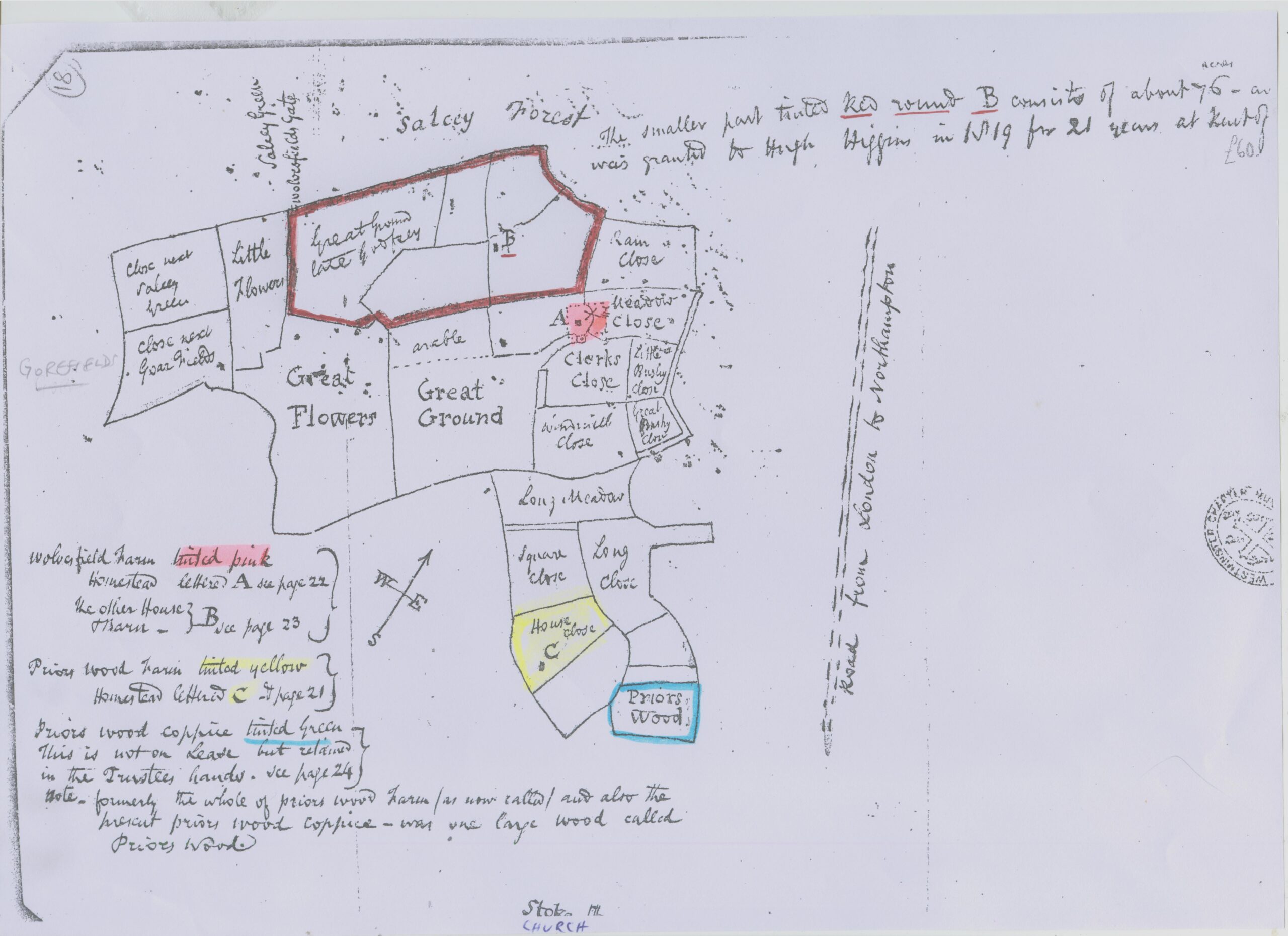
(NB Stoke Church is located at extreme foot of sketch)
Page 18 – Stoke Goldington
Pews in the Church… in the north Aisle belong to the Busby Estate. The ***Higgins paid from Levies?… amounting to more than £46, set this date of October 1831
Page 19 –Stoke Goldington Estate
Priors Wood )
Priors Wood Farm ) contains together about 364 acres; 0 Roods; 34 perches
Wolves Field Farm )
and all now situated in the Parish of Stoke Goldington.
Within a year or two after Dr Richard Busby’s death, his Trustees purchased this Manor and Estate from one of the Trustees – Daniel Finch, Earl of Nottingham – the consideration money was £4,400 being about 21¼ year’s purchase.
According to Mr Hugh Higgins, the chief tenant’s account, this money was formerly extra parochial, and entirely independent of the Parish of Stoke Goldington – previously the Finch family selling the Estate to the Trustees, the Capital Mansion was where the principal Homestead now is.
The Farm House now occupied by Mr Hugh Higgins, having formerly been the *laundry of the Great House, which was situated to the north of it, the site has been ascertained by their digging, and taking stones from the foundation to build a cow-house etc.
* When the present tenant’s father built the central chimney, he had recut the name of …Finch on one of the front stones thereof, to commemorate the family’s former residence there.
………………………………………………..
This Mansion was formerly surrounded by a large moat, the course of which can be traced almost all round. The long pond in front of the present farm and one by the side and another in the rear being parts of it.
Just without this moat, and to the south of it is the site of an ancient chapel** the foundation of it had been traced, by digging: it does not appear to have been more than about 14 feet square: and Mr H. Higgins’ father (Thomas) remembered hearing…
** By the old map, the field it stood in was called Clerk’s Close
………………………………………………..
Page 20 …hearing old people say that they had attended a Divine Service there, which was monthly and that the clergyman officiating was paid a guinea per month for doing the Duty: this must have been a century ago: at that time the poor Rates of Stoke Parish were of inconsiderable amount. – the chapel was afterwards taken down and the inhabitants attended Stoke Church and thereby saved the Clergyman’s guinea per month.
And it was not until some years after, that this Estate was assessed to the parochial Taxes, which have now increased to a distressing degree – The Lace Trade being settled in the Parish of Stoke Goldington, and so many tenancies remaining there, the population is now so large (see p23 for population) that Mr Drake, the curate told Mr Higgins there is but about an acre and a ½ of land to each individual of the Parish – and the Law being Poor increases the difficulty.
Miss Wrighte, the proprietress of contiguous land still preserves its extra-parochial exemption. “Gorefields” – see population return, 1831
……………………………………………..
Since I received the above information, I have seen at Cadell & Davis – A History of Buckinghamshire, wherein it states that “Eakley”, (now united to Stoke Goldington) was formerly a distinct Parish and had a Chapel, which was served once a month – that there were two manors in the said parish of Eakley, one was called Wolvesfield Manor and was the propriety of Lord Winchilsea, who sold it to Dr Busby’s Charity – Miss Wrighte, Manor of Stoke was held under the said manor of Wolvesfield, at a *Rent of 2S 4d (2/4d) & that the other Manor in Eakley was called Eakley Lane Manor
In the said book it also says that Miss Wrighte’s Manor of Gorefields (this adjoins the south side of the Busby Estate) is still extra-parochial.
*See account of present Quit Rents at page 27
…………………………………………………..
Page 21 – The Manor of Stoke Goldington** which has that Tithe in the Conveyance from Lord Nottingham (Finch) to the Trustees, is bounded on the northwest, by Salcey Forest; from whence the Rabbits, Hares, Deer and other Game come out and make much devastation. And there is some doubt but that the Manor has some claim on the forest for Venison – But this, if it ever existed, has probably been lost, since the Rights of the Manor have been almost all in agricultural hands.
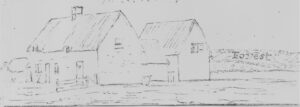
The Buildings upon this Estate are but few – the first you approach from the village of Stoke, is the Homestead of Priors Wood Farm, occupied by Thomas Higgins. It is of stone & thatch – the sketch hereunder is the south west view. The left building is the House, the next the Dairy & Cheese room with the shaft of the Horse Churn in front – the right-hand Building is the Barn. In the distance is Priors Wood.
Priors Wood Farm
…………………………………………………
** It seems from the extraction on the preceding page that the title of the name was “Wolversfield Manor” in the old conveyance the description does not specify that any but the Priory Wood Farm… were in the Parish of Stoke – but still the Manor of Stoke Goldington was conveyed by that name
………………………………………………..
Page 22 – On proceeding about half a mile to the westward of the North, you arrive at the Homestead in the occupation of Hugh Higgins and belonging to the other farm called Wolversfield, it is of stone and thatch.
These buildings are marked A on plan at page 18
South Front of Wolversfield Farm House occupied by Mr Hugh Higgins
(faint note- “this house destroyed by fire about 1844”)
On the plan at page 18 the dotted line around A is the site of the old moat; the little o in the small enclosure is above the Chapel Wood. Where the X is marked is the site of the ancient Manor … Great Manor House.
………………………………………………….
Page 23 – The remaining Buildings on this Estate are of stone and thatch and are situated in a field about 330 yards to the Northwest of the last described Homestead – The dwelling on the left is occupied by 2 of Mr Higgins’ men and the Back Building is a Barn.
South view. These Buildings are marked B on the plan at page 18
(faint note- “this granted to Hugh Higgins in 1819 with 79 acres; 1 roods; 20 perches, but on the …? called…76 a; 2f; 12p only”.
………………………………………………….
Population Stoke Goldington Parish:
1801 = 636; 1811 = 617; 1821 = 818; 1831 = 912.
The parish comprises about 2000 acres.
Page 24 – The soil of this Estate is stated to be poor, cold and wet; the latter proceeds from its nature, for it is a light mould, about half a foot thick, lying on a stiff clay; the clay preventing the rain water from sinking and it will not soon drain away even where there is a good descent, for the minute particles of the mould retain the moisture (like a sponge) by a kind of capillary action; so in wet weather, it is extremely inconvenient to pass over, and it its wetness gives sheep the Rot:
Some part of the large farm is full of anthills which would prevent its being mown, if that was required but it gives it a kind of advantage, for these little Elevations are dry situations, which the sheep lye on.

** “Priors Wood Farm” (as it is now called), as well as the part now called “Priors Wood” , were formerly all woodland and then contained altogether about 76 acres, and were in the Parish of Stoke Goldington. 2h formerly part of the Priory of Ravenstone. Higgins told…that…(unclear)
Priors Wood contains about 9 acres; 3 roods 12 perches and is retained in the Trustees hands – but, owing to the rates levied annually paid, it is hardly worth its expenses.
˃ It ought to be cut next season (viz Christmas 1828)
In 1828 Priors Wood is rated at £4 in the Parish Books
Poor Levies:
1822 = £2.2.2 / 1823 = £1.10.0 / 1824 = £1.6.0 / 1825 = £1.8.2 / 1826 = £2.4.0 / 1827 = £2.4.0/ 1828 = £2.0.0
In 1833 rated at £4 per year – the [katy?] at 1% in the pound – £2.16.0
Same year, by valuation, rated at only £3.10.0 per year
Priors Wood is Tythable – Higgins remembers 5 fields of tythes were always taken in kind
……………………………………………….
Page 25 – Timber
The Grove and spinnies all in Wolversfield Farm contain about 7:1:20 and there are several double Hedges, which essentially assist the growth of timber. – Mr Higgins, in answer to my enquiry, reports that within the last 14 or 15 years he has reared between 400 and 500 trees – but not on Mr Salmon’s plan (transplanting), for Higgins tried near 60 in one year but only one of them thrived.
(the next 11 lines of writing have been overwritten and are illegible)
Perhaps a timber table would be of some service; a very correct one might …trouble or expence (sic)
Page 26 – Comparative Quantities of the Stoke Goldington Estate, and made at different periods:
(Source) Priors Wood Priors Wood Farm Wolversfield Farm Total By Survey in 1603 being before Dr Busby’s Estates purchased the Estate
10. 1. 20 64. 0. 20 203. 2. 20 350. 0. 20 By W Letting’s survey in 1726 9. 3. 15 65. 3. 22 285. 3. 37 361. 2. 34 By Mr Davis in 1810 – – – 46. 0. 0 209. 1. 25 46. 2. 12
285. 3. 37
By a measurement? in 1822 9. 3. 12 64. 3. 12 289. 2. 1 364. 0. 35 (the next 13 lines of writing have been overwritten and are illegible)
Page 27 – the Manor of Stoke Goldington
Mr Hugh Higgins states that the Quit Rents due to his Manor and paid to the Trustees are as follows:-
£ . s . d. For a House in Stoke Goldington Town occupied by Wm. Berrill, now paid by George Osborn of Newport. 0 . 1 . 9 A good house there (late Brewton) now occupied by John Aldridge, a butcher, who pays the Rent, it being his own property 0 . 0 . 6 Another house adjoining last above, occupied by Wm Kilpin, who pays Rent; it is own property. 0 . 0 . 6 The Great House in the Parish of Stoke Goldington occupied by Mr Pierrepoint, but belonging to Miss Wrighte, who pays. ∆ 0 . 2 . 4 For a House in Stoke Town occupied by Wm. Hayward, farmer, but it belongs to Miss Wrighte, who pays. 0 . 8 . 7 Total of Quit Rents £ 0 . 13 . 8 Deputation
In 1707 was a separate deputation for Stoke Goldington to the Tenants. This was on account of damage done by Deer etc from the forest – But the Head Ranger afterwards requested the Trustees to rescind such deputation – and erected Rails to prevent Deer entering & kept such Rails in repair read more…
Pound – 2y – to keep a small one for the Manor (?)
∆ see mention of a Quit Rent of same amount at bottom of page 20
Page 28 – Tythes
The Estates of Stoke Goldington pay [moduxes?]
X Priory Wood Farm about ——————- 3. 3. 0
Wolfsfield Farm———————————- 0. 13. 4 } 2y there only
The Little Farm, late Pinkards ————— 1. 0. 0 } Easter offerings
X The Rev. W……invited Mr Hugh Higgins’ Father to Dinner and afterwards wanted him to pay 3=7=0 instead of the 3.3.0 – but Lord Winchelsea told Higgins not to pay it.
NB In 1845 & 1846 the Rector of Stoke Goldington established his claim to tithes from the whole estate
The church was now paid in 1827 or 1828 of the flow(flour?) raised at an expence (?) of between £200 & £300
(note written in pencil at foot of page – ‘original pages 29 & 30 cut out. Page 31 blank’)