|
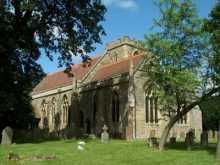
All Saints Church is widely recognised as one of the most important examples of Decorated Period architecture in North Buckinghamshire. Altough extensively restored by GE Street in the mid nineteenth century, much of the original fabric remains. Street did, however remove the internal plasterwork, which may have destroyed wall paintings such as were found at the neighbouring church of St Lawrence at Broughton.
For a more detailed description, see the section on All Saints Church elsewhere on the website.
Listed building
The building was listed in 1966
with listing particulars as follows.
SP 83 NE MILTON KEYNES WILLEN ROAD
west side
4/80 Church of All Saints
I
Parish Church. C12 origins, mostly Cl4 probably built by
Walter Keynes d1330. Coursed stone, plain parapets plastered, with
carved grotesques, mostly of reptiles in base mould, buttressed, the
buttresses at W. end of nave with ogee headed niche, tympanum of E.
gable with restored niches, tile roof. The church consists of chancel with
N. aisle, nave, S. porch, and tower at N.E. corner of nave. The chancel
arch and E. wall of nave are late C.12 the remains of an older church. The
roof and parapets were rebuilt C.19 and the interior restored. The chancel
has good Decorated sedilia and piscina and a priest's door, and is
divided from the N. aisle or chapel by an arcade of 2 bays. This chapel,
probably the chantry of Philip Aylsbury d.1349, has an ogee piscina and
an old octagonal font. The nave has three windows and door on the S. side,
two windows, door and tower arch on N. side. All the windows have
interesting Decorated tracery. The font is C.19 and there is a Georgian
carved and painted wood Royal Arms panel, also a chained bible 1613.
The S. door has a hood mould with ball flower ornament and free-hanging
tracery in the arch. Beside this door is a Holy Water stoup. The S.
porch has open arcading of 3 bays on each side, the arches with tracery.
The tower has 3 stages, a battlemented parapet and wrought iron
weather vane on N.E. corner. In the chancel is a brass with effigy to
Adam Babyngton, Rector, 1427 and there are wall monuments to C.18 rectors
and one to William Wooton D.D., Rector 1693-1727, probably the builder
of the Rectory. According to Browne Willis the N. chapel became a school
in the reign of Queen Elizabeth I.
RCHM II p.199. MON.1.
|