|



|
Adapted from "Blakesley Hall & Its Miniature Railway" by P.B. Kingston, published privately 1981. Reproduced with the permission of his descendants. Photos by Doug Blake, reproduced here with his kind permission.
Blakesley Hall and its Miniature Railway
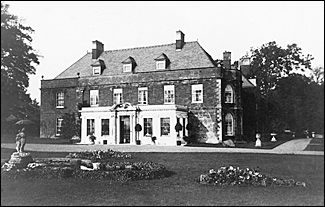
Some of the history of Blakesley Hall is recorded on the History of Blakesley pages. The manor had been in the possession of the Knights of St John before a long period under the Wight family, who had renovated the manor house and constructed what became Blakesley Hall. When it was acquired by Charles Bartholomew in 1876 and given to his son Charles William Bartholomew, it underwent a further radical change. The Bartholomews had made their money from Wombwell Colliery in Yorkshire, and the fortune they had earned funded both the developments at the Hall and the generosity C.W. Bartholomew (or "The Squire" as he was known) showed to the residents of Blakesley.
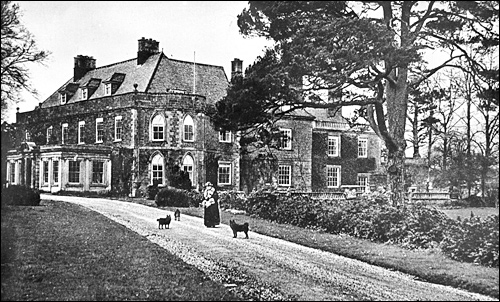
The darker area on the left-hand end of the building in the pictures above is where an extension was added, providing a museum on the ground floor with a library above. The museum had a number of interesting objects: the legs of a bed used by Princess Elizabeth (later Queen Elizabeth I) when she stayed at the Hall in 1552; some of Admiral Nelson's relics; a rocking chair belonging to George Stephenson (who was a friend of the Squire's father; and even a piece of Valencienne lace worn by Charles I when he was beheaded.
The Squire was keenly interested in engineering, having trained as a civil engineer, and he installed a fully-equipped workshop at the Hall. This workshop would be the source of many of the components for the railway he built. The Squire had a great fondness for cars, and became a founder member of the Royal Automobile Club, but it is for his miniature trains that he will be best remembered. The Hall stood in about 25 acres of grounds, and beyond that was its agricultural estate of about 80 acres which contained a small farm. The grounds of the Hall were landscaped with ornamental gardens and a waterfall. Along the northern borders of the grounds ran the line of the Stratford-on-Avon & Midland Junction Railway, with its station at Blakesley barely a mile from the Hall. The squire installed a narrow-gauge railway from the hall to the station, where he had his own private platform and small goods yard alongside the public buildings.
The railway was more than a hobby - it served a function. Trains brought coal and other merchandise to the station, where it was loaded into the side-tipping trucks seen in the pictures above and on the miniature railway to the Hall. There were regular shipments of anthracite which was converted into gas to power the generators and produce electricity. Beyond its everyday role, the BHR (Blakesley Hall Railway) was also a popular attraction for groups wanting an outing with a novelty, as seen in the photo below.
Sadly, with the death of the Squire in 1919, the impetus for further development ended. His widow and former staff maintained things for quite a while, however, even if not at the same pitch. The Hall hosted shows and events, and the railway still ran. The track was lifted in 1940. The elderly Mrs Bartholomew went to live with her son in Norfolk, the Hall's contents were sold, and then it was left to go to ruin. It was demolished in 1957.
Epilogue Some buildings of the agricultural estate still survive, as do some artefacts from the Hall grounds - salvaged from decay or the breaker. Two 2-metre high urns and two curved stone seats from the gardens have been saved and are being restored. One of the seats yielded a little secret. When it was being taken apart for restoration and rebuilding, a small envelope was found inside a hollow section, along with two pieces of wood. The envelope held the names of those who had made the seat: Alf Whitton, Foreman; Fred Pickett; Walter Smith; George Sheldrake; Joe Whitton; Charlie Whitton; Tom Watson. An addition read : "This job done by Pulham & Son, 71 Newman St, Coxford St, London W - 1907 & 1908. Finished [unclear]". One piece of wood was signed with two of the names of the team, the other had a message from all of them.
 |
||||||||||||||||||||||||||








|

