|
A Brief History of Blisworth
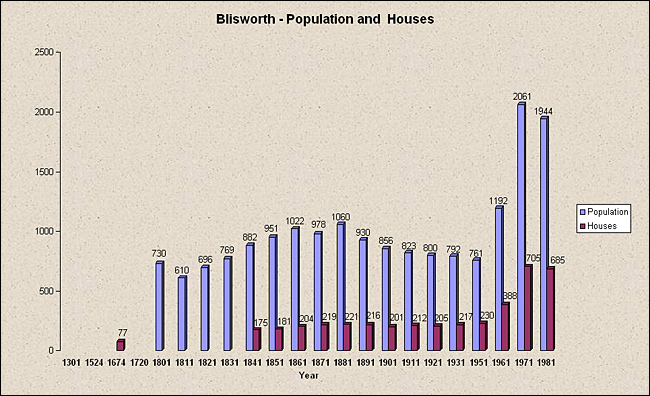
Blisworth as a settlement shows the typical characteristic of the Grafton Estate villages, in that there was a population decline in the late 19th century. But he decline seems to have continued till the period after the Second World War when the decline was dramatically reversed by new developments which doubled (and almost tripled) the population. Before the expansion in building, the village did manage to maintain a stable size of housing stock, despite the falls in population.
Blisworth was one of the original manors of the honor of Grafton and the Grafton Estate holdings in the village increased over time, till the eventual sale in 1919. Blisworth was one of the manors mortgaged to Sir Francis Crane in 1628 but was also one of the holdings the Crown recovered, and it subsequently became part of the settlement to Charles II's wife Catherine de Braganza.
|
|
|
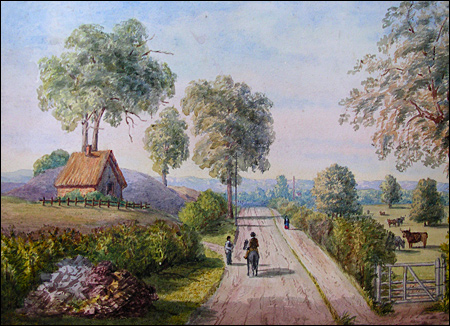
Blisworth Road, painted by Isabella Sams c.1878
The view shows that despite the earlier industrial developments
Blisworth was still a predominantly agricultural area.
|
Blisworth's history shows a connection with its two closest neighbours, Roade and Stoke Bruerne. This is most marked in the transport revolution which occurred in the 19th century and is discussed below, but even in earlier times Blisworth had a common bond with Stoke Bruerne in the shared access to Plain Woods, which lay across the border of the two parishes.
Though the Grafton Estate as a whole was not greatly affected by industrial development, certain parts of it were, and Blisworth was one of them. The 3rd Duke of Grafton was a prominent supporter of the Grand Junction Canal, which was authorised in 1793 and finally completed in 1805 when the Blisworth Tunnel was opened - a staggering feat of engineering, whose importance to the canal system can be gauged by the effects of its 4-year closure for repairs and renovation in the early 1980s.
|
|
|
(above) Two views of the north portal of the Blisworth Tunnel - about 100 years apart
(below) The former mill beside the canal at Blisworth
|
|
|
|
|
|
|
Clarke's picture of Blisworth c.1830
It is entitled " S.W. View of Blisworth Church, Parsonage & Mansion of G. Stone, Esq."
We may also note the horse-drawn barge on the canal in the foreground
|
Forty years after the building of the canal, the railway arrived with the opening of the London & Birmingham Railway in 1838. Blisworth was preferred to Roade as the junction for Northampton, and acquired a station (one of only four villages on the Grafton Estate to have one, the others being Blakesley, Roade and Stoke Bruerne). Until the opening of the branch to Peterborough in the 1840s Blisworth provided the nearest access to the main line for travellers to and from Northampton.
|
|
The elegant railway arch near Blisworth.
It carried the London & Birmingham Railway
over the Northampton-Oxford road.
|
|
Subsequently, the Stratford & Midland Junction Railway opened a line from Towcester to Blisworth in 1866. The line to Stratford was completed in 1872. Nicknamed "The Shakespeare Route", it gave rail access to some of the ironstone quarries in the area, but like so many railway plans, its hopes of growth and prosperity were never fully realised, and the line closed to passenger traffic in 1952. While it ran, however, Blisworth had the distinction of being a village with two stations almost in one.
|
|
|
Blisworth junction for the line to Towcester & Stratford-upon-Avon
(l) North of Blisworth, the line to Towcester in the foreground curves away from the main line to Birmingham
(r) Blisworth SMJR Station in 1932, with a train to Towcester waiting to leave. On the next platform is the "Ro-Railer" (see the final picture of the Blakesley Gallery for more details). The buildings beyond are part of the main-line station.
|
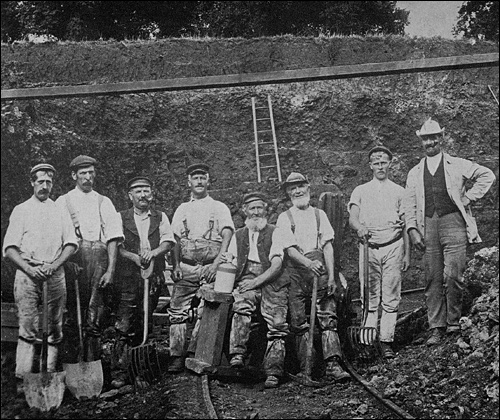
Despite the links with two major forms of transport, there was limited industrial development. John Roper worked a limestone quarry which was connected to the canal by a short tramroad, and later the Sturgess family had a quarrying business in the area; attempts in 1805 to search for coal proved fruitless; the only medium-term success was the exploitation of some ironstone seams, using first the canal and then the railway to send the extracted ore to the Midlands.
|
|
|
Blisworth ironstone quarry workers c.1906
|
The Duke of Grafton's holdings in Blisworth were proportionately the largest in any village on the estate, in terms of the trades which were conducted on land he owned: Hill Farm, Tunnel Hill Farm, Blisworth Hill Farm & Buttermilk Hall, Blisworth Lodge Farm, Plain Woods, the Stone Works, The Navigation Inn, The Royal Oak, the Brickyard, the loading wharf, two butchers shops, two blacksmiths, a wheelwright, a shop and post office, a shoemaker, not to mention substantial residential properties like Grafton Villa and Cliff House, extensive pastures and numerous cottages. One might remark - with reference to the one public house which did not stand on Grafton land - that as far as Blisworth was concerned, the Duke owned almost everything except "The Moon and Stars"! In Blisworth probably more than anywhere else, the Estate Sale of 1919 really was the end of an era.
|
|
A picture of Blisworth in the
Estate Sale catalogue of 1919, showing Lots 3, 39 & 40 |
|
 |
|
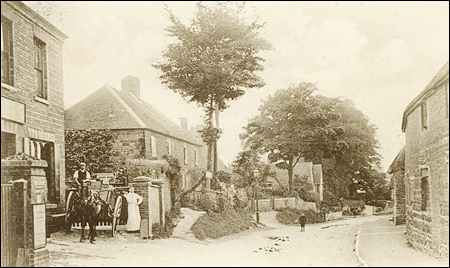
Two views of Stoke Road, Blisworth, about 100 years ago.
The shop below is the shop & post office sold in the Grafton Estate Sale of 1919.
In the photo, the tenant is shown as A. Pike
|
|
|
|
|
A final picture of Blisworth
in the same era |
|
|