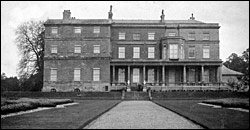
Origins and Brief History of the Grafton Estate
The honor of Grafton was created in 1542 by an Act of Parliament which combined a number of Crown estates in Northamptonshire and Buckinghamshire. The honor was centred on Grafton manor; the village’s name was changed to Grafton Regis; and the existing manor house was greatly enlarged. (For extensive details of Grafton House - the Manor and the Palace - see CD1)
The list of the king’s manors which made up the honor reads as follows:
|
Northamptonshire
|
|
|
Abthorpe
|
Courteenhall
|
Hartwell
|
Shutlanger
|
|
Alderton
|
Dalscote
|
Hulcote
|
Slapton
|
|
Ashton
|
Deanshanger
|
Luffield
|
Stoke Bruerne
|
|
Astcote
|
Delapre
|
Milton Malsor
|
Tiffield
|
|
Blakesley
|
Eastcote
|
Paulerspury
|
Towcester
|
|
Blisworth
|
Easton
Neston
|
Potterspury
|
Wicken
|
|
Bugbrooke
|
Foscote
|
Quinton
|
Wootton
|
|
Castle Ashby
|
Furtho
|
Roade
|
Yardley Gobion
|
|
Collingtree
|
Greens Norton
|
Rothersthorpe
|
|
|
Cosgrove
|
Hardingstone
|
Sewardsley
|
|
|
|
|
Buckinghamshire
|
|
|
Castlethorpe
|
Haversham
|
Little Linford
|
Snelshall
|
|
Hanslope
|
Little Horwood
|
Shenley
|
|
These all lie in a roughly 10-mile radius of Grafton. The holdings in individual places varied considerably : in one place it might be a few rents, in another the entitlement might include the manor and most or all of the land in the parish.
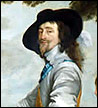
During the first hundred years of the honor’s existence, ownerships, stewardships and tenancies of the original estate lands changed on a regular basis as the Crown used these as inducements and bargaining counters to raise money. Especially significant was the mortgage of a large part of the estate in 1629 to Sir Francis Crane (so that King Charles I could pay for the maintenance of his sister, the Queen of
Bohemia
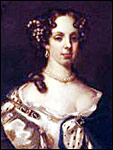
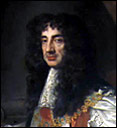
) and the subsequent legal wrangling in the 1630’s to recover the estate. To read more about Sir Francis Crane, click here for the list of villages and rents from the estate in 1634 and also see the relevant section on CD1. A major change occurred in 1665 when the estate was part of Charles II’s marriage settlement to Catherine de Braganza. By this time the list of villages with land counted as part of the estate was as follows:
|
|
The manors of
|
|
Alderton
|
Grafton
|
Moor End
|
Stoke Bruerne
|
|
Ashton
|
Greens Norton
|
Paulerspury
|
|
|
Blisworth
|
Hartwell
|
Potterspury
|
|
|
|
|
Lands in all those parishes plus lands in
|
|
Cotton End
|
Hardingstone
|
Shutlanger
|
Hanslope (Bucks.)
|
|
Eastcote
|
Little Houghton
|
Roade
|
|
|
Catherine de Braganza
c.1670
|
Grimscote
|
Northampton
|
Tiffield
|
|
|
|
In 1673 Charles II granted the estate to Henry of Arlington for his lifetime, then in tail male to Henry FitzRoy, the king’s second son by Barbara Villiers, Duchess of Cleveland.
Arlington's
only daughter (and consequently heiress) Isabella married Henry FitzRoy in 1672 - she was 5 and he was 9. They remarried in 1679, four years after FitzRoy had been made Duke of Grafton.
Arlington
died in 1685, and as Queen Catherine was still alive, he never inherited the honor, which passed to Henry FitzRoy, the first Duke. However, when he was killed in
Ireland
in 1690 the succession passed to his seven year old son Charles who became the 2nd Duke of Grafton.
The honor of Grafton had remained a Crown property for about 160 years, till in 1706 it passed to the 2nd Duke of Grafton in tail male after the death of Queen Catherine in 1705. In 1698, his mother Duchess Isabella had remarried. She still resided at Grafton House and seems to have retained an administrative interest in the estate. The 2nd Duke meanwhile had been granted the rangership of
Whittlewood
Forest
, and had thus acquired the use of Wakefield Lodge nearby. He therefore made Wakefield Lodge the family seat in preference to Grafton, and on his grandmother’s death in 1723 the mansion became the administrative centre, such that over the next two hundred years the estate as a whole was frequently referred to as the Wakefield Lodge Estate.
The Duke implemented a thorough-going rationalisation of the estate organisation and administration, and the surveys of 1723 generally mark the start of detailed record-keeping of the Estate rentals listed on this CD. As a result of the surveys we have a fairly accurate record of the size and value of the estate around 1725. Click here for the details.
Successive dukes added to the estate in the 18th and 19th centuries, especially in the 1850s when Whittlewood Forest was disafforested and inclosed, enabling the Dukes to make further major acquisitions, including the outright ownership of Wakefield Lodge and its grounds.
The estate had remained intact and had survived the agricultural downturn in the late nineteenth century, but in 1913 the 7th Duke’s advisers felt that some reduction in acreage would be desirable, in order to release capital. The first of the major sales then took place. Around 2,000 acres were put up for auction - said to be “the outlying portions of the estate” but in reality including holdings in Ashton, Roade and Hartwell : quite close to Grafton itself.
The major blow to the estate came after the death of the 7th Duke in 1918, and the huge sum in death duties to which the family became liable. Around 8,000 acres were put up for auction in 1919, with a further 4,500 acres in 1920. Many lots in the 1920 auction were unsold and were consequently sold off over the next 20 years. Wakefield Lodge itself went in 1924. Further heavy liabilities to death duties came with the death of the 8th Duke in 1930 and the tragic death at the age of 22 of the 9th Duke in 1936. Most of the remaining Grafton Estate lands in Northamptonshire were sold off after 1945.
In 1987 the 11th Duke sold several manorial titles, but retained those of Grafton Regis and Potterspury. Currently, the Grafton Estate Settlement Trust owns a farmhouse, several smaller properties and around 600 acres of land at Grafton Regis where Charles FitzRoy, younger son of the 11th Duke, and his family have a home.
|