|



|
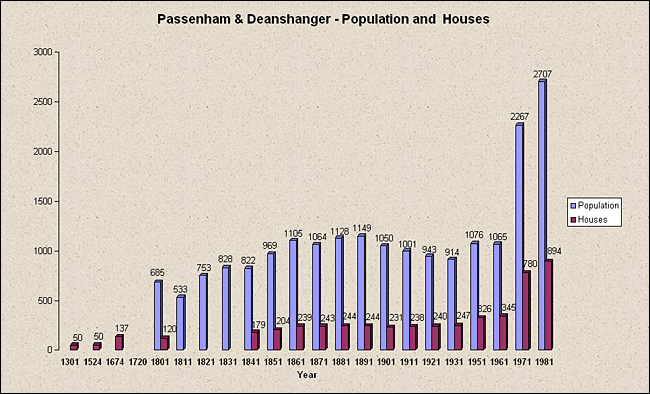
Based on the paper by M Page & R Jones "Medieval settlements and landscapes in the Whittlewood area : interim report 2000-1" in 'Medieval Settlement Research Group Annual Report 15 (2000)', pp. 10-18 - with supplementary material from The History of the County of Northampton Vol.V - Cleley Hundred (ed. Philip Riden) A Brief History of Passenham & Deanshanger The histories of these two villages are inextricably intertwined. The overall story is of the decline and ultimate abolition of Passenham as a civil parish, and the rise of Deanshanger as the main centre of population and the focus of industrial and educational investment. The development of industry in Deanshanger allowed the parish to escape the worst of the agricultural decline in the late 19th century, though the population fell in the first part of the next century before showing spectacular growth as the presence of a secondary school triggered rises in population which saw the total for the parish triple in 50 years.
The ancient parish of Passenham occupied a little over 3,250 acres in the far south-east of Northamptonshire, on the border with Buckinghamshire, from which it was separated by the River Great Ouse. In the 13th century Passenham contained four principal areas of settlement:
(Note : the histories of Puxley and Old Stratford are told in the relevant village sections elsewhere) The parish of Passenham was heavily wooded in its north-western and north-eastern parts and lay within the bounds of the royal
There can be little doubt that the settlement pattern within the parish could shift and develop. The
It may be that this contraction of the village began with the movement of the medieval manor house. It is likely that the manor house was originally situated at the east end of the village, on the north side of the street, in the field named Robins Leys on the tithe map of 1844. A moated site was discerned from aerial photographs and an excavation in 1967 uncovered house walls, together with pottery dating from the 12th and 13th centuries. It is uncertain when this house became derelict. Perhaps it was as early as the 14th century, during which period Passenham may not always have had a resident lord. There was, however, a manor house (location unknown) in 1402 when the king granted to John Cok of Passenham and John his son ‘the houses of the site of our said manor … with the gardens of the said site together with the demesnes’. This may have included the ‘great chamber at the south end of the hall’, of which the roof was repaired with slates in 1383-4. Certainly by 1566, though, documentary evidence proves that the manor house lay to the west of the church, on the south side of the street, even if the earliest portion of the surviving building dates only from the first decades of the 17th century. The new manor house is assumed to be the work of Sir Robert Banastre, who purchased the manor of Passenham in 1624. If this is the case, it seems likely that he rebuilt an existing structure. The abandonment of the original manor house may be associated with the disappearance of the de Passenham family, the resident face of lordship in the village for more than half a century prior to 1299. William de Passenham held the manor first, of the Ferrers earls of
The water-mill in Passenham belonged to the royal estate there in 1086. It was given to the Hospitallers in the 12th century, and remained with them until it was demised to Henry IV. Like the rest of the manor it came into the possession of Sir Robert Banastre and then to the Maynards. It was sold in 1918, but shortly afterwards ceased operation as a mill and was subsequently converted to residential use.
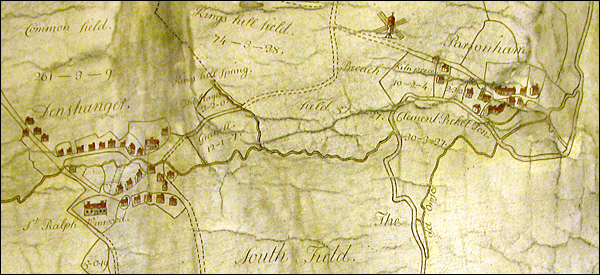
The windmill shown on the 1608 map to the north of the village (see above) was put up in about 1549 by John Fowkes alias Smith. It remained in his family until about 1570, when it was assigned to William Dyneley, who in turn assigned it to John Markham sometime before 1591. The mill appears prominently on the 1608 Whittlewood map but no trace of it can be found in later documentation. In the 1970s a low mound was still apparent to the north of the village, and appears to mark the location of the former mill. From about the late 15th to the late 18th century, the rights to a fishery at Passenham Mill were let to a series of tenants, but apart from mill-related trade, the village was too small to support other tradesmen. Instead, commercial and industrial development happened at Deanshanger, with predictable consequences. Population growth went to Deanshanger, and the ancient parish of Passenham was abolished in 1951, being divided between the present-day civil parishes of Deanshanger and Old Stratford, though ecclesiastically speaking, Old Stratford still falls within the parish of Passenham. Apart from a couple of rents in the old parish, the Dukes of Grafton had little financial interest in Passenham, even though it lies relatively close to Wakefield Lodge. The
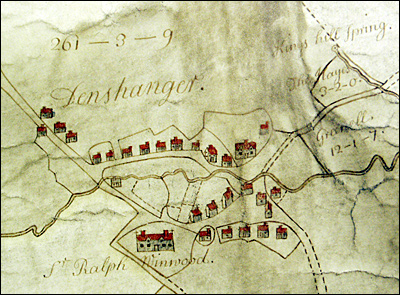
Deanshanger was included within the entries for Passenham at the time of the Domesday Survey. The earliest reference to the manor of Deanshanger appears to be that found in the perambulation of
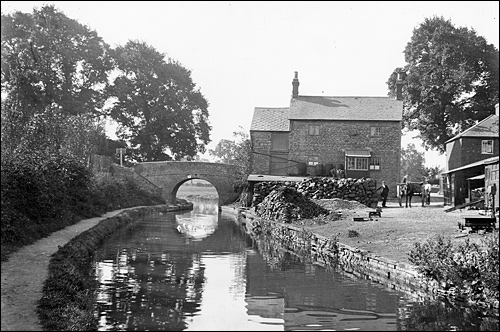
The inclosure of Deanshanger in 1772 has been referred to above. The village had a mixed economy based on farming and a wider range of industry than the usual village crafts. With a more open field structure that Passenham, with a high number of small freeholders able to establish businesses on their own property, Deanshanger saw the kind of industrial development unmatched by most other villages in the area, with the possible exception of Roade. The coming of the Buckingham branch of the Grand Union canal in 1800 was of great assistance, providing easy access for heavy goods which would otherwise have to be transported by road - which was turnpiked at Old Stratford in 1815 - or hauled from the nearest railway station at Wolverton. The canal passed through the middle of the village, and a wharf was a natural development. One can imagine the commercial advantages to local trades in of having that facility so close by. The canal continued to operate until the first half of the 20th century.
Lacemaking went on in Deanshanger until the 1930s, and in the 18th century the trade had several lace merchants, principally the Whitton family. The other common Northamptonshire craft - shoemaking - went on up to the First World War. In the early 18th century two men were recorded as being a weaver and a mercer, and there is evidence for brickmaking and limeburning going on in the village too. From the 1770s up to 1805, the Grafton Estate was paying the Colson family to burn bricks and lime at Old Copse on the edge of Whittlewood. The Colsons were succeeded by Joseph Foxley in 1807, and the association with the Grafton Estate continued until his death in 1840 and the disafforestation of Whittlewood which took place fifteen years or so later, when Old Cope Farm (which contained the brickyard) was bought from the Crown by William Boyes, who together with several successors kept the kiln operation till the First World War. On the loss of Old Copse kiln, the Grafton Estate opened a new kiln at Meanfallow near Paulerspury, (See the History of Paulerspury for details on this). At least five other brickmakers are recorded in Deanshanger, and they all appear to be involved in the allied trades of limestone quarrying and limeburning. The major stories of Deanshanger's industrial past are however those of Roberts Engineering and later the Oxide Works. In the 1820s Richard Roberts developed his original smithy into an iron foundry and engineering works situated alongside the canal. Other members of the family developed another smithy and took over a threshing machine hire business in the course of the century, but tit was Richard Roberts' venture which really expanded and it was his grandsons Edwin and Henry who made E & H Roberts Ltd a national player in terms of farm engineering. The company specialised in all types of ironwork fabrication and machinery, including elevators, binders, mowers, gratings, railing and kitchen ranges, but were especially famous for their gang ploughs and windpumps. By 1900 the company's works had expanded further and generally went by the name of Deanshanger Ironworks or Britannia Ironworks. It survived a major fire in 1912 but not the post-war slump of the 1920s. At its peak, it was the major employer in Deanshanger, and its loss caused major unemployment in the village. To offset the loss of so many jobs in Deanshanger, the Rural District Council wrote to the London Chamber of Commerce commending the site of the ironworks to companies seeking to relocate. In 1932, the Morris Ashby Smelting Company Ltd opened, initially making lead oxide, but then adding to iron oxide to their production - both important commodities in the Second World War. Post-war expansion followed, and by the end of the 1970s the company had almost 150 employees. Exports fell in the early 1980s, but a restructuring reversed things and by 1983 the new company was trading as Deanshanger Oxides Ltd. Further expansion followed and by 1988 the company had 188 employees, though only a minority were from Deanshanger. For a time, Deanshanger could claim to have the second largest iron oxide company in the world. Badly affected by far-eastern competition in the 1990s, the company was forced to close in 1999. The site was cleared and redeveloped. Roberts' engineering works had been dependent on the canal for its major transport; the products of the oxide works went by road. The nearest station was Wolverton, but for a brief interlude in the late 1880s Deanshanger was served by a steam-hauled tram service when the Wolverton to Stony Stratford tram line was extended over the River Ouse, through Old Stratford, and out to Deanshanger. The returns through fares, however, fell hopelessly short of the investment and running costs, and within two years the tram service was closed beyond Stony Stratford and the track was lifted.
Deanshanger school opened in 1859, but in its early years suffered through poor teaching and in the 1860s drew the criticism of inspectors over its poor discipline, inadequate teaching and accommodation. By 1871 the school had been enlarged, with support from Viscount Maynard and the 6th Duke of Grafton. Gradual improvements in standards ensued over the next decade, but the steady rise in population was putting constant pressure on the accommodation, which led the school managers in 1899 to lease the Baptist Chapel as a teaching area for infants. By 1925 the school's premises had been condemned as unfit for teaching. By 1939 the school was under the control of the Local education authority and had new premises. Numbers continued to rise, especially after the opening of Deanshanger Secondary Modern School in 1958 (of all the villages on the Grafton Estate, only Deanshanger and Roade had designated secondary schools, though of course for many years the schools in most villages were all-age). 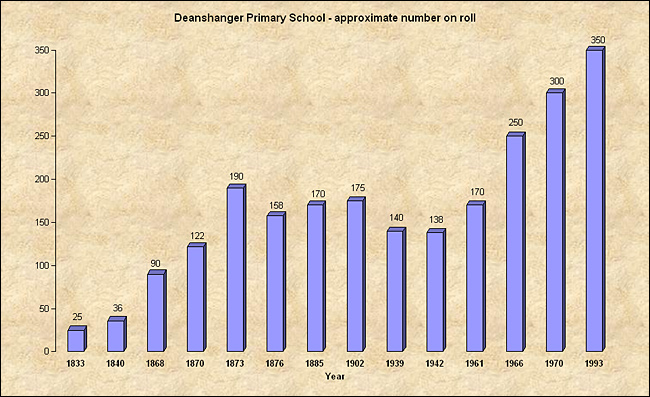 |
||||||||||||||||||||||





|

