|



|
Transcribed from David Cochrane's 1987 update of Harry Trengrove's 1980 account of the History of St. Mary the Virgin, Roade. Reproduced here with permission.
St. Mary the Virgin, Roade
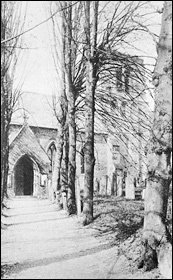
It is not always easy to give an exact date for the foundation of many of England's ancient and historic parish churches, especially when such dates are lost in the mists of antiquity. The Parish Church of St. Mary the Virgin, Roade, in south Northamptonshire, is one such church whose actual date of foundation has been blurred by the passage of time. From some old records we understand that around the year 11AD, and shortly after the Norman Conquest, the Hartwells of Hartwell and the Lupus family of Essene (now the village of Ashton) combined and established " a church at Rode.." and sometime between 100 and 1167 it was discovered that Simon of Hartwell gave his portion of the benefice, which his family had endowed, to the Abbey of St. James, Northampton, as a chantry gift for the souls of his father, Geoffrey, and his brothers William and Henry. A chantry gift at that period was for masses to be said regularly for the repose and peace of the souls named in that gift. There then appears to be a lack of information until the year 1329. By this time the Lupus family had changed their name to Hardreshall, and Sir John Hardreshall had appointed Roger Hardreshall as Rector of his portion of the benefice. Thirteen years later, 1342, a serious quarrel and dispute arose, regarding the taking up of the tithes, between Sir John, now patron of Ashton, and the Abbot of St James. This continued until 1346, when Roger broke the agreement,. The Abbot at once placed his cause before the chief Church Court at Canterbury, which confirmed the Abbot in his rights to the tithes. Very little appears to be known of the next one hundred and four years. By this time, 1450, the church had acquired four bells, which are said to have been cast locally, probably in Churchcroft. Three originals have survived, bearing the maker's markings and Latin inscriptions. A small "minute" bell, of unknown origin, is still in existence, but is badly cracked. The bell is now on a window sill in the chancel, over a large unmarked altar tomb. Again, there appears to be another blank period until 1516, when Ashton was separated from Roade, and made a Parish of itself (years later it was linked with Hartwell), but retained its one third portion as Rector of Roade. This arrangement lasted until 1816, when, with the Enclosure Act, The Rector of Ashton was given, instead of his tithes, one nomination in three to the benefice of Roade. This literally means that every third Vicar of Roade was nominated by the Priest-in-Charge of Ashton (now the Rector of Hartwell); this arrangement existed up to 1987. In 1535, the Abbot of St. James was deprived of his Abbacy during the Dissolution of the Monasteries, and the tithes of Roade parish were confiscated. A tithe was a tax of one tenth, especially on the yearly proceeds from land and personal industry, which had to be paid, via the landowner, as stipends for the clergy of the church. This was later amended into a regular rent, and finally abolished when the Church Commissioners came into being, and raised the money by wise and prudent investments. But in 1550, Richard Fermor Esq. received the two-thirds portions of the tithes from the then King, and with it the two nominations of a Priest for Roade. In 1660, a great calamity occurred to the church, when the roof of the nave fell in, allegedly due to poverty and neglect. But in 1669 some repairs were effected: a low roof was put over the nave, and cheap tiles were inserted in the south wall. The archway between the nave and the chancel, where the ringers now stand between the choir stalls, was bricked up, with only a small door to give access between the two. Eighty-one years later, a Mr Stephen Hoe of "Rode Hyde" purchased the tithes, and with them the two nominations, from Sir Hatton Fermor. These changed hands over and over again, until they were finally purchased by the Duke of Grafton. In 1727, due to damage, the then treble bell was recast by Thomas Russell of Wootton. Again we have another period of eighty-two years, until we learn that in 1809 the Duke of Grafton have his two-thirds portion of the nominations to the Bishopric of Peterborough. This arrangement persisted until 1987, enabling the Bishop to nominate - or collate - two Vicars out of three to the Parish.
During the spring of 1851, the path at the west end of the churchyard was separated from it by a four feet high stone wall, due to damage to graves and headstones by inconsiderate trespassers. In 1855 the church faced another big problem, when the tower was declared unsafe. The Duke of Grafton offered to defray part of the cost, £200 to £300, of pulling down the tower, and embodying the space within the church. The Vestry respectfully rejected this offer. A year later the tower was made safe again, but how we have not been able to discover. This rejection of his offer did not apparently upset the Duke, for in 1857 he restored the chancel, adding the now high-pitched roof. A picture hung in the chancel represents this period.In 1864 the nave was re-roofed, and its height raised to correspond with that of the chancel. The old box pews were taken out and replaced with seats of deal. The present organ (a Hunter of London) was purchased secondhand in 1879 at a cost of £110. It was formerly in the Garrison chapel at Portsmouth, and was transported to Roade on the back of a horsedrawn wagon. The vestry behind the organ was built at the same time, costing £122. We are again faced with another period of silence, for the next piece of news is that on May 27th 1924 the church was slightly damaged by lightning. Five years later in 1929, electric lighting was installed throughout the church. In early 1939 there were some alterations and adornments made to the Sanctuary; the floor level was lowered and repaved with tiles. In the south-west corner of the space within the altar rails, under the tiles, is a large stone slab with the following inscription:-
There is also a memorial stating:-
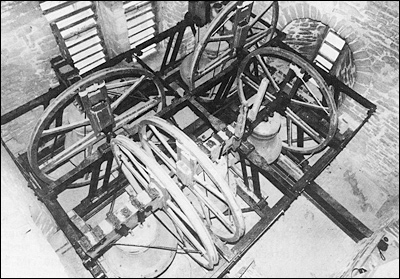
The four bells were returned and remained in the churchyard until February 5th 1950, when they were baptised and blessed by Dr Spencer Leeson, the Bishop of Peterborough. The bells were then hung in the tower in a new steel bellframe, and on February 17th 1950 pealed out over the village and countryside for the first time after a period of inactivity lasting over 200 years. A major work of restoring the interior of the church was begun on May 15th 1950, and services were held in the Church Institute. On October 15th that same year the then Bishop consecrated a new high altar, hallowed the work of restoration, and led the parishioners present in a service of thanksgiving. The new furnishings were all made of oak. The pulpit has in its pedestal pieces of 500-year-old oak from the beams originally supporting the bells and the wooden bellframe in the tower. The lectern also contains pieces of this oak and its design is based on a medieval revolving lectern. The old oak pieces are recognisable as being darker than the new. The choir and clergy stalls were also renewed at this time. The high altar is reproduced from its design from an old Jacobean cheat, and the top has inset a marble altarstone, in which five crosses are cut.
Two years later, in 1952, a new treble bell was installed, increasing the ring to five bells. Being blessed and christened St Cecilia, it was presented by the then People's warden, Mr C T Cripps MBE, and it is inscribed to "recall with thankfulness the successful restoration of the Church in 1950." A burnished gold and jewelled chalice was presented and hallowed on December 20th 1953, in memory of Ethel Sewell. A beautiful statue of the Madonna and Child, after the design by Martin Travers, from the original to be found in the Church of St. Mary the Virgin, Bourne Street, Westminster, was presented in the memory of Cecil J. Vincent, Priest, along with the Mother's Union banner, a very exquisite piece of work. On December 18th 1955, there was presented and hallowed a burnished gold ciborium in memory of H. E, Smith, the gift of his widow Mrs L. Smith. Sadly, more extensive work was found necessary to counteract rising damp in the north aisle walls, and this was completed, both exterior and interior, in 1956, as was also the reglazing of the windows. The rebuilding of the eastern boundary wall of the churchyard was undertaken and completed in 1957. In 1958, the temporary east window was replaced with a new one designed by Christopher Webb, through the generous bequest of a legacy by Miss Goodridge, to the memory of her late father George and her sister Louisa. The window depicts Our Lord Jesus Christ in Glory, surrounded by the seven angels with trumpets (Revelation chapter 8, verse 2), with two other angels holding above His Head a crown, signifying Him as King of Kings, and underneath a beautiful representation of the Lamb of God. Above this picture of Christ in Glory, there is a picture of the angel Gabriel making the historic Annunciation to the Blessed Virgin Mary that she was to be the Mother of the Son of God. Above that again, in the apex of the window, is a dove, representing the Holy Spirit illuminating Mary with His "overshadowing". The rest of the window is in clear glazing instead of the usual deeply stained glass, which, in the opinion of many, adds to its intrinsic beauty. The high altar itself is surrounded on the rear and two sides by riddle curtains, held in place by four solid posts, each one surmounted by a gilded angel bearing a candle holder, which contain the candles lit on festive occasions. These angels are replicas of those in Nuremberg Cathedral. Another burnished gold and silver chalice and paten were given and inscribed to the combined memory of Louisa Goodridge and Minnie Paxton. The then Bishop of Peterborough, Dr. Robert Stopford, presided at the Eucharist and dedicated these gifts on September 21st, 1958. This virtually completed the restoration envisaged and begun in 1949, nine years of intensive activity for a village church. In 1964, the entrance to the churchyard was enhanced by the gift of a pair of wrought iron gates given by Mrs H. Stafferton, in memory of her late husband. In November 1969 the chandeliers in the nave were installed and dedicated. They were given by Mr H. C. Collyer in memory of his wife Alice. Designed by the Peterborough Cathedral architect George Pace, they were made as an educational project by staff and pupils at Roade Secondary School. In 1970, new wooden outer doors to the porch were erected to the memory of William Sturgess and his children by Job Evans Sturgess, who constructed them himself. The new church hall was built adjacent to the church in 1972. It can be entered in two ways, from the church in the north-west corner and also from a main entrance from the path at the west end of the churchyrad. It is a fine modern building, with a large well-equipped kitchen. It was opened and blessed by Dr. D. R. Feaver, Bishop of Peterborough, on June 9th. It replaced the old church institute, which had fallen into disrepair. All that remains of this building is a stone set in the wall subsequently erected on this site. A portable nave altar was made from wood taken from the pews removed from the north-west corner of the church to permit access to the new church hall. This altar was first used on December 24th 1972, but was not formally dedicated until March 15th 1977. The cost was met by Mrs A. Hancock as a memorial to her late husband. The major part of most services, including the Eucharist, is conducted from there, due to the double arch of the chancel somewhat muffling the officiant's voice. During 1976, a memorial gift of a legillium was presented to the church, on this occasion by Canon N. Husbands. Subsequently, in 1982, he also gave to the church the ciborium used for the reservation of the Blessed Sacrament, and the cricifix and candlesticks used on the Lady Chapel altar. In 1978, a memorial gift of a legillium for the priest's use was received. New frontals for this legillium, the pulpit and nave altar were designed and made by lady church members. Together with a pair of dwarf candlesticks for the nave altar, they were given by Mrs M. Gould in memory of her late husband, Rev, S.W.A.Gould, and dedicated by Rev. W. Hobday on November 25th 1979.
Earlier that year, on October 5th, a sixth bell was added to the existing five, to become the new treble bell. It was originally ordered on May 18th of that year from Taylors, the bellfounders of Loughborough, and should normally have taken two years to make and hang in the tower. At the request of the late Sir Cyril Cripps Kt MBE, it was dedicated to his wife, Lady Amy, and christened St Thomas by the Re. Walter Hobday. After the new bell had been hung in the tower, a muffled quarter peal was rung in memory of the late Sir Cyril, a long-time churchwarden and benefactor to the parish. During 1980, new chairs, made in the village by local craftsmen, for the use of the priest and servers at the nave altar, were given. The nave altar credance table is a memorial gift given in the following year, 1981. In 1981 a project of external restioration was undertaken at a cost of around £40,000. This work involved repointing the stonework, re-roofing the Lady Chapel, and replacing much fractured and weather-dammaged stonework, especially around the windows and on the tower. During the work on the tower, some medieval carvings, including human faces and a ram's head, were discovered. They are thought to date from the 1300s and, since they were face inwards, they may have been cannibalised from other buildings during previous repairs or be apprentices' practice pieces. One of these has been repositioned on the north side of the tower, and the ram's head is displayed in the church. As this work was being completed in July 1982, the cockerel weathervane mysteriously disappered. It was found a few days later near Southam with three £1 notes and a message "My maiden flight was unsuccessful. Please take me home." It was brought back and replaced on the tower. The bookcase, situated near the door connecting the church to the hall, was erected in October 1982, as a memorial from the parishioners to the Rev, S.W.A. Gould. At the same time, a central folding span was added to the altar rail; and two kneelers, worked by two ladies in the parish, were given to commemorate the wedding of H.R.H. the Prince of Wales to Lady Diana Spencer. In 1984 the organ was refurbished; the pedal keyboard was extended to two octaves and a stop of pipes was exchanged. During the same year the church was redecorated, with the roof being coloured for the first time, and the sanctuary carpet was laid. In 1986 the eastern churchyard wall had fallen into such a state of disrepair that it was replaced by a wooden fence. Choir pew runners were received as a gift, given in memory of Mr and Mrs John Sturgess. The stained glass west window was erected in November 1986, as a memorial to the late Sir Cyril and Lady Cripps, a gift from their family. It was designed by Francis Skeat, a pupil of Christopher Webb. The window depicts three saints and their heraldic emblems; Saint Peter, the patron of our Diocesan Cathedral, and the Saints, John the Baptist and Andrew, whose feast days fall nearest the days on which the commemorated died. Also shown are the Arms of St. Mary, the church's patron, the Arms of the Cripps family, and those of the City of London. 1987 brought a change to the patronage of Roade, for the parish was united with those of Ashton and Hartwell to form one benefice. As we have previously seen, these parishes were part of the early history of Raode parish. The patronage now alternated between the Lord Chancellor and the Bishop of Peterborough. Sharing its priest is nothing new to Roade, for from 1946-54 the vicar of Roade was priest-in-charge of Courteenhall, before that parish was united with Collingtree. Two other interesting features can be seen in the church, but their exact origins are obscure. The font near the nave door, and the archway of this door, are both Norman, a throwback to the church's original foundation. Thus, St. Mary the Virgin, Roade, is now a beautiful little country church, where a happy fellowship worship their Lord in peace and freedom, not because they have to, but because it is their joy to do so.
Details of the bells of Roade Church can be found by reading Roade Scrapbook |
||||||||||||||||||||||||||||||||||||||||||||||||||||||||||||||||||||||||||||||||||||||||||||||||||||||||||||||||||||||||||||||||||||||||||||||||||||||||||||||||||||||||




|

