|



|
Adapted from The History of the County of Northampton Vol.V - Cleley Hundred (ed. Philip Riden)
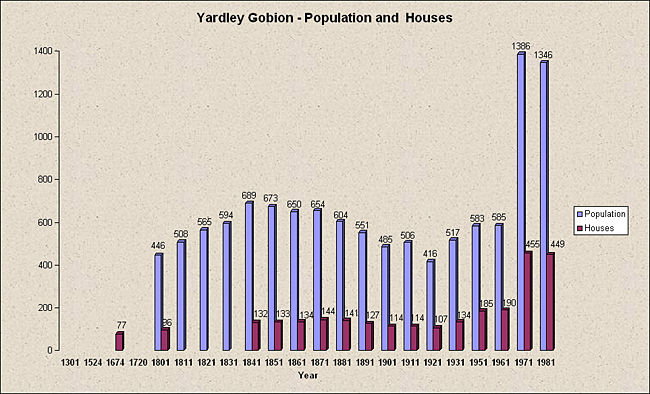
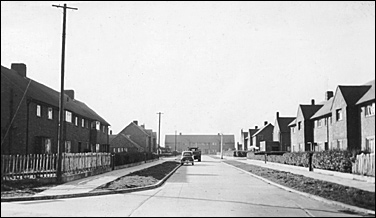
A Brief History of Yardley Gobion The hamlet of Yardley Gobion was linked to that of Potterspury within the parish of Potterspury, but from early times the two settlements kept their own poor, maintained their own roads and had separate parish constables. The boundaries between the two established in the 19th century probably reflect the earlier medieval divisions. Some Grafton Estate surveys from the 18th century link the two, and this occasional merger in data collection and returns makes disaggregation difficult at times - as happens elsewhere on the Grafton Estate. Potterspury Park, though separate from the two parishes, was common to both, and paid rates to each in equal measure. (Details on the park can be found in the Forests & Parks section). The Yardley Gobion population and housing data chart below tells an interesting story. The population peaked earlier in the 19th century than was the case in some Grafton Estate villages. From the 1841 high point, a steady decline set in, though it was less dramatic than elsewhere. The minor revival appears in the figures for 1911, rather than 1901 seen in other communities, and by 1931 things were improving again, whereas elsewhere this census year often marks the low point. The effects of the housebuilding in the 1960s and 70s is very marked, with the population showing an increase of around 250%, and almost twice as high as its 19th century high point.
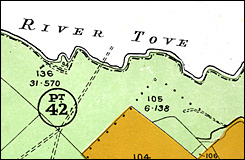
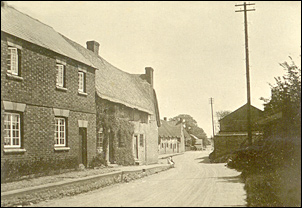
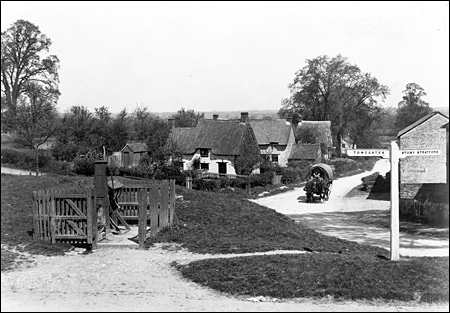
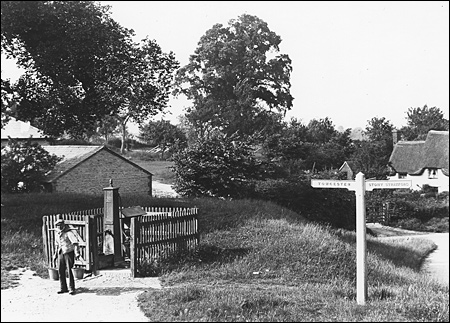
The village grew up on either side of a road running to Northampton near its junction with a lane running to Moor End and Watling Street. The medieval lords of Yardley were the Gobion family, and the village name derives from them. A moat situated about a quarter of a mile west of the junction and which disappeared in housing development of the 1960s, would indicate the site of a manor house. There also seems to have been a castle and manor not far from Moor End. Thomas Ferrers had a licence in 1347 to make a fortalice and a park. The Crown purchased the property in 1363, but by the late 16th century it was ruinous, and the farmhouse on the opposite side of the lane came to be regarded as the capital messuage of the manor. The manor of Moor End had a remarkable long-lasting series of connections with nobility and royalty. In 1382 Richard II granted it to his wife Anne of Bohemia; in the 15th century it passed through the hands of Humphrey, Duke of Gloucester (brother of Henry V), Henry VI, Jasper Tudor the Earl of Pembroke, Warwick the Kingmaker, Henry VII and finally Henry VIII in who hands it remained until he granted it to Sir Thomas Parr in 1516. Moor End was annexed to the honor of Grafton in 1542, was part of the mortgage to Sir Francis Crane in 1628, was partially recovered but was sold by the Commonwealth in 1644, before being fully recovered in 1673. It passed to the 2nd Duke of Grafton in 1725. The Gobions held Yardley as under-tenants of the Ferrers family of Potterspury. In the early 15th century the estate was divided. Part went to the Furtho family, part was sold to a local gentleman, a third part passed down the Goodman and Sotheby families, until in 1845 it was put up for sale in several lots. Despite speculation that the Duke of Grafton might purchase the whole estate, he declined to do so. The development of the Grafton Estate in Yardley Gobion followed the general pattern seen elsewhere, except that the process of amalgamation of small units into larger units was delayed by the presence of more copyholders than in Potterspury. Things moved faster after inclosure in 1776: the 10 smallholders and tenants of the 1740s had become four large farms and a small tenancy in 1776, which by the 1840s had been incorporated to make three large farms. Yardley watermill stood on the river Tove in the northernmost corner of Potterspury parish. It passed down a chain of owners and tenants with no undue problems until the 16th century, when it gradually fell into disrepair. A succession of tenants held the mill for a lowered fee on promise of repair, but though the Crown covenanted to supply the necessary timber, it repeated failed to do so, and so the required repairs were slow in being carried out. Yardley mill finally came to the Hesilriges, whose long battle with local farmers in trying to enforce the compulsory use of the mill is covered in the History of Potterspury. Like the mill at Potterspury also owned by the Hesilriges, Yardley mill was conveyed to trustees by Elisabeth Hesilrige in 1671, but appears to have had a separate history thereafter. The Horton family were the owners until 1812, when it was sold to the Sheppards. In 1736 the mill was being described as "formerly a cornmill, now converted to a papermill", though when the change in use took place is not clear. The tenants for most of the 18th century were the Radcliffs (or Ratcliffes). In 1786 they were succeeded by the Northampton papermaker William Hayes, whose family ran the mill till 1831. A series of short-term tenants followed, but the mill ceased operation around the middle of the century. By 1861 farm labourers were living there, and in 1875 it was purchased by the Grafton Estate. By the time of the sale of 1920, the buildings had been demolished and the site (described as a rickyard) was part of Grafton Fields Farm.
Yardley Wharf started life as a public wharf built by the Grafton Estate in 1801on a stretch of the canal nearest the village. For the next thirty years John Roper, the Duke's steward, leased a warehouse, coalyard, and brick-kiln there, which supplied bricks, lime, coal and other goods to the Estate - in modern parlance, "a nice little earner"..... which eventually earned him his dismissal. Click here to read the special feature on Yardley Wharf. A "machinist and implement maker" named William Walter is mentioned in 1861. While for the latter part of the 19th and early 20th century, lacemaking provided employment for women, as in most villages in the area.
Other local trades included a blacksmith - Henry Smith - who from 1920 to the mid-1930s also ran a cycle agency with his son. Directories do not list carrier services until 1874 - oddly so, considering the village's position on the main road from London to Northampton. Carrier services then began to operate to the usual destinations: Northampton, Stony Stratford and Towcester, but had ended by The First World War. By the early 1930s the village was also served by the same motor bus service from Stony Stratford to Northampton which can be observed in Potterspury.
Other significant sources of employment in the last century were the railway works at Wolverton and the Pianoforte Supplies factory at Roade. Yardley had two pubs in modern times - The Packhorse and The Coffee Pot. The former was licensed as early as 1749, the latter in 1814. Both carried on until after the Second World War; the Packhorse was subsequently turned in to private residence, but the Coffee Pot, acquired by Phipps Brewery in 1887, remains open.
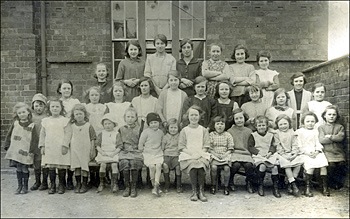
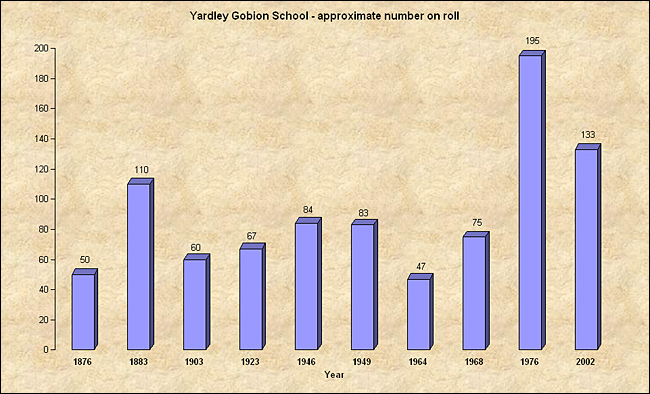
The Packhorse Inn had a longer previous history. It was the site of a medieval chapel of the Charterhouse in Coventry. After the Dissolution of the Monasteries it passed with the rectory estate to the Crown, which granted it in 1550 to Sir Ralph Sadler and Lawrence Wennington. The building stood at the junction of the main Northampton road and the lane leading to Moor End, and its remains were still visible in the 1790s, when the Northamptonshire historian Bridges visited the site. It is to him that we owe the assertion that the chapel was dedicated to St. Leonard. Proposals for a modern chapel of ease originated in 1852, when the Duke of Grafton had plans prepared. The guardians of the Union Workhouse declined to contribute to the cost, and services were held for a while in the workhouse dining hall. However, in 1863 the project was revived, the Duke conveyed the necessary land to the Ecclesiastical Commissioners, building went ahead, and the church was consecrated on December 22, 1864 - originally to be dedicated to St. Gregory, but in respect to Bridges' assertion, this was changed to St. Leonard. On its opening, the Duchess of Grafton presented the church with a new set of communion plate. Lady Charles FitzRoy had a stained glass west window put in in 1903, in memory of her husband, the second son of the 4th Duke. The widow of the 6th Duke added a stained glass east window in 1903, in memory of her husband, and an oak reredos in 1904. Yardley Gobion was the site of the above-mentioned Potterspury Union Workhouse, which served a number of villages in the area. Its story is told in more detail elsewhere in this section and can be read by clicking here. It opened in 1835 - the first in the county, built at the expense of the 4th Duke of Grafton as a conversion of existing estate buildings. Following the death of the matron and the retirement of the master, it closed in 1917 for the duration of the First World War, and did not reopen. The premises were sold in 1922 and the Union was dissolved in 1930. The building was converted to residential use. Education in Yardley Gobion can be traced back to at least 1779, when the 3rd Duke of Grafton was paying for the schooling of twelve poor boys from Potterspury and Yardley Gobion. In 1791-2 the Duke built a schoolhouse in Yardley, and this functioned until a National School was opened in Potterspury in 1817. This remained the only public elementary school serving Yardley Gobion until a school for infants was opened in 1876 on land provided by the Duke of Grafton. Initially, both boys and girls were to transfer to Potterspury at the age of seven, but by 1883 only the boys were moving, as the girls' school at Potterspury was overcrowded, and an additional classroom had to be built at Yardley. Further building occurred in 1891, but the disruption and changes in the staff impacted dramatically on teaching standards and the Inspectorate threatened to withhold the school's grant and even recognition. A change of head in 1901 led to sustained improvement, and the following year Yardley became an all-age school for both sexes.
The Second World War was a difficult time, evacuee children arrived from London and Ipswich and a branch of Fegan's Home in Stony Stratford opened at Yardley house. Organisation of the school proved difficult with a disproportionately large number of lower-age boys from unhappy backgrounds, but the school was praised for the work it did. Post-war reorganisation, then the closure of Fegan's Home and Yardley House, affected numbers badly, but the significant degree of housebuilding in the village raised the numbers dramatically. The school moved to new premises in 1968, and the old school building reverted to the ownership of the Duke of Grafton, and was later converted to residential use.
|
||||||||||||||||||
|

