|



|
Adapted from The History of the County of Northampton Vol.V - Cleley Hundred (ed. Philip Riden)
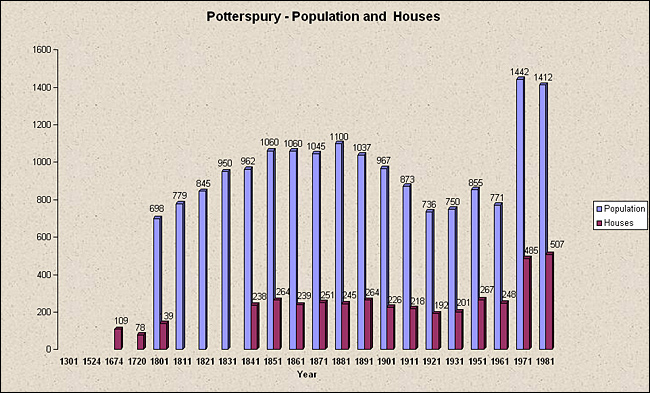
A Brief History of Potterspury The parish of Potterspury contained two hamlets: Potterspury and Yardley Gobion. Some Grafton Estate surveys from the 18th century link the two, but from earlier times the two settlements kept their own poor, maintained their own roads and had separate parish constables. The boundaries between the two established in the 19th century probably reflect the earlier medieval divisions. The occasional merger of the two in data collection and returns makes disaggregation difficult at times - as happens elsewhere on the Grafton Estate. Wakefield Lawn and Potterspury Park, though separate from the two parishes, were common to both, and paid rates to each in equal measure. The area of Potterspury Park - which originated in a grant to William de Ferrers, Earl of Derby in 1229 - had been formed when it was amalgamated in the 16th Century with Grafton park and Plum Park near Paulerspury. It remained in the hands of the Crown till 1644 when it was sold, and therefore permanently lost to the honor of Grafton. The details on these and other parks can be found in the "Forests & Parks"; some details on Wakefield Lawn can also be found by clicking here. The population and housing statistics for Potterspury show that the village follows the same general trends as most others on the former Grafton Estate: growth in the early part of the 19th century followed by decline and then expansion in the late 20th century. In Potterpury's case the rises and falls were a little gentler - the village even shows an increase in population in 1881 - and the increases in the last decades of the 20th century were more dramtic, with the doubling in housing and population the 1960s.
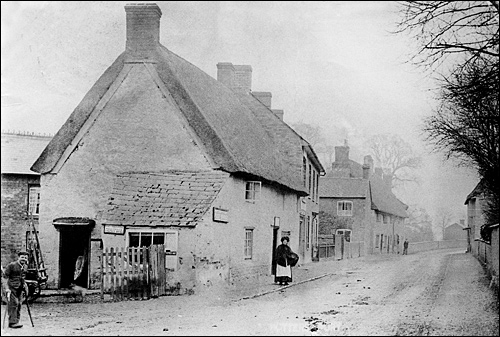
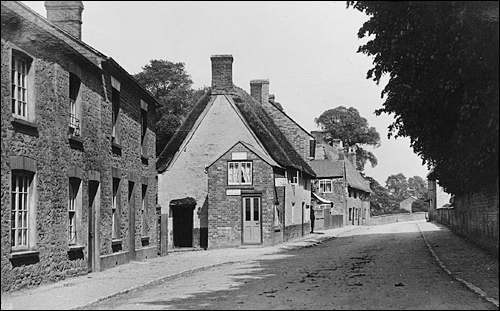
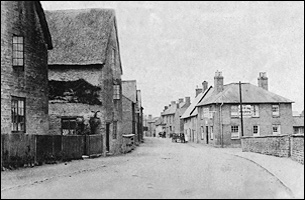
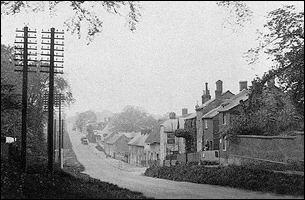
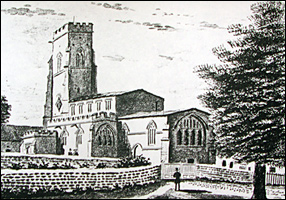
Potterspury village developed along a lane running half a mile north of the eastern side of Watling Street and roughly parallel to it. A church and a water-mill were put up near the lane, and formed the nucleus of the village which developed. By the eighteenth century there were two clearly discernible "ends" to the settlement. A cluster of houses was centred near the church on the eastern end of the settlement and became known as Lower End, later Church End. The cluster at the western end near Watling Street became known as Blackwell End.
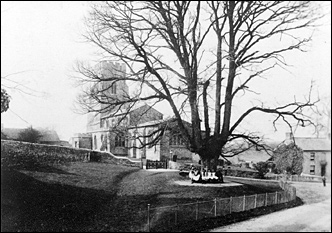
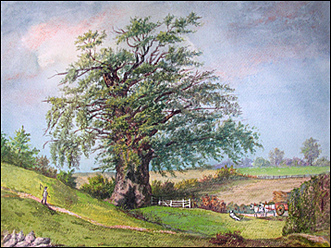
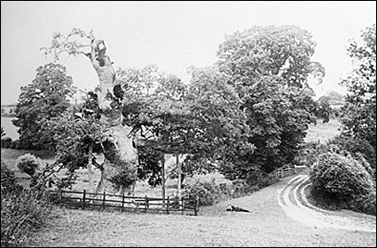
There is no recorded resident lord of the manor in Potterspury, either in the Middle Ages or later. The largest house may have been that near the church, belonging to the rectory, which owned over 200 acres of the parish in the 18th century. In 1066 "Perie" was held by Tostig, Earl of Northumbria, but after the Norman Conquest it was held by the de Ferrers family as part of the honor of Tutbury. When Robert de Ferrers rebelled in 1266, he was defeated, imprisoned and disinherited. The honor of Tutbury was incorporated into the Duchy of Lancaster, which in turn was annexed to the Crown in 1399. In the early 14th century, the manor of Potterspury passed to the Beauchamp Earls of Warwick, and despite a temporary spell as the property of the Mowbray Dukes of Norfolk when the Earl of Warwick was attainted and his lands declared forfeit in 1397, it remained Beauchamp property till it was conveyed by Countess Anne of Warwick to Henry VII in 1487. The manor with the Crown and was annexed to the honor of Grafton. It passed to the 2nd Duke of Grafton and has remained in family hands. No account of Potterspury would be complete without mention of The Queen's Oak: an ancient oak tree near Potterspury Lodge where - so the tale has it - Elizabeth Woodville stood with her two sons in the hope of meeting Edward IV and pleading for the restoration of her confiscated estates. Whether or not this happened, and whether or not the ancient tree is quite as old as the fifteenth century, is still a matter of conjecture and debate. They certainly met somewhere, and the rest is national (and Grafton) history.
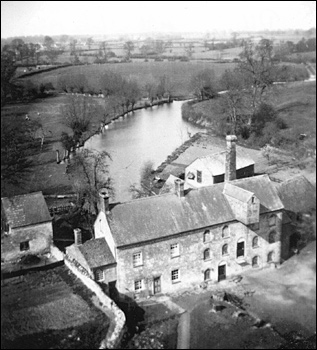
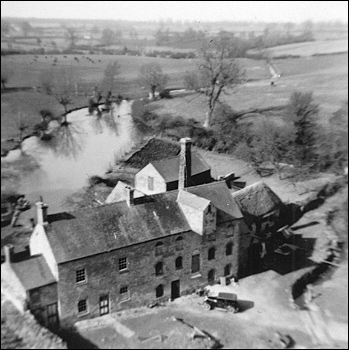
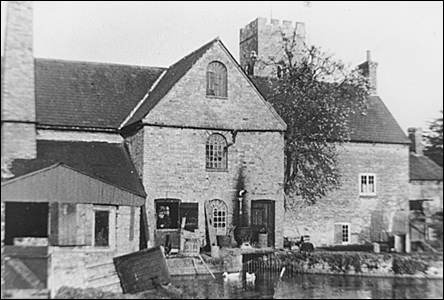
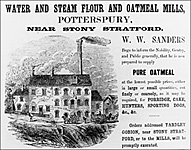
The development of the Grafton Estate in Potterspury followed the pattern of many others once the 2nd Duke's surveyors had established the overall position. The smaller farms were gradually amalgamated into larger units, and the process accelerated after inclosure in 1776. The 3rd duke made a number of opportunist purchases and consolidated his holdings: the 10 farm tenants of the 1740s had become three large farms in 1776. In 1825 the 4th Duke bought several other estates, one in Cosgrove and one in Potterspury formerly belonging to Joseph Scrivener. Further purchases in Potterspury followed in the 19th century, including the mill. A watermill was recorded in Potterspury in the Domesday Book of 1086. By 1325 "Clakke Mill" was an appurtenance of the manor of Potterspury; in 1568 it was a copyhold tenement held by Robert Packington (alias Rockingham). Two millers are recorded in Potterspury in 1585, though whether one had a windmill is uncertain. In 1591 the Crown granted Potterspury mill for life, together with the millhouse and two parcels of land, to the brothers Clarke. By 1620 the mill had been assigned to Sir Thomas Hesilrige, who had also acquired the seisin of Yardley mill. Hesilrige complained that the last surviving brother, Christopher Clarke, had built a windmill on his own freehold and allowed the watermill to decay. Worse, he had been encouraging farmers to grind their corn there or at another new windmill in Cosgrove, and not at the watermills in Potterspury or Yardley. Hesilrige claimed that this was in breach of both manorial custom and also the terms of the Crown grant in 1615, under which the Crown had covenanted not to put up any new mill within such distance of Potterspury as would damage the operation of the mill there. The accusation was denied both then and again in 1623 and 1624 when Hesilrige brought an action of conspiracy against eight local farmers who were claimed to have confederated in the building of the windmill, and enticing farmers to use the mill at Stony Stratford. In 1640, Hesilrige's grandson - another Thomas - was claiming that all the inhabitants of Potterspury, Yardley, Alderton, Grafton, Moor End, Ashton and Hartwell owed suit of mill to the two mills at either Yardley or Bozenham Mill neat Ashton and Hartwell, which his also owned. The matter only died down when a descendant conveyed the three mills to trustees in 1671. The watermill at Potterspury passed down through a number of families by sale and bequest until in 1891 the owner went bankrupt and the site was auctioned. It was purchased by the Duke of Grafton. The tenant was Job Scrivener, but in 1898 he was succeeded by Ralph Busby, who was still tenant at the time of the sale of the mill along with other Grafton Estate properties in 1920. Busby did not bid for the mill, which remained unsold at the auction. However, he remained tenant there, even past 1930 when the Duke's agent sold the mill, and by 1940 he was still describing himself as a farmer, coal and wood dealer, and miller of over 40 years standing. By 1900 the mill was steam or water driven, and in the 1930s it was converted to oil power. After the mill went out of operation, it was used for storage until the 1990s, when it was combined with the millhouse to make a single dwelling.
Apart from milling, the other industry in the parish dating from the Middle Ages was pottery making - the industry which changed the name of the village from Pury or East Pury to Potterspury. Archeological investigations have turned up evidence of a kiln in the garden of a house in the High Street, two others elsewhere, and numerous examples of pottery sherds in the village area. It would appear from fieldwork investigations in North Buckinghamshire that the Potterspury was the centre of a distribution area for a fine sand-tempered ware, which was generally buff to pink in colour, and with a grey centre. The industry does not seem to go back further than the 13th century, and it lasted until about the end of the eighteenth century. Why it did not succeed where other kilns in Derbyshire and Staffordshire did seems to be related to two things: the brittleness and lower durability of the ware itself, and the higher local cost of living which made it cheaper to import products from the other regions. Two other trades which flourished for a brief period in Potterspury were tanning and bellfounding. At least three generations of the Hillier family were tanners in Potterspury between the 1540s and 1649, and a John Woodfield is also described as a tanner in the 1550s. In 1688 Alexander Rigby, a bellfounder from Earls Barton bought a cottage in Potterspury and shortly afterwards rebuilt the premises as a workplace. Rigby's output found its way into Northamptonshire churches at Great Billing (1684) and Bainton (1702) and even went as far afield as Badgeworth in Gloucestershire. After Rigby's death the premises were converted into a malthouse, used by William Marriot who died in 1731. From at least 1738 to 1861 (and possibly later) they were in the hands of a dynasty of maltsters named Wise.
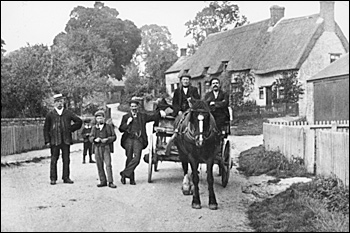
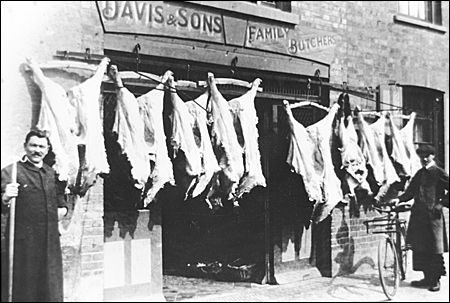
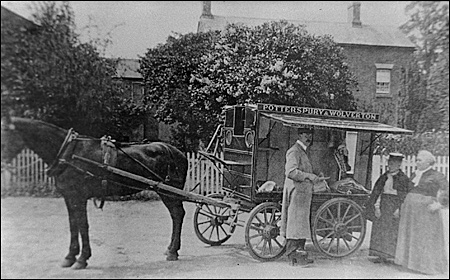
Being a large village near a busy highway and a large forest, Potterspury supported a range of trades and occupations in the 19th century, in addition to common local ones like timber dealers, lacemakers and a horse dealer. John Robinson was a hemp-dresser there in 1777; by the 1840s a William Robinson had a rope- and sackmaking business in the village, which continued in the family until shortly after 1900. In common with nearby Paulerspury, the lacemaking business flourished at the end of the 19th century (read the account of this in the history of Paulerspury) before continuing on a small scale. One celebrated exponent was Mrs Wootton, who died in 1949 aged 92, but who in her lifetime had made lace for the Royal Family. There were also local carriers. To read about one of the most famous carriers in Potterspury, click here.
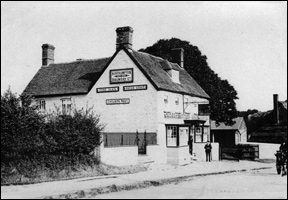
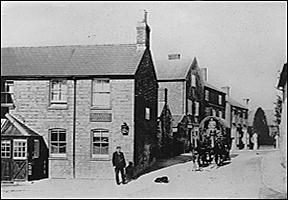
An alehouse named the Talbot was purchased in 1735, and was still licensed in 1766. In the 1770s there were at least two alehouses in the village: the Black Horse and The Blue Ball. (Click here to read more about the Blue Ball). By the 1840s there were three: the Anchor, Red Lion and Reindeer, as well as three beerhouses, one of which had become the Old Talbot by 1854. The Red Lion closed in about 1890, but the village could still boast four licensed houses up to the First World War, though the Blue Ball, acquired by Phipps Brewery in 1886, closed in 1917 for the duration of the war, and never reopened. It became a private house. The Anchor, acquired by Phipps in 1886, started advertising good stabling and catering for parties, and the three pubs were joined by a new Phipps house, The Cock, in about 1920.
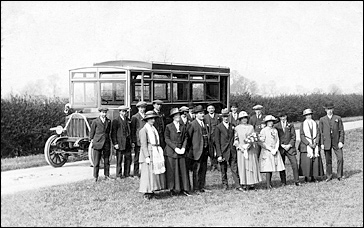
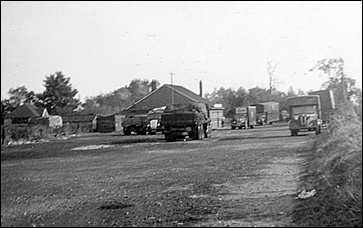
The resurgence of the trade reflects the growth in motor traffic in the 1930s, as does the subsequent emergence of Refreshment Rooms and the Nelson Cafe. Carriers operated from Potterspury to Northampton, Stony Stratford and Towcester until about 1930. By 1924 motor omnibus services began to operate between Stony Stratford and Northampton; the village had a charabanc business in the 1920s; and over the same period a garage business started which was still operating in the 1940s.
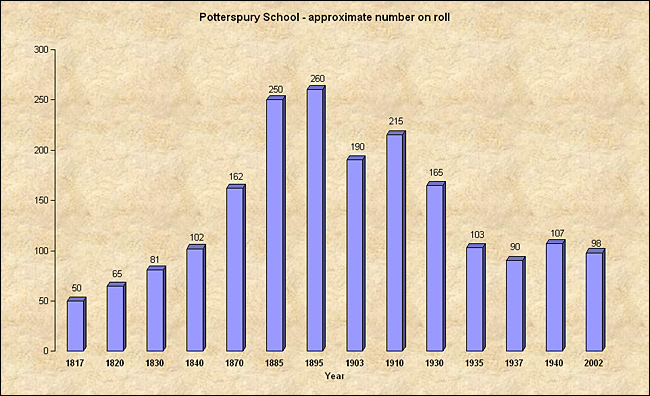
Unusually, the school was still the property of the Grafton Estate and was included in the sale of 1920. The parish had insufficient funds to purchase the building and it was offered to the county council. It reopened as a county mixed and infants school in 1924, but falling rolls brought pressure to reduce the staff. This was resisted, as was another demand on similar grounds in 1937. The arrival of 25 evacuee children in 1940 alleviated the situation. Potterspury was included as a priority for improvement in the county plan of 1947. With further reorganisation in 1949 and transfers from Cosgrove at 11 and 13 -15 year olds from Yardley Gobion, pressure on places increased again, but with the opening of Deanshanger Secondary Modern School in 1958 reorganisation followed and Potterspury lost some of its facilities. Increased housebuilding in the 1960s brought renewed pressure, but this eased when Deanshanger became a comprehensive school and pupils from Potterspury transferred at 11.
|
|||||||||||||||||||||||||||||||||||||||||||||||||||
|

