|



|
Northamptonshire Past and present Vol. VI, No.3
The Medieval Hermitage of Grafton Regis
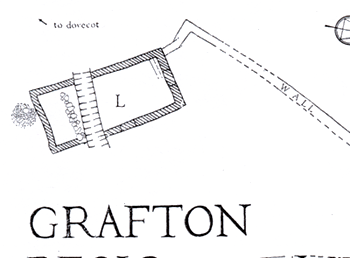
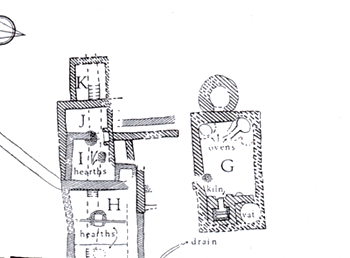
In 1964 and 1965 an archaeological excavation directed by Miss Christine Mahany and financed by the department of the Environment was undertaken in a field adjoining the village of Grafton Regis. The remains of a small religious house, constructed in the traditional manner, were uncovered: a pillared cloister (measuring 34 by 25 feet internally was flanked by a chapel (measuring 48 by 15 feet internally and containing fourteen graves); there were several other buildings around the cloister, some of them two stories high; and beyond lay a dovecote, outbuildings perhaps used as a hospital, and a complex containing ovens, a drying kiln and an emplacement for a brewer’s vat. Among the finds were a leaden papal bulla of Nicholas IV (1288-92) and a number of fifteenth-century tiles bearing the coat-of-arms of the Woodville family and of the royal house of York. But what was it? No popular memory of a priory or hospital on the site has survived, and nothing was found in the course of the excavation which offered positive identification to marry historical and archaeological records. It is virtually certain, however, that the site excavated was the “Hermitage of Grafton”, a small religious house of the Augustinian Order. Admittedly the nineteenth-century antiquarian George Baker, confidently situated the Hermitage in Shaw Wood, three miles from Grafton Regis; but Baker based this topographical attribution on a single document-a will of 1434-and even there the context does not in fact indicate the house’s location with certainty. See: Lords of the Manor - Thomas Widevill 1434 - Will. Earlier documents, however, always refer to “the Hermitage of Grafton”, and sometimes to “the Hermitage of Grafton iuxta Alderton” –and the site lies precisely between these two villages. It is most unlikely that another considerable religious house existed so close to our site, even though Northamptonshire is particularly rich in them; and it is equally unlikely that a house as large as the one excavated at Grafton should have entirely escaped notice in every surviving historical source. The assumption that our site was the Hermitage receives support from two scraps of evidence. First, the historical record shows that the Woodville family were the patrons of the Hermitage, and our site contains unmistakeable signs of the signs of the family’s presence – the crested Woodville tiles. Second, a description of the villages of Grafton and Alderton prepared by the crown’s surveyors in 1558 mentioned a small wood in the area where the excavation took place, called, significantly, “Ye Armitage Grove”. This as firm a link between the archaeology and the history of our site as we are likely to get. The earlier reference to a hermitage at Grafton comes from an undated charter of Abbot Walklin (1180-1205) of St. James’s monastery at Northampton: it was witnessed by “Helia, hermita de Grafton”. Hermits were so common in Angevin England - there were probably more of them there in any other country save Italy - that even though nothing further is known of Helias himself, we can make certain assumptions about him. The fact that he witnessed the charter of an Augustinian abbot suggests that Helias was living under the Augstinian rule ( the shortest and vaguest of the three current). He may even have begun his religious life at St, James’s. which had itself only been founded in the 1140s, and later followed a call to solitude. Monastic authorities tended at this time to look favourably on the eremitic way of life and sought to established and strengthen contacts between the hermits and themselves (partly though conviction and partly because the existence of a celebrated holy-man among their number, whose remains could be returned to the parents abbey at his death, increased the prestige of their house, and might thus help to attract new recruits and even new donations). In the course of the thirteenth century, the Hermitage came to be occupied not by one solitary recluse but by several. By 1256, and perhaps a little before, a small religious community under a Master was living there; and in 1286 we have the first recorded induction of a new master (Richard of Herleston, chaplain) to the “corporal possession of the said hospital”. The bishop of Lincoln, in whose diocese Grafton lay, enjoined the “brothers and other ministers of the said house” to obey their new master, who had been presented to the post by a local landowner, James Wydville or Woodville. It was perhaps Herleston who presided over the building of the Hermitage, with its chapel, cloister and dormitory (all of them clearly thirteenth-century work), and who received donations from three local landlords for the “Hermitage of St. Mary and St. Michael”: three undated charters from the reign of Henry III (1216-72) bestowed an annual revenue of 8s. 10d. for the support of the “master and brothers” in perpetuity. Almost certainly, a further endowment came from the patrons of the house, the Woodville family, who had already founded, circa 1155, a Praemonstratensian abbey fifteen miles away at Welford (later moved to Sulby). In the early thirteenth century a branch of this family succeeded to lands in Grafton and moved there, and no doubt they shared the desire of most other knightly families in the shires to endow a local religious establishment where masses and prayers would be said continuously for them and for the souls of their ancestors. Finding the local parish church to be held by an alien abbey (Grestein in Normandy), they seem to have turned to the other spiritual centre in the village and built upon the pious work of Helias. Turning a hermit’s cell into a small convent and preserving its links with a larger neighbouring house (St. James’s at Northampton) was a sensible and safe way of ensuring that the founder’s grant would produce a longer return in spiritual benefits than a single hermit could provide. The transition from an eremitic cell to a complex of church for orations, hospital for travellers or paupers, and accommodation for the brothers was therefore a frequent one in the thirteenth century, often aided by the natural tendency for hermits to attract disciples or assistants: the terms “chantry” or “chapel”, “hospital” and “hermitage” became largely interchangeable. Although no trace of a Woodville donation has survived we may assume that one was given: on the one hand, the family’s right to present to the mastership was always upheld, indicating a founder’s rights; on the other, the cost of building the cloister, chapel and the rest must have been substantial and a large endowment would have been needed to cover it. At the death of Richard of Harleston in 1284, the community at Grafton was already thriving, for when John de Woodville presented Brother Walter Frusellu (a monk) to the mastership, the brothers of the Hermitage put forward a rival candidate of their own; but the bishop of Lincoln upheld Woodville’s right to choose the master. In 1313, after Frusellu’s death two rivals of Woodville tried to gain the right to present the next master, and the patron had to take the matter to the king’s court at Westminster before his advowson was finally upheld and “the brothers and sisters and other ministers of the house” were ordered to accept Woodville’s choice for the mastership, the priest Adam of Banfield. Clearly the Hermitage was worth squabbling over at the turn of the century; but it did not remain so. Although the Woodvilles presented a new master in 1340 (William of Radford, priest) and in 1349 (Simon of Olney, also a priest), both incumbents were instructed to serve as “perpetual chaplains”: no mention was made of any brethren at the house, nor of any hospital functions. Simon of Olney became rector of a neighbouring parish, Paulerspury, in 1364, and no new master was presented by the Woodville family, although they resided at Grafton and were extremely active in the county. Eventually, in 1370, the bishop of Lincoln himself appointed Walter Childe “priest of the chantry of the hermitage of St. Michael of Grafton” because the lay patron had failed a present candidate within the stipulated time. Childe seems to have been the last master: no further appointments appear in the very full Episcopal registers at Lincoln. Grafton hermitage had evidently become one of the hundreds of perpetual chantries in England, many of them formerly small convents no longer able to attract new recruits, which had to be totally abandoned due to the shortage of clergy after the Black Death. Yet the hermitage still possessed lands and revenues in seven villages which yielded a revenue of 35 shillings yearly, and in 1434 a conscientious patron, Thomas Woodville, tried to revive the moribund institution for which he felt responsible. In the will he had drawn up that year, a fine example of early English testamentary style, he instructed his trustees to convey the Hermitage, its lands and revenues and his right over it, for the term of fifty years, to the abbey of St. James at Northampton (the nearest house of the Augustinian order which was in a position to help the ailing Hermitage and which might feel an obligation to do so). In return, Thomas asked that the abbey should use the new revenues to maintain “five poor men and a keeper” (probably, although this is not made explicit, living at the Hermitage). Thomas’s will was disputed by his half brother and heir Richard, so that St. James’s did not receive its donation until 1442, a year after Richard’s death; but there is little archaeological evidence to suggest that the abbey ever fulfilled its part of the bargain –only a pair of spurs and a few sherds of pottery clearly belonging to this period were found. Probably, like many other religious houses at this time, St. James’s did not have any men to spare for outlying cells and instead used all available resources on maintaining the standard of service at the main complex. Perhaps in disgust, at some point during the reign of Edward IV (1461-83), the Woodville family took the Hermitage over again. This is clearly stated in a royal writ of December1483 which ordered the sheriff of Northampton to restore the house and its revenues to St. James, which had been “wrongfully and ayenst right put out and diseased” by the Woodvilles. No doubt the family, who after 1464 were the king’s brother-in-law, were responsible for the considerable reconstruction of this period discovering during the course of the excavation: the cloister was sealed off, curtailing the inhabited area, a new room with two hearths was built and the chapel was re-floored with Woodville and York tiles – all indicating a considerable investment of time and trouble on what must have been a fairly derelict building. A number of coins of Edward IV were found in the rebuilt areas of the Hermitage, indicating that it was used if not occupied; but by the time the Woodvilles fell from power, just after the king’s death, there were still no resident priest, for in the will of Anthony Woodville second earl Rivers, in June 1483, money was left “towards the fynding a preest of tharmitage”. Perhaps Rivers had used the Hermitage as a private family chapel, since the one in his house at Grafton appears to have become dilapidated: as late as 1482, Anthony was concerned to repair his “chapel” and his attorney and business agent, Andrew Dymmock was told to “goo to Grafton to se my chappell ther for such work as must be done ther”. But a few months later Anthony was executed for treason and it is unlikely that any work had been commenced. It is also unlikely that St. James’s was able to finance further activities at the Heritage after its procurators resumed possession late in 1483, for the abbey was already experiencing difficulty in maintaining its charitable obligations in Northampton. Perhaps it was formally decided to suppress the Hermitage, for no records of its survival is contained in the papers concerning the dissolution of St. James’s and its dependent houses in August 1538. The will of Richard Woodville, third and last earl Rivers, made in 1491, mentions the “old inheritance” which he had of the Hermitage – no doubt referring to the fact that his uncle Thomas’s grant to the abbey of St. James, for fifty years, was now almost expired. But he left no money for the upkeep of the Hermitage, even though several items were bequeathed to the village church (including a special bell, a “tenor”, to toll in the steeple “for a remembrance of the last of the blood”). The rest of the Woodville lands were left by Richard to the son of his sister, Queen Elizabeth, by her first marriage: Thomas Grey, marquis of Dorset. He and his son, the second marquis, either began or expanded a park at Grafton where they could hunt. By 1526, when the marquis conveyed Grafton to King Henry VIII, the park covered 102 acres; by 1558 it had expanded to 307 acres, and a survey of that year recorded the existence of “ye Armitage grove”, covering 3½ acres and apparently situated right over the excavated site. No mention of ruins was made in the detailed survey, so perhaps the Hermitage had been levelled: planting trees over disturbed ground in the new park was obviously a sensible measure. Levelling might also explain why the dressed stones of the old religious house were not used in the repair of the manor house at Grafton by the king’s surveyor of works, James Nedham. Henry VIII enjoyed visiting his new possession (hence the change in the name of the village to Grafton Regis) and he commanded several changes to be made to the house (including the construction of a bowling alley). But in the detailed accounts of the works carried out in the 1530s, although used stone was brought from a decayed castle three miles away (Castlethorpe, which was demolished specifically to provide stone for Grafton), there is no mention of any being carried across the road from the adjacent site of the hermitage. Since carriage charges were high, it is safe to assume that, had any stone been easily available at the excavated site, it would have been used. When Henry VIII looked out of the new front windows of his house at Grafton, all he saw was parkland and woods. By 1964, not even a local tradition or memory was left to identify the bewildering complex of rubble which lay just below the surface. |



|

