|



|
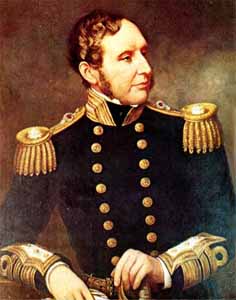
Admiral FitzRoy
Robert FitzRoy from the age of four lived with his grandfather the 3rd Duke of Grafton at Wakefield Lodge.
FitzRoy was in many ways an archetypal Victorian, a character of the highest moral standing. But his striving for perfection allowed no room for failure. Given to bouts of depression from an early age, the demons within him finally drove him to suicide on 30 April 1865. Like his uncle Robert Castlereagh, Marquess of Londonderry, the brilliant Foreign Secretary who led the British delegation at the Congress of Vienna in 1815, he took his life in a particularly gruesome way by slitting his throat with a razor. In marked contrast FitzRoy's early career was one of glittering success. From the very first he excelled in his twin passions, science and the sea. Passing out from the Royal Naval College at Portsmouth in 1819 with 'full numbers', the first student to achieve this honour, he made his reputation as captain of the three-masted brig the Beagle to which he was appointed at the tender age of twenty-three in 1828. The surveying he carried out in the uncharted waters around Cape Horn earned him the commendation of his superiors, but it was FitzRoy's decision, on his second voyage in the Beagle, to take the young and unknown natural historian Charles Darwin, a decision that was to change the history of science, that has guaranteed his fame. From the first Darwin was filled with admiration for his captain and wrote to his sister after their initial meeting: 'There is something extremely attractive in his manners and way of coming straight to the point. If I live with him, he says I must live poorly - no wine, and the plainest dinners...I like his manner of proceeding.' In the first flush of enthusiasm he even compared FitzRoy with Napoleon and Nelson and praised the way he was 'devoted to duty, generous to a fault, bold, determined, indomitably energetic, and an ardent friend to all under his sway'.
FitzRoy's second voyage on the Beagle, lasting from 1831 to 1836, had achieved the goals set by the Admiralty and their instructions to survey some of the most inhospitable coastline on earth were carried out with great diligence. Reporting to the House of Commons in 1848, Sir Francis Beaufort, Hydrographer to the Navy, asserted that 'from the Equator to Cape Horn and from thence round to the River Plate on the eastern side of South America, all that is immediately wanted has already been achieved by the splendid survey of Captain Robert Fitzroy.' Furthermore, FitzRoy completed a chronometric line around the world, 'the first that has ever been completed, or even attempted, by means of chronometers alone.' As a protege of Beaufort, he was also the first to make wind observations using the Beaufort wind scale. The only blot on the voyage was the failure of the captain's attempt to play the missionary. The four natives whom he had taken back to England after his first voyage several years earlier in the hope of educating them were returned to Tierra del Fuego where they soon reverted to their natural state.
FitzRoy's career outside the realms of science and the sea was less successful. His time as an MP was blighted by a protracted row with his fellow candidate William Sheppard, ending with both men threatening to settle their differences at pistol point. FitzRoy's governorship of New Zealand in 1843 was no more successful as he was caught between settlers and the native Maoris over the thorny question of land settlement. His reputation as a scientist, however, remained high. He was elected a Fellow of the Royal Society and his old friend Bartholomew Sullivan, who had served under him on the Beagle and was now an admiral, came to his rescue. Following the Conference of Maritime Nations at Brussels in 1853, FitzRoy was appointed Meteorological Statist (or Statistician) by the Board of Trade, a job for which he was ideally qualified. He had already shown great interest in weather conditions in his account of the voyage of the Beagle. Now his ambition was to predict the weather from a study of the direction and strength of the winds carried out over a period of months, together with an analysis of atmospheric pressure, temperature and humidity. The Meteorological Office was set up under his direction in 1854. With the help of instruments he had loaned them, captains submitted statistics on wind to assist the efficiency of navigation. Gradually FitzRoy widened the project, setting up barometer stations around the country. Morse's recent invention of telegraphic reporting ensured that this information was processed swiftly. Although the information he received was by no means comprehensive, FitzRoy believed that it needed to be used immediately in order to help save lives. This belief was reinforced by the deaths resulting from a disastrous storm in 1859. The admiral, as he had now become, began to visualise or forecast weather conditions, to use his favourite term. The information was transmitted to the newspapers, including the Times, and from 1860 onwards they printed daily weather forecasts. The following year he began issuing storm warnings. A year later he published his Weather Book. On FitzRoy's recommendation, a barometer was set up in every port so that seamen could read them by looking at the level of mercury before embarking. In 1863, the year he was promoted Vice Admiral, he was highly gratified to provide a private forecast for Queen Victoria herself, about to set out from Folkestone to Boulogne. The memorable report, dated 4 March, reads: 'weather on Friday favourable for crossing - moderate - mild - cloudy, fine, perhaps showery at times.'
But FitzRoy's ideas were not universally approved and he was criticised in Parliament and the newspapers. This criticism deeply wounded the admiral's pride and led directly to his early death. Let us hope that Michael Fish and his team, with infinitely superior equipment, never have to suffer the opprobrium that this high-minded and inventive man endured. No wonder his widow Maria could write so passionately to her MP: 'If this system of Storm Warnings is so useless and defective why do other countries eagerly adopt them? Why is it the cry of the wives of fishermen on the Northern coast of Scotland, 'Who will now take care of our husbands?' and why do the boatmen of our Southernmost ports in England say 'We have had a sad loss' - both and many others I could instance alluding to that most melancholy and untimely fate of a man who gave all for his country leaving his family nothing but his reputation.' Despite this tragic end, FitzRoy's ideas slowly took root. His barometers were mass-produced from the 1860s onwards. With their mixture of camphor, ammonia, alcohol, potassium nitrate and water, they reacted to air pressure, wind direction and the electrical charge of the air. In FitzRoy's own words: 'It should always be remembered that the state of the air foretells coming weather, rather than indicates weather that is present'. This idea was completely revolutionary. Slowly, their influence spread but it was not until 1921 that the University of Wisconsin first publicised daily weather forecasts. Next time you find yourself drifting off to sleep, soothed by the cadences of the shipping forecast, spare a thought for the great Victorian seaman to whom so many sailors and fishermen owe their lives. On 4th February 2002, the Met Office re-named the sea area Finisterre, FitzRoy, after the first ever professional weatherman. |
 Darwin had the highest respect for FitzRoy's outstanding naval abilities. His ship was fitted up with all the most modern scientific equipment including lightning conductors. It was the morose element in FitzRoy's character and his occasional flashes of ungovernable temper that Darwin sometimes found unendurable. But, whatever the strains of sharing a cabin with the captain for over five years, he was more than happy to acknowledge the chance he had been given to gather the material, in the Galapagos and elsewhere, that was to revolutionise the theory of evolution. On his return he wrote to FitzRoy: 'I think it far the most fortunate encounter of my life that the chance afforded by your offer of taking a Naturalist fell on me.' Both men wrote extensive descriptions of their epic voyage. It was only much later, with the publication of the Origin of Species in 1859 which FitzRoy saw as undermining his fundamentalist view of the Bible, that they had serious disagreements.

|
