|



|
Adapted from The History of the County of Northampton Vol.V - Cleley Hundred (ed. Philip Riden)
A Brief History of Hartwell
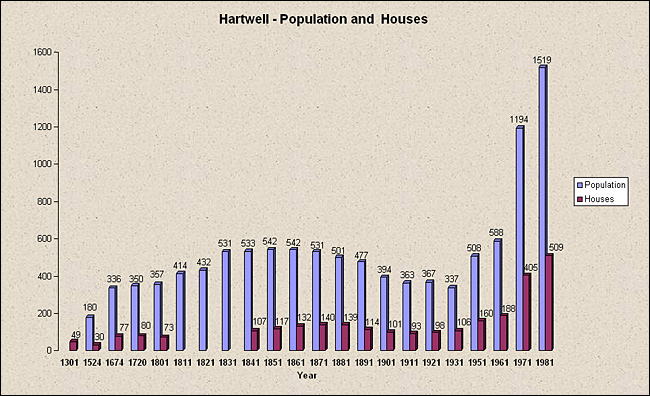
The parish of Hartwell has always been closely linked to those of Ashton and Roade, in both lay and ecclesiastical terms. Until inclosure in 1821, the common fields of the three settlements were intermixed. Though the three villages were distinguished, in 1301 Hartwell was assessed for taxes as part of "Roade with members". The lords of the manors of Ashton and Hartwell built a church at Roade and chapels on their respective manors. In 1925 the parish was united with Ashton, and in 1987 the two were united with Roade - closing the circle begun in the 13th century. In terms of growth of settlement and population, Hartwell shows an interesting mixture of gradual and then dramatic change. The population rises in the early 19th century are far more gradual than elsewhere on the Grafton Estate, and the usual decline of the 1880s seems to have carried on without any of the recovery in 1901 seen elsewhere. Radical change arrived after the Second World War. Extensive housing development and the accompanying inward flow of people meant that between 1931 and 1981 the village saw an almost fivefold increase in houses and population.
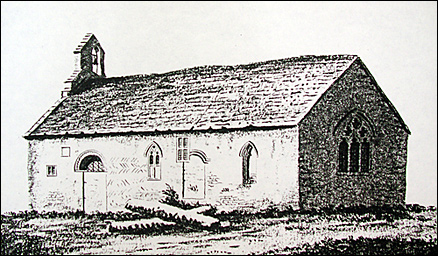
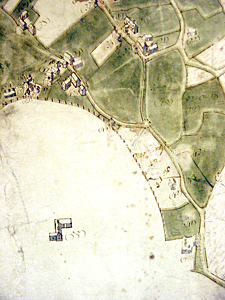
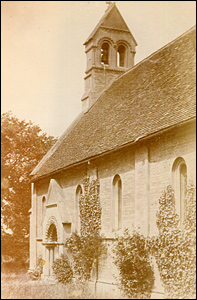
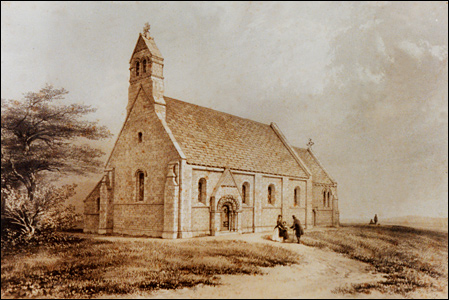
The main settlement in Hartwell in Medieval times, was a hamlet to the south of the present village and west of the road from Hanslope in Buckinghamshire to Roade in Northamptonshire. The village had a medieval chapel dedicated to St. John the Baptist. Though the village had become entirely deserted by the middle of the 16th century, the chapel survived another three hundred years, becoming absorbed - as so frequently happens across the country - into a single farmstead (in this case named Chapel Farm).
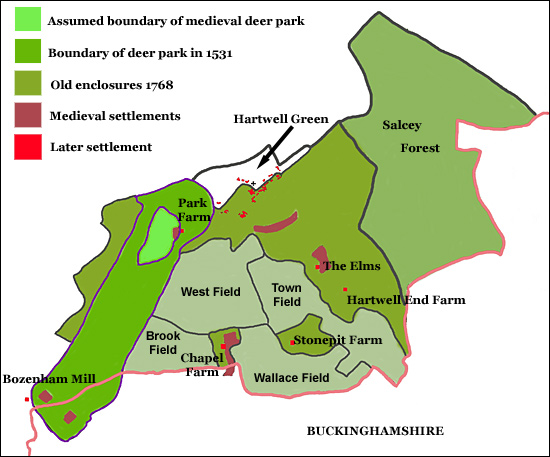
Further settlement remains have been found in the immediate vicinity of the modern village, eg. near Elms Farm and near the site of Bozenham Mill (which seems to have alternated between Ashton and Hartwell as to inclusion in a particular parish, and whose feature is covered in the section on Ashton). Hartwell village as we know it grew up to the west of the road (known as the Portway) which leads north from Hanslope to Quinton through Salcey Forest. A road from the Portway towards Ashton ran through an area of common waste, and it was on either side of this road - in an area known as Hartwell Green - that the modern village arose. The township contained three open fields and areas of common meadow, which were later inclosed in the 1820s, along with the remnants of Hartwell Green. The manor of Hartwell was the property of Odo, bishop of Bayeux in 1086, held for him by William Peveril. From Odo it passed to the Walchelins, and then by marriage to the Say family with whom it descended until 1482 when it passed to Anthony Woodville, Earl Rivers. As part of the Woodville properties it later passed to Thomas Grey, Marquess of Dorset and in turn to his son, who in 1527 gave it to Henry VIII in exchange for estates in Leicestershire. Henry VIII had also purchased Chapel Farm from the Marquess of Dorset, and the manors formed the nucleus of the honor of Grafton when that was established in 1542. The title of Lord of the Manor of Hartwell descended with the honor until 1987, when it was offered for sale by auction, though Chapel Farm was leased elsewhere in its subsequent history.
Henry VIII had also acquired Hartwell End manor in 1537, buying it from William Marriot of Ashton. This manor was also annexed to the honor of Grafton, and was centred on a house on the site of the later Hartwell End Farm. The property was alienated from the Crown by James I, and passed down through the Ouseley and Knight families to the Castlemans and then descended with the rest of their estate in the parish. South of Hartwell Green there was a small medieval deer park. This was greatly extended by Henry VIII - mostly out of the fields of Ashton, Hartwell, and Hanslope. The church incumbents of these three parishes, along with Roade, were compensated annually for the subsequent loss of tithe income. In common with titles like the rangership of Whittlewood Forest, the keepership of Hartwell Park was held by a series of peers in the 16th and 17th centuries. Among them were the Earl of Leicester in 1571 and the 4th Earl of Dorset in 1629. By 1633, however, the land had been disemparked, and became Park Farm. For more details on the park, see the "Forests & Parks" .
When the Dukes of Grafton took over the honor, change was gradual, here as elsewhere on the Grafton estate. The old leases were maintained while the 2nd Duke's surveyors went round the whole estate, mapping and assessing the size and value of the Duke's holdings. Consolidation of smaller farms into larger ones followed the deaths of relevant tenants. The eleven farms of the 1740s became seven on the early 1760s, two were amalgamated in 1773, another two in 1781. The medieval open fields were inclosed in the 1828, and Salcey Forest was disafforested. By that time Hartwell had more or less become divided between four estates of which the Duke of Grafton's was the largest. The Duke's holdings were most affected by inclosure, because almost all of his lands lay within the old open fields, and also because he was the major beneficiary of the disafforestation and Inclosure of Salcey Forest. For more details on Salcey Forest, click here, and see also the "Forests & Parks section on CD1. Immediately after inclosure, the Grafton Estate established a new farmstead at Stonepit Farm, and later put up new buildings at Grange Farm. Both were offered in the Estate sale of 1913, and both failed to sell. However, they were sold in the next sale in 1919. Listen to Charles Harry Smith talking about the Grafton Estate Sale in Hartwell
As mentioned above, the old chapel still standing at Chapel Farm did not survive the 19th century. In 1851 a new church was built in the village. In 1850 the 5th Duke of Grafton had presented the Ecclesiastical Commissioners with a site for a new church in the centre of the village. Like its chapel predecessor, the new church was dedicated to St. John the Baptist. An organ and a new set of communion plate was presented by Mrs FitzRoy of Salcey Lawn in 1853. The organ lasted almost 90 years before being replaced in 1945 by a new model, funded anonymously. For details on the Methodist Chapel in Hartwell, click here.
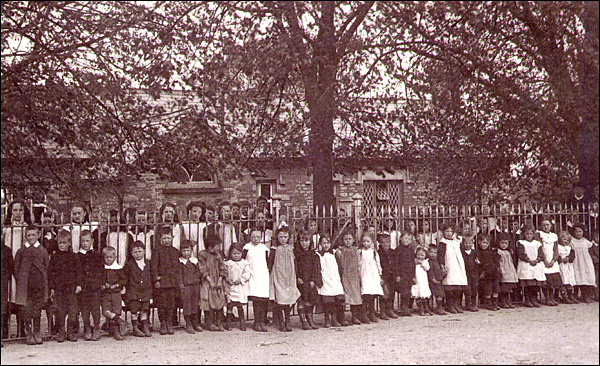
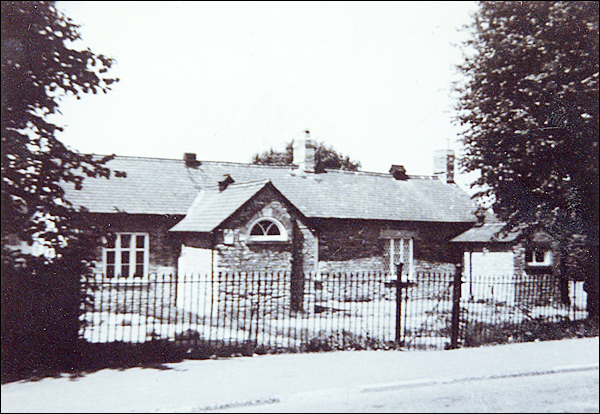
Up to 1826, the children of Hartwell were entitled to attend the endowed school at Courteenhall, but in 1826 a school for both boys and girls was established at Hartwell by the Earl of Euston, who paid the master eight shillings a week. The school was held in a house in park Road opposite Grange Farm. The Wesleyan Methodists, who had put up a purpose-built meeting house certified in 1819, also had a day school in Hartwell in 1840. In 1861, the 5th Duke of Grafton conveyed to the minister and churchwardens of Hartwell a plot of land on Forest Road on which a National School was built the same year. In 1870 the average age of the highest class was only nine, and the accommodation was inadequate for the 85 children between 5 and 9 who lived in the parish. As the school population rose, the school was extended in 1884 and again in 1894, and further improvements were carried out in 1912. The school roll reflected the decline in population in the early part of the last century, and remained an all-age school until after 1944, those as at Ashton, numbers rose in the Second World War owing to evacuee children. A new school opened in 1962, and numbers rose strongly with the growth of the village. The number on roll currently stands at over 200 pupils.
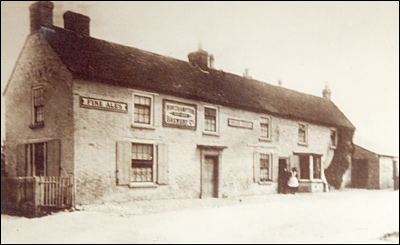
Most employment in Hartwell prior to 1800 arose in connection with agriculture and forestry, though in the 19th century the village was able to support a number of other trades and crafts, including two public houses, a couple of shops, a blacksmith and one or two shoemakers. There was also a bakehouse, and a carrier trade developed in the early 20th century. Listen to Charles Harry Smith talking about the bakehouse in Hartwell Listen to Charles Harry Smith talking about the carrier trade in Hartwell
Apart from the break-up of the Grafton estate in 1919, the most important change to the village came with the introduction of bus-services to Northampton, giving access to alternative employment. By 1931, the village was described as being "of mixed nature" , with some farm labourers, but also railwaymen and artisans who worked in Northampton. The only new work in Hartwell itself came with the opening of the sawmills belonging to D. Chapman & Sons (c.1922-1963) and E. Whatton & Sons (1916-82). For the full story on the Whatton family business, see the special feature. After the Second World War, an R.A.F. maintenance unit was active in Salcey Forest till 1957. The other main source of employment was the Pianoforte Supplies factory at Roade, and the railway works at Wolverton, though this contracted in the 1970s. Gradually, new business arrived. Important local business came in the form of the quarrying carried out first by Thomas Cross & Sons (a local coal and timber merchant), who had bought Grange Farm in 1947 and Stonepit Farm in 1955. The stone they extracted between 1958 and 1960 went towards the construction of the M1 motorway. They later demolished Grange Farm, erected warehouses and opened a do-it-yourself store, as well as continuing their coal and farming businesses. Salcey Precision Engineering Ltd., - established during the Second World War as Salcey Jig & Tool Company - was sold by the original proprietor in 1972 and moved into new premises in 1983. By the 1990s, its customers were drawn from the aerospace, electronics, food, chemicals, oil & gas, and fibre optics industries. Considering such local employment opportunities and developments, one might understand how Hartwell has managed to survive all the changes and become a flourishing village. |
|||||||||||||||||||||||

|

