|



|
Adapted from The History of the County of Northampton Vol.V - Cleley Hundred (ed. Philip Riden)
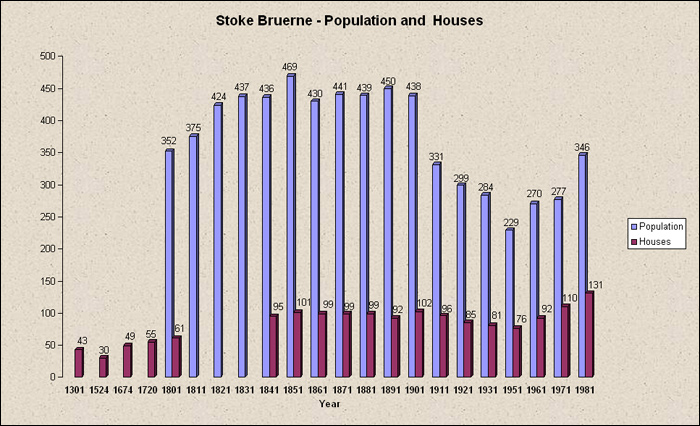
A Brief History of Stoke Bruerne The ancient ecclesiastical parish of Stoke Bruerne was made up of two hamlets: Stoke Bruerne itself, and the smaller settlement of Shutlanger to the east. For all civil purposes however, the two hamlets were treated as separate parishes for much of their existence. As the population graph below shows, Stoke Bruerne survived the agricultural downturn of the 1880s and 1890s much better than most Grafton Estate villages, though like Shutlanger there was a marked decline in the middle of the last century, before modern development reversed the trend of depopulation.
At the time of the Domesday Book in 1086, Stoke Bruerne had a manor - held by the Englishman Swain, son of Azor - which consisted of four hides, 14 villagers, 7 smallholders and a water mill. It reverted to the Crown shortly afterwards and was then granted to the Mauquency family, but later passed back to the Crown. King John granted it to the Warenne earls of Surrey, whose undertenants held the manor. By the early 14th century the manor had passed through the hands of the earls of Pembroke to the Greys of Ruthin. A number of the undertenants held also lands in the neighbouring manor of Alderton - the de Chaworths, the de Combemartins, etc. When William de Combemartin died in 1316, his three daughters were his co-heirs. Each daughter married three times and the complex co-ownerships of the manors of Stoke Bruerne and Alderton passed through a number of families including the Knightleys, the Harrowdens, the Longevilles and the Woodvilles till they were inherited by (in the case of the Woodville portions) or conveyed to Henry VIII, who incorporated them all into the honor of Grafton in 1541 and 1542. The manor then descended with the rest of the Grafton Estate till 1987, when the title of Lord of the Manor of Stoke Bruerne was offered for sale. (The lordship of Alderton was retained by the Duke of Grafton.) The only addition to the manor of Stoke came in 1841 when the 4th Duke of Grafton acquired 100 acres, divided between Stoke and Shutlanger, along with a farmhouse, some cottages, and the Navigation Inn. Stoke Bruerne lacked a resident lord, and while no evidence exists for a manor house at Stoke in either the Middle Ages or later, what undeniably did and does exist is a superior building called Stoke Park, to the south of the village. A park had been created in 1529-30, and more land was added to it following the creation of the honor of Grafton. Villagers were compensated for the loss of common land. In 1628, Charles I mortgaged much of the honor of Grafton - including Stoke Bruerne - to Sir Frances Crane (see the section on Sir Francis Crane for full details). Crane demolished part of the royal palace of Grafton to provide building materials for the erection of a new mansion at Stoke Park - a process which continued in the mid-1630's even as the mortgage was being redeemed. In 1632 Crane settled Stoke Park for his own use, and it remained in his family, passing subsequently to the Arundels and the Vernons, till it was bought in 1928, by Edward Brabazon Meade. In the Second World War, the mansion was requisitioned by the Army, and in 1946 when it was derequisitioned, it was bought by Leopold Behrmann Ltd, timber dealers. Ultimately, it was bought in 1954 by the Chancellors, with whom it now remains. Click here for Alexander Chancellor's account of Stoke Park The creation and subsequent enlargement of Stoke Park obviously disrupted farming on the estate, and at a date around 1590, the tenants, annoyed at the loss of grazing on common land, asked the steward and the rector if they might inclose an acre for every 20 acres they held on the common land. This was agreed and was a success, so much so that in 1610 their neighbours in Shutlanger asked for the same thing of Sir George Fermor of Easton Neston, provoking the wrath of the rector of Stoke Bruerne, Richard Lightfoot, whose had clashed with the Stoke tenants in 1608-10. In 1612-14, ill-feeling stirred again, with accusation and counter-accusations between the parishioners and Lightfoot, and between the parishioners and the newly-appointed Crown under-steward who was deemed to be oppressive, and who in turn accused the villagers of damage to the park, illegal inclosure, encroachment on the waste, and similar misdeeds. Things settled down, and from the Restoration of the Monarchy to the era of the Dukes of Grafton, everything proceeded in an unhurried way. There was a gradual amalgamation of the small farms in the latter half of the 18th century, till by 1760, when the Stoke and Shutlanger tenancies had been separated, there were eight farms in Stoke Bruerne. By 1776, it was four. A major agricultural reorganisation occurred in 1844, with the inclosure of Shutlanger and Stoke Bruerne - the last major area of open fields in South Northants. Again, things did not proceed without violent opposition. In June 1841, 24 local men were arrested and charged with riotous and tumultuous assembly at Stoke Plain, accused of damaging and destroying new fencing erected there on the Grafton Estate, and committing other outrages. The Duke agreed to drop the charges if the men would change their plea to guilty and agree to be bound over to keep the peace. They did so, and this brought to a somewhat anti-climactic end what may in fact have been the last inclosure riot in England. Inclosure was followed immediately by the building of three new farms on the newly inclosed land in Stoke and Shutlanger. The two farms in Stoke were at Stoke Plain and Stoke Gap and followed the architectural pattern of all farms built and developed by the Grafton Estate in the middle of the nineteenth century. (Click here for more details on the Grafton Farms). The agricultural depression of the later decades of that century left its mark, and though Stoke Gap was bought privately in the Estate Sale of 1919, Stoke Plain and Rookery Farm in the village were unsold. Stoke Plain was sold privately in 1922.
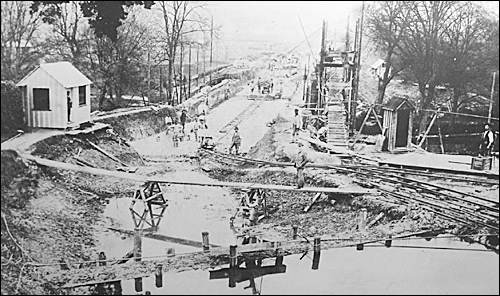
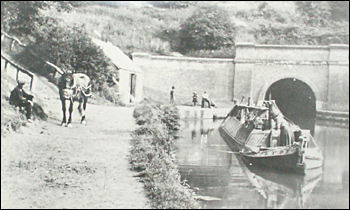
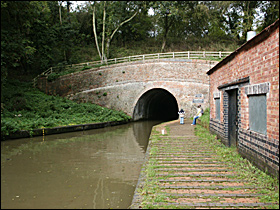
The coming of the canal in the late 1790s changed the character of the village forever. It radically altered the layout of the village, necessitating as it did the closure or realignment of lanes, the severance of contiguous land such as the glebe land (the rector insisted on an accommodation bridge being built to provide him with access), and a set of seven locks to lift the canal from the Ouse valley floor. Two of the locks were in the village and a new bridge had to be built there too. The canal reached Stoke Bruerne from the south in 1800. Barring its northward progress was the massive bulk of Blisworth Hill. The canal had been completed from its northern terminus in Braunston as far as Blisworth (on the other side of the hill) in 1796. Plans had existed for a deviation round the hill, but these involved 29 locks and a reservoir. Abandoned as unfeasible, a road was built over Blisworth Hill in 1797, and this was used to carry goods from Stoke to the wharf at Blisworth. So heavy was the tonnage involved, however, that it proved beyond the capacity of the road, and in 1800 Benjamin Outram of Butterley Ironworks in Derbyshire was contracted to build a double-track horse-drawn railway along the towpath and then over Blisworth Hill. In its five-year life it was probably the most intensively worked line of its kind in Britain.
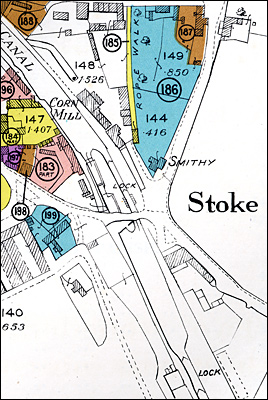
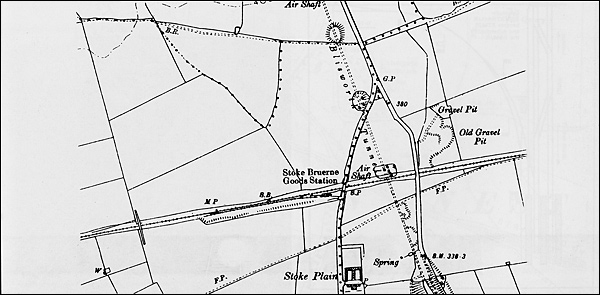
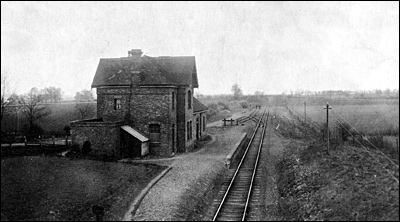
Work had begun on a tunnel under Blisworth Hill, and this resumed in 1802. The tunnel opened in 1805, and the tramroad was taken up. Competition from railways in the 1830s prompted improvements to the canal, and to speed up traffic through stoke Bruerne a second parallel set of locks was built, which in the village meant building a wider span bridge to carry the main street over the tail of the new lock, which was to the east of the original one, as seen in the diagram above, which also shows the ancillary development whiz occurred, such as the corn mill with cottages for the employees, a rope walk, and a smithy. On the west side of the canal by the mid-19th century there was an inn (the Boat Inn - marked Lot 183 on the diagram) with stables, a coal yard, wharfinger's house and office. Further to the south, and still on the west side of the canal, there was a brickyard for much of the 19th century. Further development in the village over this period included the building of cottages by the Grafton and Pomfret estates, as well as a Wesleyan Methodist Chapel (see below). The rope making and brickmaking trades (see more details here) were both canal-related at Stoke. Ropemaking began in the 1850s with John Amos, and was continued by his son Thomas till the late 1920s. A Joseph Ludlam opened a brickyard and supplied bricks during the construction of the Blisworth Tunnel, but was sent to prison in 1805, the year the tunnel opened, whereupon the yard closed. In 1846 George Savage, who occupied a commanding trade position in the area, having interests in a number of local enterprises, (being a miller, farmer, butcher, and coal merchant, as well as the owner of the Navigation Inn) established a brickyard south of the canal bridge. After the closure of the inn in the early 1850s, Savage confined himself to farming and brickmaking, and by the 1860s the family business had other yards in Towcester and Blisworth, and by 1910 in Greens Norton too. His two sons continued to trade after his death in 1899, and bought the yard - which was rented from the Duke of Grafton - when it came up for sale in 1919, but after only a couple of years the business closed. The Northampton Builders Chowns took over the site in 1946 and installed new kilns, but within a couple of years the yard closed for good. The Estate Sale of 1919 caused a radical change to the local economy, and to the canal trade in particular, which had to adjust to the loss of bulk orders from one single large customer. By now, the use of lorries was making inroads on the trade of supplying farmers, and boatmen were leaving the canal for better pay and conditions in the factories at Northampton, the Piano Supplies factory at Roade or the railway works at Wolverton. The inter-war years of the Depression did nothing to help: attempts by the canal company to develop a limestone haulage trade (by opening a quarry near the top lock at Stoke) failed. Trade picked up a little during the Second World War, but in 1953 the entire canal was without any warning faced with the threat of closure. In the harsh winter on 1962-3, no proper arrangements were made for ice breaking, and the whole carrying trade disappeared soon after, save for a little specialised traffic. In common with many former industrial and agricultural parts of the country, respite arrived with the growth of the leisure industry, though this caused pressures of its own. Pleasure cruising grew in the 1950s, and Stoke was always one of the most popular mooring points on the canal network. In 1963, a canal museum opened in the former corn mill, based on the collection of Jack James, who had been the new lock-keeper in 1947. The Boat Inn was modernised in 1960, and a tea room opened in 1963. The growth in visitor numbers began to alarm the parish council, and for the next twenty years there was prolonged hostility between the council and British Waterways over the latter's repeated proposals for the development of the canal museum and ancillary services. At least the canal fared better than the railway which served Stoke Bruerne. A line from Towcester to Olney was authorised in 1879, but it was 1891 before it opened. A fairly substantial station building was erected to serve Stoke Bruerne. It opened in December 1891 ...... and closed the following March, having had very few passengers. It remained open for goods services until 1952.
The line itself continued in use, and saw quite heavy traffic in the period of the Second World War, as freight trains from Bristol carried bananas to London on a country route which avoided the main lines into Paddington, and earned the line the local nickname of "The Banana Line". Post-war freight traffic declined, however, in common with many rural branch lines, and final closure came in 1958. The station building was subsequently converted to residential use.
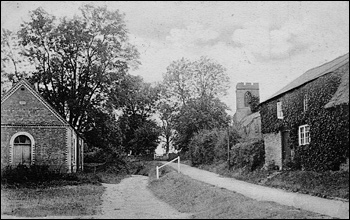
A Wesleyan Methodist chapel was built in 1846. It was replaced in 1879, by a new chapel erected on land given by George Savage (see above) whose firm supplied the bricks. By 1900, the chapel was free of the resulting debt. In 1922 the members of the Chapel were drawn from communities other than Stoke Bruerne and Shutlanger They included Blakesley, Greens Norton, Bradden, Hartwell, Silverstone, Alderton, Caldecote and Towcester. Between 1947 and 1952, the congregation carried out major repairs, including the installation of electric lighting to the chapel built in 1979, and fabric repairs to the earlier building of 1846, which had later been used as a schoolroom. A Coronation Committee grant in 1953 allowed electric lighting to be added to the schoolroom, but in 1961 it was agreed to sell the schoolroom and use the proceeds to improve the chapel. By 1974, however, a suggestion was made to close the chapel and transfer the members to Roade or Shutlanger, whose congregation had generally been consistently higher than Stoke's. Despite opposition from those who wanted to keep a free church presence in what was becoming an expanding village, the decision to close was taken by a majority of only one in November 1974. The sale was completed in 1976, and the majority of the members moved to Shutlanger. The chapel building was subsequently used as a museum of agricultural bygones and then a tea room - still its current function.
A schoolmaster named John Smith is recorded in 1777, and in the early years of the 19th century there were several lace schools in Stoke, where girls (and a few boys) were taught lacemaking and were also supposed to learn to read and write. There were two infants schools in Stoke in 1833, as well as the lace school and a Sunday School which had been established by the rector, Philip Lee. Lee applied to the National Society for funding to build a room for the Sunday school, and on being told that assistance was only given to day schools, he revised the plans, obtained a site from R.E. Sheppard, which was conveyed in trust to the rector, the 4th Duke of Grafton, and F Vernon of Stoke Park. A grant of £50 was forthcoming from the National Society and the new day school opened in 1840. The school received a favourable report in 1867. Between 1880 and 1882 a new classroom, master's house and entrance porch were added, the necessary land being given by the 6th Duke of Grafton, and in 1897 the Grafton Estate gave land to enable the playgrounds to be enlarged and new toilets to be built behind rather than in front of the buildings. Further improvement work was completed in 1912. When Shutlanger school closed in 1916, Stoke school numbers rose, though the next two decades became times of difficulty as the numbers fell in line with the population downturn which is shown in the graph at the top of the page. The school was also facing the imminent loss of all pupils over 11 to a larger school at Roade. Matters were worsened by a rift between the rector and the lay managers which culminated in a unilateral proposal by the rector in 1933-4 to transfer the school in its entirety to the local authority. The bishop intervened to prevent him pursuing this particular course of action. In 1944 the rector reported that under the terms of the 1944 Education Act, the school would close, with the transfer of the children to either Paulerspury or more likely Roade. The following year, the local authority confirmed the probability of closure under the county development plan, saying it would likely be in the late 1950s. However, the school was to prove more resilient than expected. The school was brought up to modern standards; the new headmistress in 1955 showed resourcefulness in her teaching methods and the institution of open days for parents and visits for the children. The school received an excellent inspection report in 1960; further improvements and links with the community were brought about by the next headmistress, and the school continues to this day - probably the one institution apart from the parish church which has survived the changes over the years.
|
|||||||||||||||||||

|

