|
Extracts from
Fifty Years of Foxhunting by J.M.K.Elliott
Published 1900
|
|
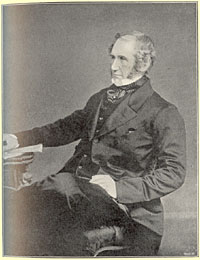
J.K.M. Elliot
Mr. Elliott recalls his time with the Grafton Hunt in great detail.
Born on the Grafton estate, at a very early age I was sent hunting by my mother on a pillow, in front of the head groom; and having persistently followed the Grafton Hounds for so many years, I may reasonably call my self a “Grafton” man.
|
George Carter
In the year 1833, during my early boyhood Carter was first whipper-in to Ned Rose; he left for a time, and went to the Oakley. Ned was not successful, and let the hounds get out of repute, so he gave up. Carter was engaged, and came as huntsman, but he found the hounds so bad that he went to the Duke after the first season, and told his grace he was afraid he should not give satisfaction. The Duke, with his usual urbanity, said, “Carter, I am quite satisfied with what you have done.” From that time Carter took heart, and made a pack that was of the highest character.
|
|
Adam Sherwood, Chimney-Sweep and Sportsman
No history of the Grafton Hunt can be considered complete which does not contain a memoir of one who was a great celebrity in his day - I mean Adam Sherwood, a sweeper of chimneys residing at Stony Stratford. He had a great taste for fox-hunting, and gained a considerable knowledge of the “Art and Science.” Living so near to the forest, he obtained a good deal of practice in the autumn and spring. He had no great taste for cross-country work; for, truth to tell, his steed was not exactly thoroughbred. Adam’s hunting costume consisted, most appropriately, of a “chimney-pot” hat, the altitude of which had been considerably lowered by repeated bangs upon the top, and large wrinkles on the sides; a green smock-frock, and corduroy continuations complete his attire. Adam always wore a smile upon his face, and had a twinkle of humour in his eye, which greatly illuminates the countenance, even if it be a dark one. He was gifted with a very pleasing voice; and when he used it it was evident that it was directed by an intelligent and active mind.
 |
|
|
On hunting days he always carried a flask. It was the first of the kind I ever saw; two glass bottles welded together at the lower ends and up to the necks; and each mouth was neatly corked; in fact it was very like one of the oil and vinegar cruets with the crossed necks. In offering refreshment to a friend, he would say, “One side gives gin, the other brandy; I am sure it is pure,” and he would name the wine-merchant. Adam became so popular that Mr. Lorraine Smith provided him with a coat of arms, which I am able to reproduce.
Adams did not in the least mind talking “shop,” or taking orders, in the field. He had a wonderful trade, and was fond of telling people how many gentlemen’s chimneys he swept. I once asked him which was his largest house. “Mr. Cavendish’s. Thornton Hall,” he replied, “it has 101 chimneys.”
One day Adams had finished his morning’s work at the Rev. Mr. Drummond’s, and was taking his money. The reverend gentleman said: “You black-coated men earn white money very quickly, Adams.” “Yes, sir; we gentlemen who wear black-coats do earn money very quickly, don’t we sir?”
Adams was fond of a game of whist, at Stony Stratford of an evening, dressed for his whist party. He put on another dress then, a good silk hat, carefully brushed, a nice cloth coat, sporting style, and such a waistcoat! Worked worsted, with a scarlet ground, and the thickest row of foxes’ teeth down the front, instead of buttons, and nicely spotted all over with foxes’ heads; which sumptuous article of apparel was worked for him by the Misses Lorraine Smith.
By dint of hard work and taking care, Sherwood made money; but he sustained a nasty blow in losing £400 by a bank failure. Nevertheless, he saved enough to retire upon, and to enable him to enjoy the repose in old age which he so well deserved. No man in his station stood higher in the estimation of all classes than did Adam Sherwood.
|
Charles Third Baron Southampton, M.F.H.
Charles, the third Lord Southampton, resided many years at Whittlebury, and held high offices in the county of Northampton.
In 1842 Lord Southampton succeeded the 3rd Duke of Grafton as Master of Hounds. Lord Southampton bought a pack of hounds of Mr. Harvey Coombe, which had previously been bought from Mr. Osbaldson, and were all bred by the gentleman. They were a very variegated pack in colour: Sailor, Saucebox, Syren, Symphony and singwell were all white. Challenger, the most vivid yellow and white. The noted Merriman nearly all black, was half-faced and had a “wall-eye”; he was by Furrier, by Yarborough Chaser, and that blood predominated in goodness during the twenty years Lord Southampton hunted the country.
In 1844 Lord Southampton engaged Ned Rose, who had hunted before George Carter for the Duke. Ned had been keeping the “Spotted Dog” (the” Talbot”) at Towcester, and subsequently “The Cock” at Stony Stratford. His upper proportions had so much increased and his legs decreased in size that he resembled a “beer barrel on toothpicks.” Lord Southampton sent Ned out in July, and asked me to go with him to Nun Wood, on the estate where I was living. We went and killed a fox, but more by accident than anything else. The hounds ran into standing corn, so they went home and remained for three weeks.
Rose accomplished his cub-hunting with credit; but cross-country work he could not manage.
Lord Southampton entertained very largely; many of the single noblemen came, and brought their hunters to the village of Whittlebury, and stayed some time. There was always a capital party. My lord lectured very much, but he was very jolly for all that. I told Lord John Scott that I would rather be blown up by Lord Southampton than praised by half the people!
Lord Southampton’s kindness had long been appreciated by his neighbours; in 1850 they had presented him with a testimonial, which took the from of a magnificent silver centrepiece representing an oak tree, which stood in the park near his lordship’s house, with deer underneath it. It would have been even larger if the subscriptions had not been limited by his own request.
Charles, Lord Southampton, was brother of the 3rd Duke of Grafton.
Find out more about the 3rd Duke
|
|
|
Dick Simpson came from Puckeridge; but I think he had spent a year on a farm he had just bought before coming. He had the character of catching his foxes too quickly. The Grafton foxes when they get upon their legs require some catching. He was nicknamed “Dirty Dick,” which was a slander, for, beyond carrying a dab of mud in the hollow of his ear for two or three days, there was nothing to complain of on the score of cleanliness. A more civil man there could not have been, and he had, as a rule. A shy, retiring manner. After a fox fresh found he was a demon, with a charming voice, and a fine-toned horn. He delighted Mr. Clarke, the Royal keeper. “Hark at him!” he would say; “he puts the ‘demi-semi’ into it!
In 1850 at the end of the season Simpson left and returned to his farm; but he was not destined to enjoy himself in his own way for long, as Lord Henry Bentinck sought him out and offered him the largest salary that ever was heard of. He hunted the Burton until he got farm-sick again then ended his most prosperous career as a huntsman.
|
After Dick Simpson left Lord Southampton kept the same whipper-in, and took his old servant George Beers back from the Oakley. Beers felt quite at home again at Whittlebury, and remained to the end of his lordship’s reign.
An advertisement appeared in 1850 in Bell’s Life that the Badminton pack was to be reduced. Of these hounds Lord Southampton bought, I believe. Thirty-three couples. Beers brought them into condition with the pack, and took them cub-hunting. They did not
please George at all. Beers made his report, my lord said he would send for Will Long to come and catch a fox with them; but nothing would move our huntsman. It ended in seven and a half couples being kept and the others sent away.
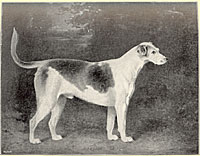
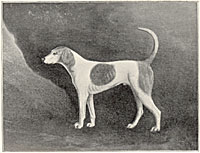
Beers always thought very highly of the Osbaldeston Furrier blood, and he left many of the sort in the pack, twenty couples at least, most of them from that capital dog marquis. Lord Southampton had this dog’s portrait painted and gave beers the picture, and also the portrait of a noted hound his Lordship had in Leicestershire, named Hazard, bred by the Marquis of Tavistock.
When Lord Southampton retired , the farmers and fox preservers regretted the loss of the noble lord, but when the time for his retirement came they were, to a man, rejoiced that the hounds were to continue in the FitzRoy family, and transferred their support to his Grace the fifth Duke of Grafton and the Earl of Euston in May 1862. Lord Southampton sold the whole pack to the late Mr. Selby-Lowndes, of Whadden Hall. The dog hounds were sent by that gentleman to Tattersall’s and were sold by auction, four couples of them returning to the old country to keep the Furrier blood in the kennel.
The Duke appointed Frank Beers to be huntsman, and the country was without hounds until the late Lord Penrhyn came to the rescue and telegraphed to his friend Sir John Johnson, “Buy Hill’s hounds!” Sir John acted accordingly, and Lord Penrhyn wrote to the Duke begging his Grace’s acceptance of the hounds. The Duke readily accepted this handsome offer on behalf of the country. With these four couples above-mentioned, and some young hounds from Mr. Drake’s the pack was formed, and the present pack at Paulerspury is descended from them.
Frank Beers availed himself of the opportunity of crossing with Mr. Hill’s hounds, and the favourite sort, and the most successful. Many a time have I heard him cheer and say, “Hark to the Marquis blood!”
|
|
|
The first Lord Penrhyn had resided at Wicken Park in the county of Buckingham, for hunting, for some years previous to the circumstance related above of his buying Mr. Hill’s hounds, by which he did all a good turn in setting the ball rolling. A nobleman is sure to be popular in any country if he is generous and helps his neighbours. His lordship was a clever man, and exercised his talents, as well as spending his money, for the benefit of others.
Lord Penrhyn hunted for many years from Wicken, and his two sons were there entered to hounds.
|
The Sixth Duke of Grafton, M.F.H.
In the year 1863 the fifth Duke of Grafton died, and was succeeded by the sixth Duke in the title and estates, as also the mastership of the hounds. His Grace hunted the country until 1882 with the greatest success.
His Grace was a kind and liberal landlord, following, in that respect, in the footsteps of his ancestors, and carrying into practical realisation the principal that property has its duties as well as its rights and privileges.
In hunting matters the Duke adhered to the system adopted by his grandfather; he was a great buyer of horses in his own country, and became the possessor of a stud which was second to none. Horse breeding was encouraged by the best of blood being placed at the service of the farmers at Wakefield. Some of the elders of the hunt used to hope that his Grace would resume the old livery, but the Duke said ‘he preferred the scarlet and did not care to go back to green.’
The hounds and horses, by the kindness of Lord Southampton, found accommodation at Whittlebury for the first season under the sixth Duke of Grafton’s mastership, whilst the new kennels on Wakefield Lawn were being built. His Grace was always held in high esteem by the farmers, who greatly appreciated his liberality in distributing game amongst them. The giving of prizes for the best puppies walked by the farmers was introduced by this Duke.
|
Frank Beers, Huntsman
Frank Beers was about twenty-six years of age when he was appointed huntsman. I had known him from the time when he was a boy of twelve years of age, having first seen him riding on a pony in the Chase, with the Oakley, to which his father was then huntsman. He soon after in top boots and scarlet, riding second whipper-in to William Smith, until there was a change to Tom Smith, a brother. He could not have been more than twenty-one years old when Mr. Oldacre engaged him to go to Russian-Poland to take a pack of hounds, and hunt the wolf for a foreign Count. He remained there until war broke out, when all foreigners were sent home. Frank much regretted the change, and it was several years before he became reconciled.
The hounds were kept at Whittlebury, until the new kennels were built. It was a great ordeal for so young a man to take the horn with a new pack.
In the summer of 1865 our huntsman’s health failed, and serious fears were entertained about him. The Duke of Grafton was so kind as to insist upon Frank’s spending the winter in the Isle of Wight. George Beers was residing at Whittlebury, and the Duke placed the pack in his charge. Such good hunters were provided that George rode just as well as ever. It was a great trial to his son to leave the pack, and he took his departure very unwillingly.
Happily, in the spring. Frank Beers returned, a new man, and was able to resume the duties of huntsman. During the next season all went well, and barring colds, and asthma now and then, Frank had a brilliant career.
At the end of the Season, 1889-90, Frank Beers’ health gave way, and his brilliant career as a huntsman ended. Tom Smith then took the horn, and hunted very much to the satisfaction of all.
|
George Sholto Douglas-Pennant
Second Baron Penryn
In 1881 it was announced that the Duke of Grafton had decided to retire from the master-ship, after hunting the country for twenty years in the most liberal manner. The announcement was received with great regret, and was quite unlooked for in any quarter. During the whole time his Grace had had the staunchest support from all landowners and farmers in the hunt. It had always been the Duke’s study to do what lay in his power to help the farmers, and his Grace was a good customer for a hunter in his own hunt. Some of the best hoses in the stud were bought of the farmers.
At the end of the season, the Duke called a meeting at Towcester, for the purpose of stating his reason for giving up, which was failing health. “But remember,” he said, “I am going to do all I can to help you after I retire.”
The Grafton farmers had a great respect for the Douglas-Pennant family; when it became evident that there was no hope of the Duke changing his mind, the Hon. George S. Douglas-Pennant was chosen as Master and asked if he would kindly take the office.
The new Master was soon at work in buying horses and making plans for carrying out his duties in a fitting manner. Mr. Robarts, a long and strong supporter of the hunt, put his shoulder to the wheel and soon bought land and built kennels. Good houses and stabling were erected by many supporters of the hunt.
Lord Penrhyn had been master for nine seasons, when he wrote a letter to J.K. Elliott Esq. Lillingstone Lovell.
Penrhyn Castle, Bangor. Jan 1st, 1891
"I really cannot find time to attend to my duties as Master of Hounds, without running the risk of neglecting business in this part of the world."
A meeting of the Hunt was called, and a vote of thanks was passed to the late Master; and universal regret was expressed at losing his lordship’s services.
The Grafton were in luck once more. Mr. Robarts and the Hon. Edward Douglas-Pennant carried on the Hunt in the old form.
|
The late Mr. Selby-Lowndes commenced to hunt the upper part of the Grafton country in the autumn of 1842. He was a great admirer of George Carter, and took Dickens, the second whipper-in as his kennelman and whipper-in.
About the year 1853 Mr. Lownes gave the country back again to Lord Southampton for a time, during which he hunted the North Warwick and the Atherstone. However, he returned and took back the country from Lord Southampton after five seasons, and it has remained in the possession of father and son ever since. In 1862 Mr. Lowndes bought Lord Southampton’s hounds, of which he retained the bitches, selling his own pack and the Whittlebury dog hounds at Tattersall’s.
It was matter for great regret that Mr. Lownes did not breed hounds enough to keep up that perfect pack of bitches, and at the time it would probably puzzle anyone to trace back to them.
Time has slipped away and the old Squire is no more; he is succeeded by a son. An expert horseman and a good sportsman; the farmers are with him, and may he live long to enjoy the hunting and his neighbours’ friendship!
|
In the month of December, 1875, Her Majesty the ex-Queen of Naples came to England for fox-hunting. Her Majesty took up her residence at a house called “Park View,” near to Towcester, and quite in the centre of the Grafton Hunt, whence she attended many of the open meets.
The ex-Queen’s first appearance in the hunting field took place at Castlethorpe. Although she was a splendid horsewoman, quite devoid of fear, had ridden at the head of an army and had been under fire, yet Her majesty had never ridden over country. Mr. Fredrick Allen, the riding master, had given her many lessons in the art, and great credit was due to him for teaching the Queen so successfully. Mr. Allen also provided the hunters; two chestnut horses called respectively Pilot and Pickles, which could not be surpassed in any way for the purpose of carrying the Queen. As time went on it became apparent that the ex-Queen was passionately fond of hunting, and the bigger the fence the better she liked it!
Riding home from Stowe-Nine-Churches one evening with the Empress of Austria and the ex-Queen I was asked if I could get them a glass of milk. Knowing a nice old farmer, a tenant of the Duke of Grafton, at Grimscote, I rode to his house, which being on a bank, prevented access on horsesback to the front door; I therefore went into the farmyard, where I met Mr. Gibbins, and told him that I had come to ask for a glass of milk for the two Royal Ladies. Of course I received a ready response, and on the arrival of their Majesties they were perforce to ride up to the back door, where the hostess appeared with a jug of milk and tumblers, and handed the refreshment over the paling where the horses were standing up to their knees in straw. The idea struck me what a nice picture it would have made! The good people were deeply sensible of the honour done them, and the Empress and Queen thanked them most graciously.
The ex-Queen hunted two seasons and part of a third, and then, owing to her Majesty’s health giving way, she was obliged to retire in the month of January.
|
|
|
|
|
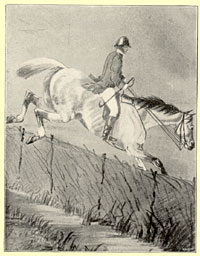
'Jonathan' - one of Dick Painter's Flyers: ridden by Frank Beers when Whipper-in.
|
|
This worthy was a well-known dealer in horses who lived at Bicester. In the exercise of his calling he gained a large circle of friends, and earned an honest living. Dick was the youngest of a family of four girls and four boys, who were left orphans while still young; and the girls, being all older than their brothers, worked hard and brought them up.
They were plodding, steady boys, but none of them showed any aptitude for business except the youngest; and two good gentlemen in Bicester, forming a satisfactory opinion of his capabilities, financed Richard, as they did call him, and enabled him to go into Wales to buy horses. From a small beginning Dick, by degrees, formed a fine connection for buying, and dealt very largely.
Being very straightforward in all his dealings, and a very amusing man besides, he enjoyed the patronage of most of the Bicester gentlemen.
Dick’s education did not amount to much, but he was full of tact and common-sense, and possessed a vocabulary all his own. He was, as before remarked most amusing. He had a brother called Jack who assisted him in his business, being a good rider, but was not allowed to do business alone; and if anyone called in Dick’s absence something of this sort would take place. The customer would inquire, “What horse is this Jack?” to which Jack, unwilling to risk the smallest show of independence, would reply, “Don’t know, ne’er ‘eared our Dick say!” One day a friend of mine, led Jack on with questions, and amongst other things, asked him, “Had any wet up here lately?” “Dunno,” answered Jack, doggedly, “ne’er ‘eared our Dick say!”
Making a further effort to elicit information, the questioner said, “Where is the nice bay horse I saw here the other day?”
“Oh! Our Dick selled ‘im.”
“Oh indeed; where is he gone?” pursued the enquirer.
“I dunno,” said Jack, “a little way up the country, t’other side Italy!”
When I paid my first visit to Dick Painter, and stated my wants, he said, “You want a gallopin’ ‘oss, I have one!” The hunter was led out and I mounted him. “There,” said Dick, “you be on a ‘oss now, he can gallop as fast as you can clap your hands, and jump like a flea!”
A gentleman who wanted a horse called at Dick’s stables, and stated his requirements in terms which indicated perfection. Dick listened in silence as the customer enumerated the requisite points, and then expressed his to supply the demand thus: “Ah! I know just what you want, sir, you want a H’Angel, and I don’t deal in ‘em!”
Dick was a great favourite with Colonel Thomas, who was at that time Master of the Horse to His Royal Highness the Prince of Wales; and the Colonel at one time pressed Dick to take some hoses to the Windsor stables for His Royal Highness’ inspection, and wrote a kind letter about quarters and so forth. Dick wrote in reply: “I ‘m much obliged, but I think I won’t!”
I myself dealt with Painter for many years, and always without the slightest misunderstanding; good animals of all kinds were obtained from Bicester.
Mr. Charles Praed had a stud of ten weight-carriers, all of which were bought from Painter, and were considered to be second to none in those days. Mr. Henry Lambton much liked the horses which he obtained from Dick out of South Wales and Shropshire. Colonel Gipp, also a hard man, bought many horses of Dick, who always called him “Mr. Colonel Gipp.”
On one occasion Dick showed me what he called “A funny ‘oss,” and of which he said, “He can go as far in an hour as will take him all day coming back!”
“What are you going to do with him?” I laughingly asked.
“I’m beggared if I knows!” was the characteristic reply.
Dick would persist in saying “Indisgestion,” which very much disturbed his two patrons before mentioned, who used very frequently to walk down to see Dick after breakfast. On one such occasion another brother of Dick’s, named George, who worked for him was passing with a server of oats. One of the visitors took a handful of them, and, calling Dick’s attention, asked him which horse they were for; and, on hearing, he said: “If you put some chaff into them he will di-gest them better.”
“I hope to goodness he won’t, “ cried Dick, “he cost eighty guineas!” The gentleman, turning to his brother, said that he must give Dick up as incorrigible.
In his latter days Dick became very ill, and sent fro Dr. Symonds from Oxford. When he came Dick said to him: Doctor, I have a bit of money and no one my very near kin; if you will undertake my case and attend to me, you may as well have some of it as any one else.” The doctor took the hint and did his best, and pleased Dick’s friends very much by relieving him, thereby prolonging his life. The gentlemen from the club used to go down every evening, after hunting, before they dressed for dinner, to tell dick the events of the day.
All the family lived to a great age, except Jack who was the only one who married. Dick said he married a woman who kept an inn, and Jack got too near the barrel!
I have bought horses from all of England and Ireland, but none better than those purchased from Painter, which came out of South Wales, Herefordshire, and Shropshire. The softest horse I ever bought in my life I obtained from Ireland, where he had been the property of a priest; and although, in deference to his late owner, I named him His Reverence, he was a cur!
Having at length brought my book to a conclusion, I must crave the indulgence of my readers, and beg them to take into consideration the fact that I was never entered for, nor intended to be an author; and I must apologise for the liberty I have taken in placing such a production before the public.
I cannot close this book without expressing great thankfulness for the number of years allotted to me, with health and strength, to enjoy fox-hunting; and hope my readers will join me in wishing success to the noble sport, which has been well termed “The Sport of Kings.”
At the end of the Season, 1889-90 , Frank Beers’ health gave way, and his brilliant career as a huntsman ended. Tom Smith then took the horn, and hunted very much to the satisfaction of all.
|
|
|