|
The Discovery of Grafton Hermitage
by Don Farrand
 On Thursday 29th August, 1963, when I was employed as a bulldozer driver, I was sent to Grafton Regis to level some heaps of spoil and rubble which covered a large area of ground. At first it was a straight forward leveling job, then, in one of the heaps the tractor blade moved the earth to uncover something that wasn't just rubble but seemed to be foundations of a building. The more I worked the blade I realized that I was uncovering something that might be important. On Thursday 29th August, 1963, when I was employed as a bulldozer driver, I was sent to Grafton Regis to level some heaps of spoil and rubble which covered a large area of ground. At first it was a straight forward leveling job, then, in one of the heaps the tractor blade moved the earth to uncover something that wasn't just rubble but seemed to be foundations of a building. The more I worked the blade I realized that I was uncovering something that might be important.
I stopped work and went to see the owner who wanted me to carry on and just level the field, which was the job I was hired to do. When I refused he sent for my employer and after a great deal of talking it was decided to contact some local archaeologists and ask their opinion. This was Friday night - so nothing would be done until Monday.
By now I was really interested so on Saturday morning I went back to work at the site which was near home. My wife and two sons decided to join me, bringing with them small brushes and trowels. In one area which we thought was the kitchen we found some broken pottery, animal bones and a great amount of oyster and large mussel shells, These were probably brought in from the coast and packed in wet moss to keep them fresh on the journey.
I was very careful in using the tractor blade as the unit weighed about 20 tons, so rather than push the soil I slowly scraped the top off the heap and gently removed the soil layer by layer.
At first we found a few loose tiles then we found the floor and carefully scraped and brushed the soil off to reveal about a 4 -5 foot square of tiles which seemed to be a large crest of some kind. All the coloured tiles laid together forming this crest. The crest was surrounded by a border of tiles. The tiles were approximately 5 inches square (I didn't measure them) and were coloured red and blue/grey on a cream background. Later I was told the crest was of the Woodville family.
On the Sunday I went to work again. My family carried on uncovering more stone work and tiles. I worked the ground and lifted out 2 large stones. On one there was carved a FLEUR - DE - LIS and on the other was carved a church cross.
That Sunday some people came and put a scaffold frame up to take photographs of the crest from above. When they had finished the crest was covered by a sheet. This did not do much good as by 7 am. Monday morning (my starting time) the crest had disappeared. Did someone steal it? No one seems to know where it is!
It was on Monday that a so called archaeologist pointed to the two large carved stones and asked me if I would break them with the dozer blade and make them smaller as he wanted them to be fitted above his new fireplace. This I refused to do as I thought they were of great importance. I understand that someone did break them later.
As the site developed and more things were discovered Gwen Brown came and was in charge of the dig. The work was done by boys from the Wellingborough borstal and they worked a 5 day week. The ones who I spoke to told me that they enjoyed the work as it was something different to do outside the prison walls. There was a shed on site in which Gwen Brown kept many of the objects that were dug up. There were knives and forks - buckles - rings and beautifully worked jewelry and many other things which I cannot remember now. The jewelry probably came from the graves for I believe some skeletons were found under the chapel floor.
On the main building I think there was a chapel, living areas and kitchens. These were the kitchens where we found the animal bones, the oyster and mussel shells, and pottery.
As I remember it the main building foundations were clean all around the building although some of the stones had been burnt. So I would think the building had been thatched and burnt down.
I haven't been over the site for many years and have not seen any plans of the dig, but looking South at the main building, I remember that on the right-hand side, were many more smaller buildings spreading up to the large fish pond.
To the left of the main building was a large rectangular building. Now this building was different as all around the foundations were Colyweston roof tiles of which many of them were burnt. So this building must also have been burnt down. So in my opinion this put this building in a different time-scale to the main building.
To the north of the buildings, down a long slope were many more foundations which were mostly of brick. Some were circular, some rectangular. I thought they were grain stores as I am nearly sure when I uncovered them there were some corn seeds near the walls.
To the south of the main buildings were a few fish ponds. All the fish ponds had stone bottoms and stone walls round them.
A short distance from the main building to the south, at right angles to the building is the remains of a long road which would have crossed under the existing road which is there now, towards the church. In the other direction the road went towards the A5.
Perhaps there is still a lot to know about the site which I discovered all those years ago!
Don Farrand
JULY 9TH 2002
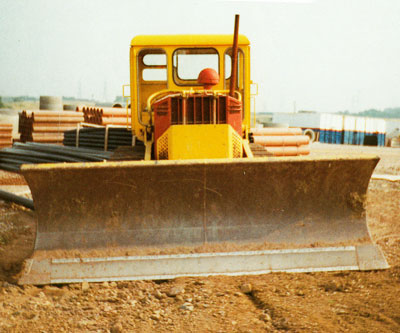
Fowler Challenger 33 Crawler Bulldozer
|




