|



|
Adapted from The History of the County of Northampton Vol.V - Cleley Hundred (ed. Philip Riden)
A Brief History of Alderton Alderton has remained a fairly small parish throughout its history, with its roots very firmly in agriculture. Settlement in the village seems to have been confined a the small nucleus around the higher ground near the church and the site of a former ringwork castle and alongside a road running in a roughly northeast-southwest direction from the main road from Northampton to Old Stratford to the former Watling Street at Paulerspury. The available data for population and housing shows that the population peaked in 1801 - far earlier than in other villages on the Grafton Estate - but then went into a steady decline which was only reversed in the period after the Second World War. However, by 1977 the size of the village and its population still wasn't back to the level of 1841.
In the section on Alderton there are several special features and accounts which cover much of its history in depth, so references and links will be provided on this page, rather than repeat all the information. At the time of the Norman Conquest, Alderton was held by Edmar and Edwin. Within twenty years it was part of the extensive holdings of Robert, Count of Mortain, half-brother to William the Conqueror. The manor remained intermittently in royal hands until it was assigned to William de Warenne in 1204. From the Warennes it passed down a line of families as lords and undertenants: the Brewers (Brueres), the Maudits, the Sauvages, the Chaworths and the Combemartins, till in 1542 it was annexed to the honor of Grafton, along with the lordship of the manor of Stoke Bruerne to which it had long been linked. Although the latter lordship was put up for sale in 1987, that of Alderton still remains with the Duke of Grafton. Alderton is the one of the very few villages in the Grafton Estate to have had a castle, as opposed to a large manor house. In this case, the castle was right in the centre of the village. The site, known as the Mount, seems to have been the location of a wooden ringwork castle from about the mid-12th to the mid-14th centuries. With the changes in military technology and the national political situation, the castle on the Mount fell into disuse. Later tenants of the Crown created an alternative residence on the lower southwest slope of the hill on which the Mount stands. After the manor was leased by the Crown to Sir John Williams in 1548 a manor house seems to have been built, but by 1567 when Robert Stafford had the lease, it was in need of repair. The major upgrading of the property seems to have been carried out by the next lessee, William Gorges, who in 1582 built a large new mansion on the site of the older property. This mansion survived about 100 year till part of it was demolished by Samuel Rolt, the then lessee. A farmhouse grew up on the site, and parts of it contained windows of the old mansion. Some fragments were still preserved when the farm was extensively remodelled as one of the Grafton Estate model farms in the mid 19th century.
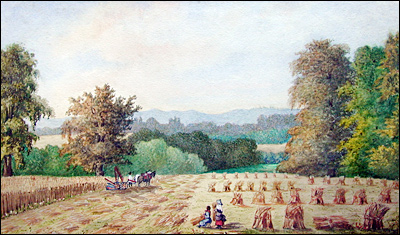
The arable land of the manor of Alderton was divided into the typical three open fields of the Middle Ages. After the annexation of the manor to the honor of Grafton, it was leased as one large unit for tenancy purposes, though it remained sub-divided into a number of farms, open fields and other holdings. The enlargement of three parks in the area - Grafton Park, Potterspury Park and Plumpton Park - in the reign of James I meant that the tenant farmers of Alderton lost some of their land. They were granted in return the common rights in the King's Close, just inside Grafton parish. The inevitable result of this was a running legal battle between the farmers of the two parishes between the 1630s and the 1660s. Once the Grafton estate proper was established under the 2nd Duke of Grafton in 1725, the usual process of consolidation into larger units began, as seen elsewhere on the Grafton Estate. By 1757 the number of farms had fallen from seven to four. The common fields were reorganised in 1780, giving each tenant an equal share. The village was inclosed in 1821. The consolidation process described here was accompanied by a second process - that of the opportunist purchasing of small freeholds, thus extending the Duke's holdings. By this means he had acquired Horton House in the 1720s - a house and freehold estate near the south of the village. The property had been the subject of a forced bankruptcy sale. Horton House became the home of one of the estate's farm tenants, and when the former Horton estate was merged with the Manor Farm holdings into one large unit, the then tenant, Robert Fountaine, changed the name of Horton House to Manor House.
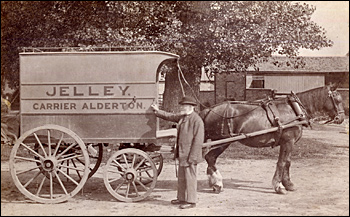
Alderton seems to have offered little alternative to agriculture as a form of employment up to the middle of the 19th century. A house near the Mount was bought by John Elmes in 1779 and became The Plough Inn - Alderton's only pub, until it closed in 1958. There is little evidence for a water-mill in the village: the one at Twyford Bridge lay in the parish of Stoke Bruerne. A windmill may have once stood in the area north of the village called Windmill Leys. Between the 1850s and 1910 the Jelley family operated a carrying business in Alderton, and from 1919 to 1952, Leonard Edwards operated a bus service from Paulerspury through Alderton to Northampton. After his retirement the route was taken over by Basfords. (Click here to read about Basford Coaches of Greens Norton). For women in Alderton in the 19th and early 20th centuries, the standby was of course lacemaking.
The only form of industrial development near Alderton is that of potash- and brick-making. In the 18th century the Bodaly family had a kiln making potash, and then it developed into a brick-making concern. The kiln was acquired by the 4th Duke of Grafton in 1818. The business grew under a series of tenants - including the Duke's own steward William Roper - and supplied bricks, tiles and other building materials to the Estate, amongst others. By the early 1840s the business was in the hands of the Foxleys, who produced large quantities of bricks for the new Grafton farm at Shutlanger Grove (click here for details of the Farm). The operation closed in 1903; the kiln building survived until the 1920s but thirty years later had disappeared. A smallholding, known as Brick Kiln Farm, has been established on the site. If things had not altered very much in Alderton over many centuries, change started in earnest in the early 20th century. Fifteen men from the village went to war in 1914 - two never returned. The Grafton Estate holdings went for auction in 1920, though many did not sell and were the subject of opportunist purchase and upgrading later. The RAF built a bombing training range over part of Alderton during the Second World War - and accidentally bombed the village one night. Farming became mechanised; new houses appeared, and the newcomers did not work in the village. The process from farming village to commuter village had started. The Church was left as the only social focus to the village when The Plough closed in 1958. Alderton had never had a village school of its own: some children were taught privately, but mostly they went to Grafton, at least until that closed in 1934 and the younger children had to go to Paulerspury (older children had transferred there some years earlier). For a full account of life in the first part of the last century in Alderton, read Mrs Fountaine's Scrapbook |


|

