|



|
Adapted from The History of the County of Northampton Vol.V - Cleley Hundred (ed. Philip Riden)
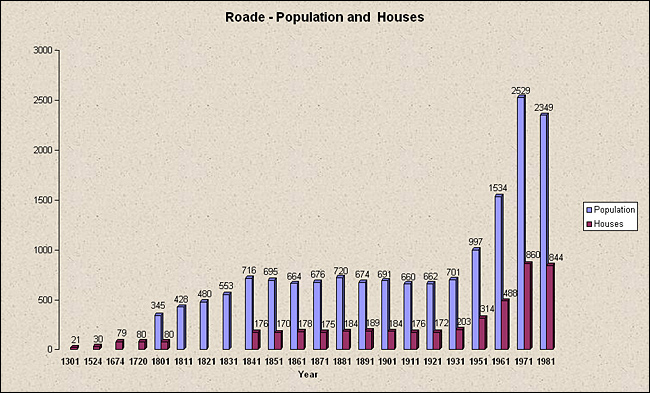
A Brief History of Roade The medieval parish of Roade also included Ashton and Hartwell. The three communities were assessed together in 1301 as "Roade with Members..." though households in the other two villages were distinguished from those in Roade. Ecclesiastically, a change came in the 16th century when the church at Ashton, which had hitherto been a chapelry of Roade, was made a rectory, and Roade was subordinated as a chapel with a perpetual curate (who was known as a vicar from the 19th century). Hartwell remained a perpetual curacy until it joined with Ashton in 1925, before all three livings were united in 1987. The common fields of the three settlements remained intermixed until the inclosure of Ashton and Roade in 1819 and that of Hartwell in 1827. Roade differs from most Grafton estate villages in that it sustained its population at around the upper 600s after the growth of the early 19th century, and thereafter almost quadrupled it in forty years. The reasons may lie in the kind of industrial development the village enjoyed, which is unmatched across the other Grafton Estate villages, with the possible exception of Deanshanger, and allowed these communities to survive the fluctuations in agriculture and broaden their economic base. Interestingly, like Deanshanger, Roade was the only other former Estate village chosen as the site for a secondary school.
The main settlement seems to have originated near the church. Roade was never an ancient manor, but seems to have been part of several estates. One was that of the Mauntells, who held lands as part of the honor of Peveril. The estates passed down through the family until the 16th century when John Mauntell was convicted of murder and executed in 1541, whereupon his lands went to the Crown. A second estate in the ownership of the de Botelers included lands in Hartwell and Ashton. This estate passed to the Knightley family, but in 1542 it was conveyed to Henry VIII in exchange for other estates. The third estate belonged to the Woodvilles of Grafton, and descended with the family until it passed to the Crown in 1527. All three estates were annexed to the honor of Grafton in 1542. A small settlement had also grown up at Hyde, half a mile to the west of the church, and had been granted to the monks of St. James' Abbey, Northampton. By the early 16th century however, the settlement had shrunk to a single large farmstead whose house dates from the 14th century. There were fishponds at Hyde and a dovecote still remains, though it is uncertain whether this is of medieval origin, or of a later date. The land at Hyde remained in private hands after the Dissolution of the Monasteries. Click here to read more about the dovecote at Hyde.
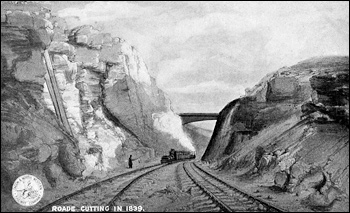
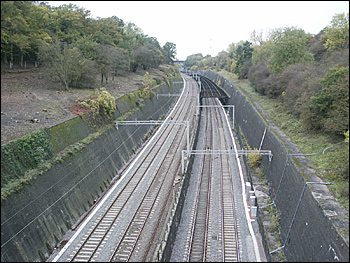
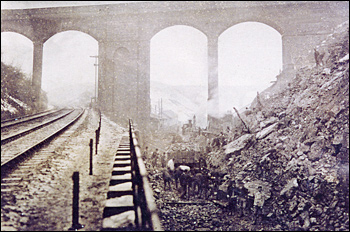
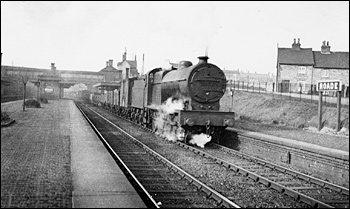
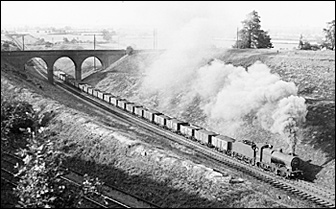
The Grafton Estate owned about half the farmland in Roade and about 30 houses in the village itself. This did not alter very much from 1723 when the 2nd Duke took charge of the honor, through to the Estate Sale of 1913. There was some consolidation at inclosure in 1819, and during the 19th century most of the Grafton holdings outside the village were down the eastern side and centred on one major farm - Blunt's Farm, which was added to through merger and consolidation. The Campions were the tenants from 1820 to the 1870s, when the farm was rented first by Thomas Williams and then by Thomas Burman, under whom the name seems to have changed to Burman Farm. Burman was succeeded first by C.A. Blunt and then by W.S. Sturgess & Sons, a firm of quarry owners, builders and brickmakers mentioned again below. In the Estate Sale for Roade in 1913, the farm did not sell, though most of the houses in the village did. It was finally bought in 1919 and almost immediately re-sold to Robert Cozens, who moved in on January 1st 1920. He built up a large dairy herd and modernised the farm, such that at his death in 1955 milking was fully mechanised and the farm had five tractors in place of five horses. The farm was acquired by C.T. Cripps, owner of the Pianoforte Supplies factory described below and was incorporated into Burman Farms Ltd by 1963. By 1995 the company owned most of the farmland around Roade and had moved into newer premises. The old farmhouse was sold for residential conversion. Though Roade was close to the newly-opened Grand Junction Canal (see the history of Stoke Bruerne for more details), this had little impact on the village's economy. Real change came with the building of the London & Birmingham (later the London & North Western) Railway in the 1830s. The line was built on land sold by the Duke of Grafton. It passed close to the heart of the village and meant the construction of embankments near Ashton and a huge cutting at Roade. Roade saw the arrival of large gangs of navvies during construction, and at the end of the process the village had a station which for a while saw much use as the most convenient station for Northampton. Early railway locomotives were simply not powerful enough to climb the gradient out of the Nene valley from Northampton, so the main line by-passed the county town on its way north through Rugby. Roade's importance as a station soon declined however, when a line opened from Blisworth to Peterborough via Northampton in 1845. Things revived a little when the line was widened from two tracks to four in the 1870s. Further major engineering work took place in the cutting, with a two lines branching off to Northampton, since newer engines were now equal to the gradient. Roade acquired a modernised station, but it was never again as busy as in the early days. In 1889, the Stratford and Midland Junction railway built a line which passed south of the town - again on Grafton Estate land - but this was only lightly used by passengers and locally was mostly used by goods trains in the 1920s carrying limestone from the quarries of Sturgess & Sons.
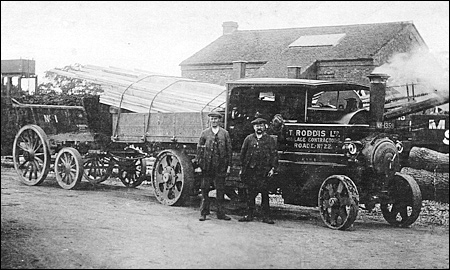
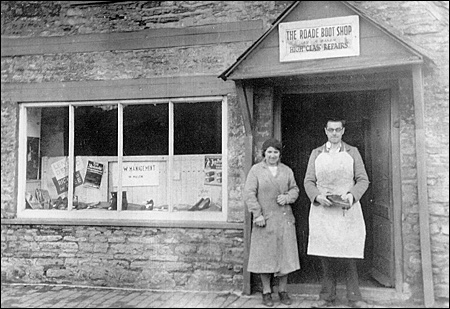
The railway might not have had quite as much long-term impact on the village as could perhaps have been expected, but the major change for Roade came around 1910 when the London firm of J. Masters opened a polishing paste factory near the station. The venture only lasted two years, and its successor the Simplex Polish Co. Ltd only another ten, but the factory was then acquired by a former Simplex employee, C.T. (Cyril) Cripps, who had set up a business in London making piano components. He took over in 1923 and expanded the Pianoforte Supplies enterprise until by 1938 the firm was employing 400 men, having survived a major fire in 1933. It has also broadened its product line and was supplying car components to manufacturers such as Austin, Morris and Vauxhall. Work in the Second World War making aircraft components allowed the company to diversify further in the 1950s. By 1953 it was employing over 800 workers, rising to a peak of 1800 in the 1960s. It continued making piano strings until 1979. The workforce declined in the latter part of the last century, but in 1995 there were still about 600 employees. Other major employers in the district in the post-war period included the RAF maintenance depot at Salcey Forest, which had an almost exclusively civilian workforce up to its closure in 1957, and the railway works at Wolverton, to which access by rail was of course direct (and free to workers there). In addition to major external employers, the village itself boasted the usual range of trades. There were carriers, blacksmiths, haulage contractors, garage owners, shopkeepers and of course for Northamptonshire - boot and shoe makers, though they declined sharply in number from 15 in 1861 to 2 in 1891. The number of lacemakers also fell in the same period, from 65 to 12.
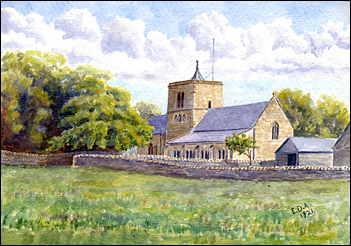
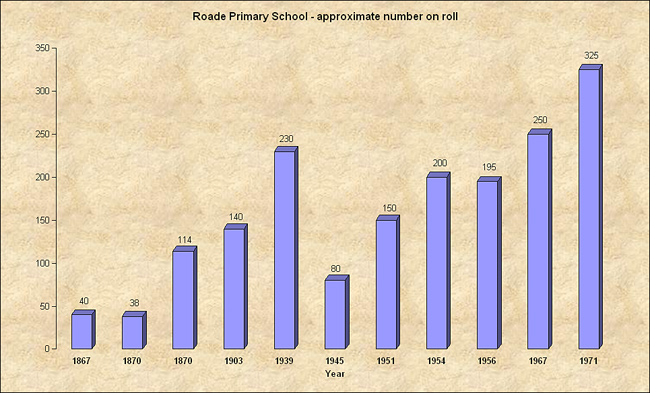
The story of the parish church of St. Mary the Virgin is told elsewhere in this section as a special feature (click here to read it), but Roade had flourishing congregations of other denominations. A Baptist Church was founded in the late 17th century, and a meeting house was built in 1737. Click here to read the Baptist Book of 1730-87. Despite difficulties in the early 19th century, the community grew. In the early 20th century baptism services were held in a stream running past Hyde Farm, which at the time was in the possession of the Warwick family who were leading members of the church. Open air services were also held in neighbouring villages. The period after the First World War saw the start of a decline in congregations, and despite an experiment of a joint pastorate with Blisworth, by the end of the 1990s the chapel was closed. The Methodists opened a new chapel in Hartwell Road in 1875 and, like the Baptists, flourished in the last part on the 19th century. They too saw a decline in congregations after the First World war, but the church still survives as an active community. The Roman Catholics opened a church in 1962, but it closed in 1990 after a new Catholic Church opened in East Hunsbury in 1989 and was more conveniently situated for worshippers from the southern fringe of Northampton. The final major story of successful growth in Roade is that concerning education. A church school developed in the mid-1840s and by 1870 the pressure grew to fund a new school, which duly opened in 1876 on land bought from the Grafton Estate and partly funded by the Baptist and Methodist congregations. The school was especially fortunate in having two successive talented and visionary head teachers who raised the standards and reputation of the school to the level of international recognition. The school had a school garden in 1907, a woodwork class in 1911 and cookery in 1917. Success came in music and gardening competitions, such that the school's gardening syllabus served as a model for a similar course in Southern Rhodesia (now Zimbabwe) and the head was giving evidence to a departmental committee in 1927 on the training of teachers for rural schools. Though school numbers declined in the 1930s, the Second World war saw the influx of 100 evacuee children and the expansion of the Pianoforte Supplies factory. Even when the evacuees had gone, major house building in the village after the war began to put continuous pressure on accommodation and a new school was opened in 1971. The long-standing reputation of the school for practical work, together with the post-war housing boom and a well-established large senior class at Roade school, made Roade the obvious choice for a new Secondary Modern School, which opened in 1956 with 332 pupils, which rose to 426 by 1958. The school saw consistent growth and went comprehensive in 1975. By the 1980s it had acquired an excellent reputation, like its primary counterpart sixty years previously, and has continued to grow, attracting new people into the catchment area.
|
||||||||||||||||||||
|

