During the second half of the eighteenth-century Britain ceased to be self-sufficient in grain. There were a series of bad harvests in the 1790s. Legislation in 1791 raised the price at which the free import of corn was permitted. The wars with France led to a survey to assess home food production. While the resulting data is not always accurate it appears that wheat was by far the main crop in Bradwell in 1801. Women and children in the area were often employed in either lacemaking or plaiting straw which was then collected and taken to Luton. The introduction of machine-made Nottingham lace in 1820, and the arrival of Chinese and Japanese plait in the latter years of the century caused both industries to go into decline. In 1838 the village was parish was crossed by the London to Birmingham Railway, with some fields on the other side of the tracks to the main farms in the village. Railway workers moved to the area and clay pits for bricks, were opened as Wolverton, New Bradwell and Bletchley grew in size.
In 1860 a local was found guilty of pinching a wheel from an outbuilding called ‘the Chapel’ which was part of Robert Adams’ Bradwell Abbey farm. In 1863 the local Methodists called for the local pubs to be closed on Sundays, perhaps not successful an appeal as James Elliott was fined for being drunk on a Sunday in Bradwell in 1883. There is an account of the Bell being used in April 1870 for an auction of local houses with ‘good gardens’, a well and outbuildings. It was used for an inquest in December 1870. In 1889 the body of a railway employee with a wife and seven children who was killed when hit by an express from Euston was taken to the Bell Inn to await an inquest. This may not have been uncommon.
Bradwell 1861 census. Lace maker May A Coley was head of a household with sons William (25) and George (20) and daughter Emily 17. She was a lace maker and the sons Engine Fitters.
Also in the village in one house were were Ann Walers 20, a straw plaiter, LNWR labourer Henry Edmunds, 20 and straw plaiter Elizabeth Thorn 61, a wife of a labourer, head of the household, Thomas aged 62.
There were 411 people in Old Bradwell in 1871 – half of them were aged under 28. Twenty were aged 70 or over. It looks as though a little over a third died before their fifth birthday.
About a quarter of the population was too young to work – they mostly stayed at school until 11.
About a quarter of the population was old enough to work but did not have a formal occupation – mainly because they were wives.
The other half of the population was working – mostly as a labourer or a lace maker. Bradwell was largely agricultural, but a fair number worked for the railway.
- 72 scholars
- 55 wives identified by husband’s occupation
- 23 sons with no occupation identified
- 20 daughters with no occupation identified
- 13 wives with no occupation identified
- 7 paupers
- 6 with no calling or occupation
- 1 nephew with no occupation
- 1 widow with no occupation
- 1 former farmer
- 1 retired builder
- 1 unemployed labourer
| Labourer (farm) | 57 |
| Lace maker | 35 |
| Labourer | 18 |
| Labourer (factory) | 13 |
| Laundress | 7 |
| General servant | 5 |
| Carriage lifter | 3 |
| Dressmaker | 3 |
| Engine driver | 3 |
| Fitter engine | 3 |
| Labourer (for bricklayer) | 3 |
| Labourer (in carriage works) | 3 |
| Plate layer | 3 |
| Straw plaiter | 3 |
| Blacksmith | 2 |
| Boot maker | 2 |
| Butcher | 2 |
| Carpenter | 2 |
| Cook | 2 |
| Farmer | 2 |
| Groom | 2 |
| Housemaid | 2 |
| Labourer (in gas works) | 2 |
| Labourer (railway) | 2 |
| Painter | 2 |
| Publican | 2 |
| School mistress | 2 |
| Shepherd | 2 |
| Labourer (at engine works) | 1 |
| Baker | |
| Bookbinder | |
| Bootmaker | |
| Brick maker | |
| Bricklayer | |
| Cattle dealer | |
| Coach maker | |
| Dairymaid | |
| Footman | |
| Gardener | |
| Gas fitter | |
| General blacksmith | |
| General dealer | |
| Goods porter | |
| Grocer | |
| Grocer’s assistant | |
| Hat sewer | |
| Labourer (iron works) | |
| Labourer (stone pit) | |
| Licensed hawker | |
| Magistrate | |
| Pointsman | |
| Railway plate layer | |
| Railway porter | |
| Railway shop worker | |
| Scullery maid | |
| Servant | |
| Shoemaker | |
| Teacher assistant | |
| Tinman | |
| Vicar |
Pubs
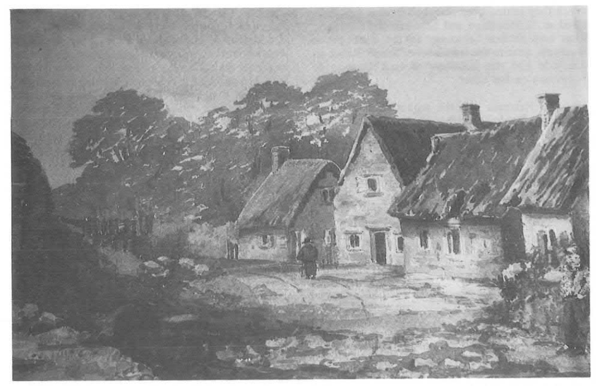
There is a painting by Col. Duncan of Vicarage Road in the mid nineteenth century is held in the Northamptonshire Record office. It shows a farmhouse occupied by John Newman in the seventeenth century, which is now the ‘Victoria’.
Source: P/639, Northamptonshire Archives and Heritage Service, Wootton Hall Park, Northampton, NN4 8BQ. Tel: 01604 526038
Rabies case
In October 1866 five-year-old Elizabeth Walters of Bradwell died of hydrophobia (the name then used for rabies). The symptoms include vomiting and violent movements and the child was strapped down. According to a witness, the rabid dog was killed and its liver was fed to the child with some bread and tea. The antidote failed as Elizabeth died a week after being bitten. An inquest was held at the Prince Albert and the jury concluded that this was death caused by hydrophobia.
The same pub was familiar with death as in February of the same year William Harper, a travelling salesman from Oxford, requested accommodation and before receiving a reply, sat down and died from what an inquest concluded was heart disease.