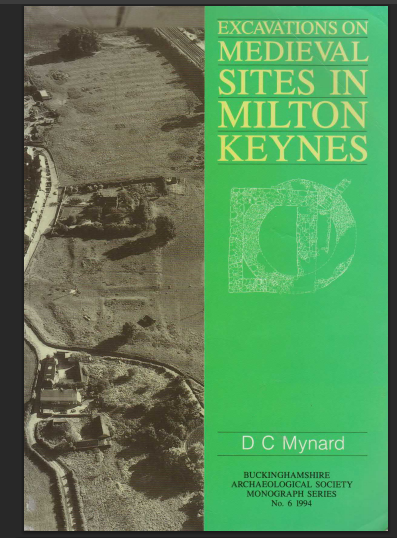
This material is from Dennis C. Mynard’s 1994 text, Excavations on medieval and later sites in Milton Keynes, 1972-1980, Buckinghamshire Archaeological Society, 1994, available here.The Bradwell site features on the cover.
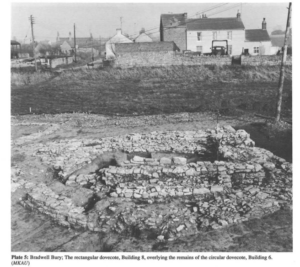
The photograph shows the rectangular dovecote, which overlay the remains of the circular dovecote.The Tithe Map shows the dovecote standing on its own to the north of the moat.
On the west side of Abbey Road there is the small moated site with the late 18thC Moat House. To the north of the moat (under Bradwell sports field the earthworks, the banks, ditches and slight mounds, indicated that the moated site had formerly extended northwards to the lane that led from the village to Bradwell Abbey Farm,the site of the medieval Bradwell Priory. In 1975 a medieval manor house was uncovered and was covered again beneath what is now the sports ground.
The Victoria County History (VCH 1927, 284-5) indicates that a late Saxon manor (which eventually became the main manor in the parish) was held in the mid eleventh century from Edith of Wessex, the wife of King Edward the Confessor by a 11th century landowner, Alviet. After the Norman Conquest it passed to Waiter Giffard.
The current theory is that there were some late ninth or tenth century timber buildings. 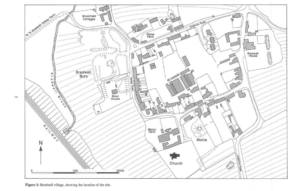
In the early thirteenth century the manor, a stone house within a substantial moated area, was held by the Barre family, who also
held the adjoining manor of Stantonbury. The d’ Aylesburys had acquired the manor by the early fourteenth century. In1423 it
passed to the Staffords. It went out of use in the mid to late fourteenth century, and may have been demolished. While the farm buildings (barn and dovecotes) almost certainly continued in use there is little evidence of activity on the site until the late eighteenth century. In the later sixteenth century Sir Humphrey Stafford sold the manor to Michael Colles. In 1603 the manor was sold by Colles to Roger Fuller of Great Brickhill, whose descendants held it for over a hundred years. In the early eighteenth century, the manor passed to Elizabeth, nee Fuller, the wife of Thomas Mercer of Hackleton, Northants.
In the late eighteenth century the ‘Moat House’ , which has
a datestone inscribed ‘T.M. 1784’ was built within the
southern end of the manorial moat. The initials are those of
Thomas Mercer, a descendant of the earlier Thomas who
had married Elizabeth Fuller in 1707. This house was
rebuilt shortly before the enclosure of the parish. This was a time
of reorganisation of the manorial farms when the reconstruction and enlargement of Manor Farm (notably the addition of the east front with a datestone of 1790) took place.
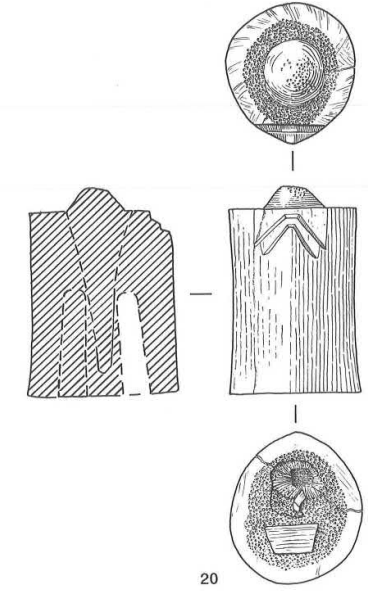
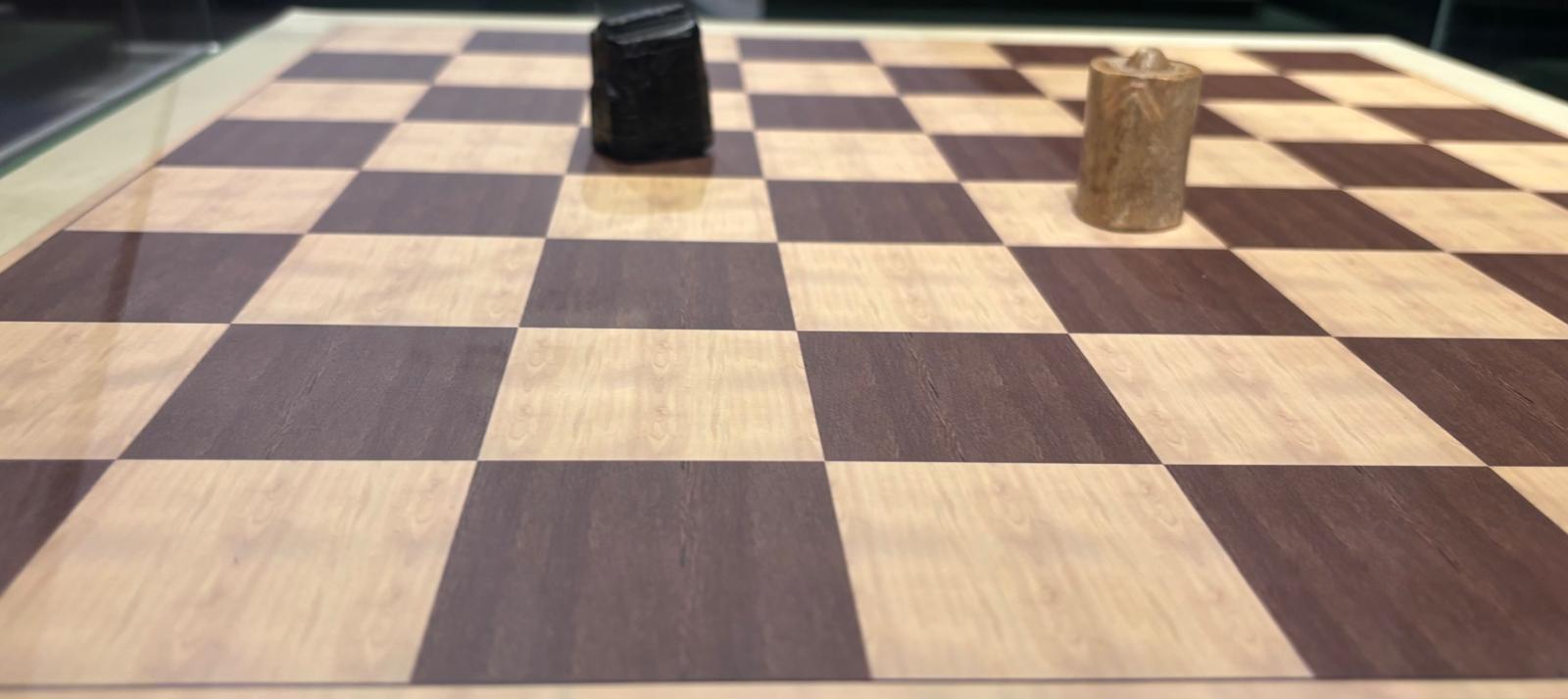
There is considerable detail about the archaeology in Mynard’s book which includes an image of a chess piece which was found in a shallow pit in the floor of the west bay of the Manor building. The bone chess piece is now on display in Milton Keynes Museum. Mynard’s description of it follows:
A cylindrical gaming piece made of red or fallow deer antler (pers. comm. S. Davis and S. Paine), with a central conical dome. Decoration is limited to two carved chevrons near the top of the main cylinder. The object has been carved from a larger piece of antler, as the area where the chevrons occur protrudes. The central conical dome is made from a separate piece of antler tine that is inserted into the main body.
Originally there were also two plugs inserted into the base of the piece. One of these is now missing but the other, trapezoidal in section, remains. The removal of the cancellous material from the centre and the plugging of the cavity can be seen with several other chessmen [..] Height of main cylinder 39 mm, height of domed protrusion 5 mm, dia. 27 mm. […]
The Bradwell Bury piece is almost certainly a chessman, although which particular one is not altogether obvious. Given its size and decoration it cannot be a pawn […] Knights tend to be cylindrical, with a single protrusion from the upper edge […] The chevron decoration may indicate that it is a
bishop, although most known examples have two projections. Alternatively it may be a king or queen.