|



|
The Ownership of Grafton
In 1066 the manor of Grafton was held freely by the Saxon Godwin, who also had estates nearby at Cosgrove and Furtho. After the battle of Hastings, the victorious Norman knights were given vast land holdings throughout England. Grafton was given to Robert Count of Mortain, half-brother of William the Conqueror, whose sub-tenant William held four-fifths of one hide, as recorded in the Domesday Book in 1086. The Normans retained strong links with their native Normandy. Some time between 1086 and 1106 (when his estates were forfeited by rebellion), Robert's son and successor Count William gave to the abbot and convent of Notre-Dame de Grestain [Greatain], a Benedictine house near the mouth of the Seine founded by William's grandfather in 1040, all that he possessed in Grafton, together with the church there. The abbot of Grestain thus appears as the tenant of Grafton in the early 12th-century survey of Northamptonshire.
Grestain continued to hold Grafton until the middle of the 14th century, at which time there were seven free tenants and 15 other tenants of the manor, the number later rising to 31 tenants. Most of the abbey's dealings with the village refer to disputes over ownership, the abbot's gift of six oaks to Grafton in 1245 being a rare exception. The abbey was generally successful in resisting the claims of various parties, including that of Walter de Wideville, Lord of Grafton (the first mention of the famous name of Woodville which was to form such a central part of Grafton's history). However, its absentee role became more complicated at the beginning of the Hundred Years' War between England and France. The patron of Grestain, Jehan de Melun, Sire de Tancarville, was captured at the Battle of Crecy in 1346, the great victory won by Edward III. This was also the year of the Black Death, and with the twin scourges of war and the plague devastating the north of France, the abbot of Grestain was hard pressed to raise a ransom for his patron. He decided to dispose of the abbey's holding at Grafton to a merchant named Tidemann de Lymbergh. Tidemann appears to have been acting simply as a middleman: in 1350 he secured a licence to grant the former Grestain estates to any English man he chose, to be held of the king by the service of one knight's fee, and four years later sold his holding at Grafton to Sir Michael de la Pole, a wealthy Hull merchant, for the remainder of the term of a thousand years. Grafton, together with some of the Grestain manors which passed through Tidemann de Lymbergh's hands, remained in the possession of the de la Pole family for the next three generations. Michael de la Pole had one of the most spectacular careers in late medieval England. In 1385 he was created Earl of Suffolk and Chancellor of England, but the following year he was impeached and convicted by Parliament with many of his lands forfeit. The proceedings against him were declared void in August 1387 but, fearing for his life, in December that year he fled the realm. In his absence he was found guilty by Parliament in February 1388 of high treason, and all his honours forfeit. He died at Paris in 1389. Nevertheless, the manor remained in the possession of the de la Pole family for a further fifty years. In 1440 it passed to Richard Wideville and his wife Jacquetta. From about this date the mansion can legitimately be called a 'manor house' as the home of the Wideville family, during which time the village was known as Grafton Wideville. A measure of Grafton's increasing importance during this period can be gauged from the grant made by Earl Rivers (as Richard Wideville had become) in 1465 of a weekly market at his manor of Grafton. Before the advent of the Woodvilles, as they came to be called, Grafton played a peripheral role in English history. Nevertheless, standing on one of the major roads from the capital to the midlands and the north, it witnessed many stirring events, including the funeral cortege of Queen Eleanor of Castile, wife of Edward I. The great medieval King, conqueror of Wales and 'Hammer of the Scots', was devastated by the death of his beloved wife at Harby in Nottinghamshire on 4 December 1290. Eleanor had been his constant companion for many years, and had even accompanied her husband on the Crusades, where she is supposed to have sucked poison from his wound. The King commanded that her body be brought to London for the burial in Westminster Abbey (although her heart and entrails were buried separately in Lincoln), and that crosses be erected wherever her body rested for the night, surmounted by statues of the Queen: hair loose, a sceptre in her hand. On 9 December the procession wound its way slowly past the village of Grafton en route from Northampton, where the original Eleanor's cross still stands, to Stony Stratford. The final landmark at Charing Cross remains one of the most evocative sites in London, though the Cross there is a replacement for the one pulled down and destroyed in the English Civil War. The cross at Stony Stratford suffered a similar fate but was never replaced. In ancient documents the Woodville family name occurs in many forms: Wideville, Widevile, Wivill, Wydeville and Woodville. It is, however, the latter version that has been most generally used in modern times. On Queen Elizabeth's tomb it is spelt Widville. Wydvilles, who claimed descent from a Norman called William de Wydville and his wife Emma, a Saxon, were in fact an old family of minor gentry who settled in Northamptonshire during the reign of Henry II. (1154 - 1189), when a Willelmus de Widviull of Northamptonshire is mentioned in the "Liber Niger Scaccarii," the earliest extant register of England tenants in Chivalry and their holdings - Woodville being liable to provide half a soldier. In this same reign, a William de Wivill held lands in Grafton for which he rendered 25/- yearly to the Abbot of Greistein [Greatain]. In the seventh year of John (1205) the Woodvilles are again mentioned. Grant to John Wedevile 13th CenturyThe Woodvilles continued to rise in local importance and in 1297 a John de Wydevill held lands to the amount of £20 yearly and upwards and as such, summoned under general writ to perform military service in person with horse and arms in parts beyond the seas. He married Alice of Passenham and from this marriage came a son, John de Wydeville, who claimed privileges in Cleley hundred in 1329. He, too had a son, Richard de Wideville, who became one of the most influential men in the country. He held the office of High Sheriff eight times in the reign of Edward III (1327-1377), and married Elizabeth, daughter and heiress of Sir John Lyons of Warksworth. Woodville Family Tree Click on the red names on the Family Trees to find out more about the Royal connections with Grafton...
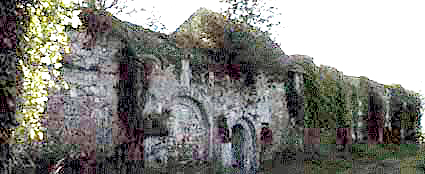
Sir John Woodville rose to the rank of Sheriff of Northampton but his investment in the life of Grafton can still be seen today in the form of the west tower of the church, which he funded. His son Thomas acquired the manorial rights to Grafton, and both he and his brother Richard lived there in their time. Their tenure of high offices in the kingdom was testimony to the family's steady rise in prominence - something which was further accentuated when the next Richard Woodville caused a massive social stir by marrying Jacquetta, the former Duchess of Luxembourg and the widow of the Duke of Bedford who had been a brother of Henry V and the most prominent warrior and administrator in the English holdings in France after Henry's death. The Woodvilles were now tenuously related to royalty, and Grafton manor was their home. Over the next fifty years their power and influence would spread throughout the land and include the throne itself, enabling the numerous offspring to acquire estates and titles. It was the norm in medieval times for a family's importance to be strengthened through favourable marriages and patronage, including royal favour. However, turmoil spread throughout the kingdom in the first half of the fifteenth century as splits developed between those loyal to Henry VI and those who took the part of Richard of York. Richard and Jacquetta's child, Elizabeth Woodville, had married Sir John Grey of Groby. He took the King's part, but was killed in battle in 1461, leaving Elizabeth a homeless widow with two children. To end up on the losing side of a conflict in those days was a unenviable position. The King or rival claimant might be magnanimous and pardon the rebel, sometimes at the cost of a fine; or the offender might be executed, imprisoned, and/or be "attainted" i.e. branded a traitor and suffer the loss of land and title. The family of a deceased attainted nobleman suffered the same loss of lands and titles, which is what happened to Elizabeth Woodville. Having lost Groby, she came to live with her mother at Grafton (Her father had been killed at the battle of Northampton in 1460). It was her desire to reverse the loss of her estates for the sake of her sons which prompted her to petition Edward IV in person. And so the fateful meeting took place, which led finally to the secret marriage of Edward and Elizabeth on May 1st 1464.
Once Elizabeth was Queen, the Woodville estates - including Grafton - passed after the death of Jacquetta to other members of the Woodville family to use for residence and/or income generation. With Elizabeth as Queen the family rose rapidly in power and influence as scores of high offices and favourable marriages to traditional nobility secured their rise in society. What was really happening in political terms was that the King was creating a power-block loyal to himself to counter the influence of the Earl of Warwick and the Neville family who were the dominant members of society in the 1460s. Grafton became part of the holdings of the Marquis of Dorset, Elizabeth's first son by Sir John Grey, and remained in Dorset ownership till the reign of Henry VIII. Meanwhile, the Woodville family suffered in the events towards the end of what is now generally called The Wars of the Roses. The rise of the Woodvilles created resentment amongst many members of the traditional aristocracy, as Elizabeth used her position as Queen to ensure that members of her large family were well secured in office. While Edward ruled, the family were invulnerable; with his death in 1483, however, things changed. Elizabeth had to cope with the arrest and execution of Richard, her second son by John Grey; the failure to see Edward - her first son by Edward IV - crowned as king; and the disappearance of him and his brother Richard after they were taken to the Tower of London. She herself took to Sanctuary at Westminster. Devoid of power and influence, her last hope was to agree to the arrangement that her eldest daughter Elizabeth be married to Henry, Earl of Richmond if he should succeed in winning the throne. When he did this at the battle of Bosworth Field in 1485 and became Henry VII, her fortunes rose again, but never to the same height as before. The now Dowager Queen Elizabeth was treated with respect, but her power was severely curtailed, and there were suggestions of her involvement in Yorkist plots against Henry. She ended her days in the abbey of Bermondsey.
Henry VII's prime aim was to strengthen royal power by increasing the wealth of the Crown, so that it would never again be in thrall to other paymasters. As King, his general method was to fine people heavily rather than execute them. With other preoccupations, he took little interest in Grafton, which remained with the Dorsets until the1520s, when Thomas Grey, the 2nd Marquis of Dorset, presented Grafton (and the manor of Hartwell) to Henry VIII in exchange for the manors of Shepshed and Loughborough in Leicestershire. The estate now remained with the Crown for the next hundred years, surviving the renewed troubles which beset the realm as Henry VIII sought to establish a male heir. Henry paid a number of visits to Grafton, and in 1542 an Act of Parliament created the Honor of Grafton. The honor passed with the Crown to Edward VI, Mary I, Elizabeth I, and James I. The latter two monarchs also visited Grafton on royal progresses. Full details are given below.
The estate was then caught up Civil War of the mid-1640s and the subsequent execution of Charles I. By the time Charles II came to the throne, a significant part of the estate had been lost forever. The honor of Grafton formed part of Charles' marriage settlement to his Queen, Catherine of Braganza, and remained with her for life. Charles' need to provide for his illegitimate children, however, led him to grant the estate to Henry Arlington for his lifetime, then in tail male to Henry FitzRoy, the King's second natural child by Barbara Villiers. Arlington died in 1685 and never inherited the estate, since Queen Catherine did not die till 1705. Henry FitzRoy was made Duke of Grafton and married Henry Arlington's daughter and heir, thus establishing the secure tenure of the estate and the future succession. The first Duke never took charge of the estate however, since he was killed in 1690. Arlington's widow had remarried and was living at Grafton and taking an interest in the running of the honor. It was Henry's son Charles, the second Duke, who finally came into his own as Duke and owner of Grafton on his Mother's death in 1725, and the succession has remained unbroken ever since. By an Act of Parliament of 1542 the manor of Grafton was created an honor and a number of other manors in Northamptonshire were annexed to the honor. Grafton received the epithet Regis on May 1st of the same year, 78 years to the day of the marriage of Henry's grandparents Elizabeth Woodville and Edward IV. Henry Frederick, Prince of Wales (died 1612)
Royalty and Nobility
- their direct involvement with Grafton The following links are not definitive biographies but outlines of their interest in the Palace and Estate.
|







|

