SIR KENELM DIGBY 1603 – 1665
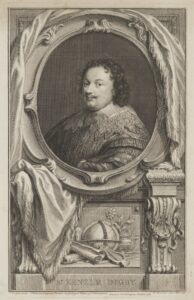
Kenelm Digby, “The Ornament of England”, was born on 11th July 1603 at Gayhurst. He was one of the most picturesque and versatile of historical figures, combining the roles of Courtier, Naval Commander, Statesman, Philosopher and Scientist.
This splendid and stately Tudor mansion in Gayhurst had come into the Digby family through Kenelm’s mother. She was the daughter and heir of William Mulsho and she married Sir Everard Digby, one of the ill-fated conspirators of the Gunpowder Plot.
Gayhurst stood in a wooded park of two hundred acres with two small lakes, some hillocks, travel paths and geometrical hedges, with dovecotes and stables beyond. The River Ouse runs out to the East and, to the North, there was a long avenue of very tall oak trees.
The main house was built in Henry VIII’s time. Later, Queen Elizabeth evidently made a gift of it to Francis Drake before it came into the Mulsho family.
It changed a little; the traditional squat H-shape was filled out into a heavy U but its warm cream grey stone and the façade were the same and the proportions, which gave it distinction among Elizabethan mansions, remained essentially unchanged.
Amongst the thirty rooms there was the Drake Room, the Burleigh Room, the Prince’s Room (which a Prince of Wales had occupied) and there was a room of delicate colouring, modelled on Catherine de Medici’s poisoning room in Blois Castle, which had long panels exquisitely painted with the flowers of the county.

Flower Room – Gayhurst House (c) SGAn
Kenelm was only three years old when his father Everard, died on the scaffold on 31st January 1606, aged twenty-eight.
In Kenelm’s childhood stranger parts of the house were also used; the priest-holes and the secret room on the east where his father and the other plotters were thought to have concealed themselves at some of their meetings after passing through a hidden door or behind a revolving fireplace.
These and the secret passages running throughout the house must have been very familiar to Kenelm. It was here that he wandered as a boy, through the well-planted grounds, out into the meadow lands, by the water and out toward the main road which ran from Northampton to London.
At an early age he was taken from the care of his mother, a fervent Roman Catholic and placed under the tuition of Archbishop Laud. Opinions differ as to whether he ever renounced the faith of his parents, for as early as 1625 he describes himself in his Memoirs as being a Roman Catholic.
He went to Oxford when he was fourteen and entered Gloucester Hall (now Worcester College). There he came under the influence of Dr Thomas Allen, one of the most learned scholars of his day, who inspired him to study science and philosophy, interests which he preserved throughout his life.
Dr. Allen died about fifteen years later, and left his books to Kenelm, who later presented them to the Bodleian Library in 1634-9
During his vacations Kenelm became the constant companion of the beautiful Venetia Stanley. She was the daughter of Sir Edward Stanley of Tonge Castle, Shropshire and grand-daughter of Thomas Percy, seventh Earl of Northumberland.
Her mother died when she was only a few months old and her father retreated into a life of solitude, so Venetia was sent to relatives who lived in the neighbourhood of Gayhurst.
Kenelm fell deeply in love with Venetia but his mother, Lady Digby, was strongly opposed to an alliance, mostly because of Venetia’s “dubious reputation”. She was involved with at least four other suitors besides Kenelm.
He completed his four years at Oxford in 1620, without taking a degree and was then sent abroad. He often returned to Gayhurst to visit his mother over the years but he never really lived there again.
At their farewell meeting Kenelm presented Venetia with a diamond ring “Entreating her, whensoever she did cast her eyes upon it, to conceive that it told her in his behalf, that his heart would prove as hard us that stone in the admittance of any new affection.” Venetia, in return, gave him a lock of her hair.
Kenelm first went to Paris to study but he found the University in the midst of changes and the summer months bringing the plague to the city so he retreated to the provinces. He arrived at Angers, where Marie de Medici, widow of Henri IV and regent for her son Louis X11, held court.
There at a masque Ball the Queen Mother of France fell passionately in love with the handsome but bewildered young man. Kenelm fled as his heart remained ever constant to Venetia.
Kenelm travelled to Italy. ‘Whilst in Florence in l622 he met Van Dyck and the two became intimate friends. Van Dyck painted Kenelm and Venetia over the years.
In England Venetia heard rumours that Kenelm had died and was heartbroken. Kenelm’s letters, telling her the true facts, never reached her and she became engaged to a former suitor.
When Kenelm heard of this he was furiously angry
“This much will I swear, And call heaven to witness, that for the future I will have irreconcilable wars with that perfidious sex; and so blaze through the world their unworthiness and falsehood, that I hope their turn will come to sue men for their love, and being denied, despair and die.”
Not long after, Venetia discovered that her new lover was unfaithful and she broke off the engagement. On Kenelm’s return to London he and Venetia met and resolved all the misunderstandings.
However, before he returned to England, Kenelm went from Italy to Madrid to visit his cousin Sir John Digby, afterwards created Earl of Bristol. Sir John was trying to negotiate a marriage between Prince Charles and the Infanta of Spain on behalf of King James I
The subsequent arrival of Prince Charles and Buckingham did not help matters. Buckingham made himself most unpopular and the Infanta did not reciprocate the Prince’s advances. Because of his religious persuasions Kenelm was selected to confer with the Archbishop of Toledo, the Primate of Spain.
Finally, in September l623, Prince Charles disconsolately sailed for England and Kenelm accompanied him as one of his suite.
The following month the King knighted Kenelm at Hinchinbrook. The ceremony might have had disastrous consequences, had it not been for the timely intervention of Buckingham. The King was looking elsewhere and pointed the blade of his sword directly at Sir Kenelm’s eyes.
Buckingham was now planning an alliance between Prince Charles and the sister of the King of France and was anxious to have Sir Kenelm’s assistance and company on a projected visit to Paris. Kenelm could not raise the expenses but Venetia offered to supply the necessary money.
Her generosity so touched him that he proposed to her. They were secretly married in 1625 but they did not make their marriage public until after the birth of their second son.
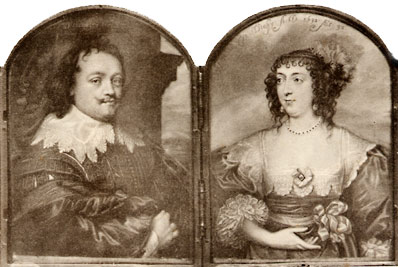
Sir Kenelm and his wife Venetia
Kenelm now held a Court appointment and was a great favourite of King James, who was especially attracted to him because of his knowledge of alchemy and science. His position was not an easy one, as he owed much to the unscrupulous Buckingham, who was very jealous of Sir John Digby 1st Earl of Bristol.
During a temporary absence of Buckingham, Kenelm, always keen for adventure, persuaded the King to give him the command of a privateering expedition. The ulterior motive was the capture of French trading vessels. The two ships selected for this venture, The Eagle & The George and Elizabeth, set sail in December 1627.
After many excitements and skirmishes Kenelm won a victory over the French and Venetians at Scanderoon. On their return, after an absence of thirteen months, the victors had a great reception and Kenelm “received gracious entertainment from the King and a happy welcome from all his friends”.
Whilst away he had studied archaeology on the Greek islands and he had proved himself an able naval commander.
Venetia died in 1635 and was buried in Christ Church, Newgate. It was rumoured that her death was caused by “Viper-wine” invented and prescribed by Kenelm to retain her beautiful complexion.
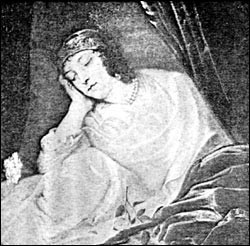
Lady Digby, after death
Kenelm was inconsolable after her death and retired to live at Gresham College where he studied chemistry and “wore there along mourning cloak, a high-cornered hat, his beard unshorn, looked like a hermit, as signs of sorrow for his beloved wife”.
The portraits of him by Van Dyck before Venetia’s deaths depict him as a courtier in velvet and lace and those after she died as a recluse in a black gown.
In 1640 the House of Commons pressed the King to remove all Roman Catholics from his Court – Sir Kenelm being especially mentioned. He was exiled in France and whilst there fought a duel with a French lord, who insulted the name of the King of England.
Sir Kenelm fought with the Royalists during the Civil War and was imprisoned. His old admirer, Marie de Medici interceded on his behalf and he was released in 1643.
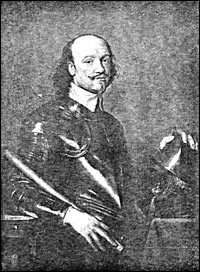
Sir Kenelm Digby in armour
He returned to France until the declaration of the Protectorate and then started negotiations with Cromwell for the reinstatement of Roman Catholics.
He wrote on a wide variety of subjects including his “Memoir” (which was first published in 1827).
He wrote on philosophy, religion, cookery, medicine and spent the later years of his life writing, studying and traveling.
He died on his birthday, 11th June 1665 at his house in Covent Garden and was buried by the side of his wife in the vault in Christ Church, Newgate.
He left no Digby descendants. His elder son, Kenelm, was killed fighting for the Royalists at the Battle of St. Neots; his younger son had only two daughters.
Sir Kenelm Digby’s epitaph reads:
Under this tomb the matchless Digby lies,
Digby the great, the valiant, and the wise:
This age’s wonder for his noble parts,
Skilled in six tongues, and learned in all the arts:
Born on the day he died, the eleventh of June,
On which he bravely fought at Scanderoon;
‘Tis rare that one and the same day should be
His day of birth, of death and victory.
Addendum
Digby is also considered the father of the modern wine bottle.
During the 1630s, Digby owned a glassworks and manufactured wine bottles which were globular in shape with a high, tapered neck, a collar, and a punt. His manufacturing technique involved a coal furnace, made hotter than usual by the inclusion of a wind tunnel, and a higher ratio of sand to potash and lime than was customary.
Digby’s technique produced wine bottles which were stronger and more stable than most of their day, and which, due to their translucent green or brown colour protected the contents from light.
During his exile and prison term, others claimed his technique as their own, but in 1662 Parliament recognised his claim to the invention as valid.
Sources:
“My Ancestors: Being the History of the Digby and Strutt Families” by Lettice Digby. Privately Printed by Spottiswoode, Ballantyne and Co Ltd ,1928.
“Sir Kenelm Digby: The Ornament of England: 1603-1665” by R.T. Petersson. Published by Jonathan Cape. 1956
“The Life of Sir Kenelm Digby” by Thomas Longueville. 1896.
“Sir Kenelm Digby and George Digby, Earl of Bristol- by H.K. Digby. 1912.
“Sir Kenelm Digby and his Venetia” by Eric Bligh. 1932. “Private Memoirs of Sir Kenelm Digby” London 1827.
The Victoria History of the County of Buckingham”. 4 vols. London 1905-27.
“The Journey from Chester to London” by Thomas Pennant. London 1782.
“The History and Antiquities of the County of Buckingham”. 4 vols. by George Lipscomb. London 1847.
“Blackwood’s Magazine” CCXX11. 1927.
“Country Life” no. 315. January 17th 1903. Ten illustrations of the House and gardens appear in this edition.
Return to Gayhurst Residents page
(NB the author of this original article is presently unknown. Any new information would be welcomed)