
Thomas Pennant – The Journey from Chester to London
The Journey from Chester to London mainly concerns a journey in 1780, but also included an earlier journey from Northamptonshire to London going slightly further east, via Northampton, Luton and Enfield.
Pennant was more interested in antiquities than new industries, and provides lengthy descriptions of the portrait collections of stately homes. He does comment on the impact of the then-new canal system on the landscape. He describes the towns he passed through in considerable detail, but both his journeys end precisely on his entering London: he says nothing at all about the metropolis itself.
BUCKINGHAM (COUNTY)
“Here the country improves. After passing Stoke Goldington , a small village, a beautiful vale opens on the left, watered by the Ouze , running through rich meadows, and embellished with the spire of Oulney church. This river rises near Sysam in Northamptonshire , and, after watering this country, becomes navigable above Bedford , by means of locks; runs by Huntingdon ; and, after creeping almost undistinguished amidst the canals of the fenny tracts, falls into the sea at Lynn Regis . The name is probably derived from the British , perhaps signifying a river; being, in common with Avon , the name of numbers of British streams.
ABOUT half a mile from its banks, on a rising ground on the right, stands Gothurst, antiently (sic) Gaythurst ; whose venerable form has not been injured by inconsistent alterations. It was begun in the forty-third of Queen Elizabeth, and was greatly improved, a few years after, by William Mulsho, Esquire.
The windows are glazed with propriety: only part of the back-front is modernized. The lands are very finely dressed, and swell into extensive lawns.
One before the house consists of a hundred and twenty-eight acres; and on the sides are others of great extent. The woods are vast, and cut into walks extensive and pleasing. Several pretty pieces of water, the view of the Ouze and its verdant meadows, and the old respectable house of Tyringham , with its church, on the opposite side, are no small embellishments to the place.
THIS manor, at the time of the compilation of the Doomsday-book, was held by Robert de Nodavirs , or de Nouers , under Odo bishop of Baieux , Earl of Kent , and half-brother to the Conqueror.
The De Nouers became possessed of it in their own right in the time of Henry II; perhaps earlier: but the first I meet with is Radulphus , and his son Almaric , who lived in 1252, the thirty-seventh of Henry III.
It continued in that family till 1408 the tenth of Henry IV, when it became the property of Robert Nevyll , descended from Hugo de Nevyll , who had lands in Essex in 1363, or the thirty-fifth of Edward III.
Robert Nevyll possessed himself of Gothurst , by marrying Joanna , sister and sole heir to the last Almaric de Nouers ; his two other sisters, Agnes and Gratia , having preferred a monastic life
THE Nevylls remained owners of it till the reign of Henry VIII. when Maria , only daughter of Michael Nevyll , on the death of her two brothers, became possessed of it; and she bestowed it, with her person, on Thomas Mulsho of Thingdon , in the county of Northampton, a respectable family.
I find sheriffs of the name, as early as the time of Richard II; and one of that house governor of Calais in the reign of Henry VI. But the first mention of the name is in 1370, when lived John Mulsho of Goddington, Oxon.
Gothurst continued with the Mulshos till the beginning of the reign of James I; when Maria , daughter and sole heiress to William (who died in 1601) resigned herself and great fortune to Sir Everard Digby, one of the handsomest and completest gentlemen of his time…
She had not been married three years, before her husband was snatched from her by an ignominious and merited death, for his deep concern in the (Gunpowder) plot, which, thanks to the charity of the times, is execrated by each religion. It is very probable, that a mind so tinctured with bigotry as his was, soon devoted itself to the most desperate resolutions, for the restoration of the antient church. He foresaw the certain consequences of ill success, and, preparing against the event, took every method to preserve his infant son from suffering from the fault of the father.
Before he committed any acts of treason, he secured to his heirs his estates, in such a manner as to put it out of the power of the crown to profit by their confiscation.
THIS illustrious line was the chief of the Digby family; the peers of that name springing from younger branches. The origin is Saxon . The first, of whom notice is taken, is AElmar, who had lands at Tilton in Leicestershire, in 1086, the twentieth of William the Conqueror.
They afterwards took the name of Digby, from a place in Stokedry, Rutland…
I NOW return to the period when the family emerged from its misfortune, and in the person of Sir Kenelm, the son of the last Sir Everard, was restored to its former honor, by his uncommon merit. He married Venetia, daughter of Sir Edward Stanley of Tongue Castle, Shropshire, Knight of the Bath.
His eldest son, Kenelm, was slain in 1648, in the civil wars, at St. Neots: his second son, John, succeeded to the estate, and survived his father many years.
He left by his wife Margaret , daughter of Sir Edward Longueville of Wolverton, in this county, Baronet; two daughters; the eldest, Margaret Maria , married Sir John Comvay of Bodryddan , in Flintshire ; the younger, Charlotta , married Richard Mostyn of Penbedw , in the same county, Esquire.
These two gentlemen, in 1704, sold this manor, with Stoke Goldington , and the advowson of both the churches, to George Wright, Esquire, son of the lord keeper, Sir Nathan Wright ; in whose posterity it still remains.
By the preceding owners, the reliques of Sir Kenelm’s collection came into my country; but the leaving behind the two beautiful busts of lady Venetia, impresses no favorable idea of their taste.
SOME portraits, belonging to the former possessors, still keep a place in the house. In the parlour is a full-length of old Mr. Digby, father to the unhappy Sir Everard. He is represented in a close black dress, a laced turnover ruff, and with lace at his wrist: his hair black, his beard round, with one hand on his sword. The other, of.
HIS lady, Mary daughter of Francis Neile , Esquire, of Prestwold and Keythorp in Leicestershire , and widow to the Staffordshire antiquary, Sampson Erdeswik. Her dress is black, pinked with red; she has a high fore-top adorned with jewels, a thin upright ruff, round kerchief, a farthingale, with gloves in her hand.
THEIR son, the victim to bigotry, is here at full-length, in a black mantle and vest, the sleeves slashed, and pinked with white, large turnover, and turn-ups at his wrists: one hand holds his gloves; the other is gracefully folded in his mantle.
A REMARKABLE portrait, of a young man of large size, in a quilled ruff, white jacket, black cloak, purple hose, flowered belt, a bonnet with a white feather in it, with one hand on his sword.
Above him, in a tablet, is represented a lady, in a most supplicatory attitude, with a lute in one hand, and a purse in the other, offering it to him. He stands by her, with averted look, one hand on his breast, and with an air which shows his rejection of her addresses, and horror at the infamy of mercenary love; and as if uttering to her the words inscribed near to him, his majora.
THIS I suspect is a portrait of the famous Sir Kenelm, in his youthful days; that prodigy of learning, credulity, valour, and romance, whose merits, although mixed with many foibles, entirely obliterated every attention to the memory of his father’s infamy. The circumstance of the lady painted along with him, is a strong confirmation of the truth of the story related by Lloyd, that an Italian prince, who was childless, earnestly wished that his princess might become a mother by Sir Kenelm, whom he esteemed as a just model of perfection.
It is probable that the princess would not have disobeyed the commands of her lord: but whether the painting alludes to our knight’s cruelty on this occasion, or whether it might not describe the adventure of the Spanish lady, recorded in an elegant old ballad, I will not pretend to determine.
IN the long room above stairs, is the picture of his beloved wife Venetia Anastatia Stanley, in a Roman habit, with curled locks.
In one hand is a serpent; the other rests on a pair of white doves. She is painted at Windsor in the same emblematic manner, but in a different dress, and with accompaniments explanatory of the emblems. The doves shew her innocency; the serpent, which she handles with impunity, shews her triumph over the envenomed tongues of the times. We know not the particulars of the story. Lord Clarendon must allude to her exculpation of the charge, whatsoever it was, when he mentions her as “a lady of extraordinary beauty, of as extraordinary fame”.
In the same picture is a genius about to place a wreath on her head. Beneath her is a Cupid prostrate: and behind him is Calumny, with two faces, flung down and bound; a beautiful compliment on her victory over Malevolence. Her hair in this picture is light, and differs in color from that in the other.
I have heard, from a descendant of her’s, that she affected different hair-dresses, and different-coloured eyebrows, to see which best became her.
SIR Kenelm was so enamoured with her beauty, that he was said to have attempted to exalt her charms, and preserve her health, by a variety of whimsical experiments. Among others, that of feeding her with capons fed with the flesh of vipers; and that, to improve her complexion, he was perpetually inventing new cosmetics.
Probably she fell a victim to these arts; for she was found dead in bed, May 1st, 1633, in the thirty-third year of her age. She was buried in Christchurch, London, under a large insulated tomb of black marble, with her bust on the top. This perished in the Great Fire; but the form is represented in the Pedigree-book, and from that engraven in the Antiquaries Repertory.
THE other is a l’antique. The head is dressed in the same manner, only bound in a fillet: the drapery covers her breast; but so artificially, as not to destroy the elegancy of the form.
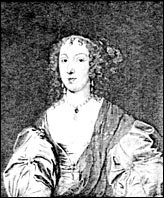
I KNOW of no persons who are painted in greater variety of forms and places, than this illustrious pair: possibly because they were the finest subjects of the times. Mr. Walpole is in possession of several most exquisite miniatures of the lady, by Oliver, bought from the heirs of Bodrhyddan and Pembedw, at a very high price. The most valuable one is in a gold case, where she is painted in company with her husband.
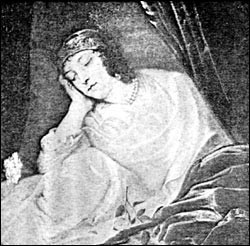
There is another, said to be painted after she was dead (above): and four others, in water-colors.
AMONG other portraits, is a full-length of the lord keeper, Sir Nathan Wright, in his robes… he first received his appointment in the year 1700, unfortunately for him, as successor to Lord Somers; whose precipitate dismission, in favor of a Tory, hardly allowed time for reflection on the impropriety of the choice.
Sir Nathan kept his place till the year 1703, when he was dismissed, not without disgrace; more through defect of ability than want of integrity: but contemned by both parties.
……..
THE church lies at a little distance from the house; it is new, and very neat, having been rebuilt, in pursuance of the will of George Wright, Esquire, son of the keeper. The figures of father and son face you as you enter the church: the first in his robes: the other in a plain gown: both furnished with enormous Parian perriwigs.
IN the old church was a grave-stone, lying in the chancel, supposed to have been laid over John de Nouers, who lived in the time of Edward III.
The inscription was in French: JO: DE: NOVERS: GIST ICI DIEV: DE: S’ALME: EIT: MERCI: AMEN.
(“I, John Novers, lie here. God have mercy on his soul. Amen.”)
TYRINGHAM
FROM Gothurst I crossed the Ouze, to the respectable old house of Tyringham, (once the seat of a family of the same name) which stands very high in point of antiquity.
Giffard de Tyringham gave the church of Tyringham to the priory of Tickford, near Newport Pagnel, in 1187.
Sir Roger de Tyringham was one of the knights who attended Edward I. into Scotland; and Roger, his son, was sheriff of this county as early as the fifteenth of Richard II
Return to Gayhurst Gardens