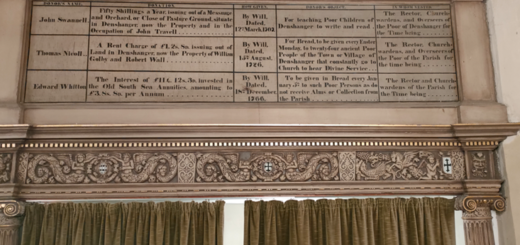
Photograph of the charities’ notice inside St Guthlac’s Church, Passenham; taken by Jennie Dott January 2026
If you visit St Guthlac’s Church in Passenham you will see a notice describing several charity donations to the parish. Thomas left money in his will:-
THOMAS NICOLL A rent charge of £1 2s 8d issuing out of land in Denshanger, now the property of WILLIAM GOLBY and ROBERT WALL; by will dated 15th August, 1726 for bread, to be given every Easter Monday, to twenty-four ancient poor people of the town or village of Denshanger that constantly go to church to hear Divine Service. Trustees – The Rector, churchwardens and Overseers of the Poor of the parish for the time being.
Thomas Nicoll was the 3rd child of Humphrey and Barbara Nicholl. He was born in 1647 in Olney. His father was baptised in 1618 in St Olave’s Church which, today, is situated near Fenchurch Street Station, London. His mother Barbara nee Ashenden was born 1619, in Ludgate. They were married in St Martin’s in Ludgate, near the Old Bailey and St Paul’s Cathedral, in 1639. Humphrey’s place of residence at the time of the marriage was listed as Olney.
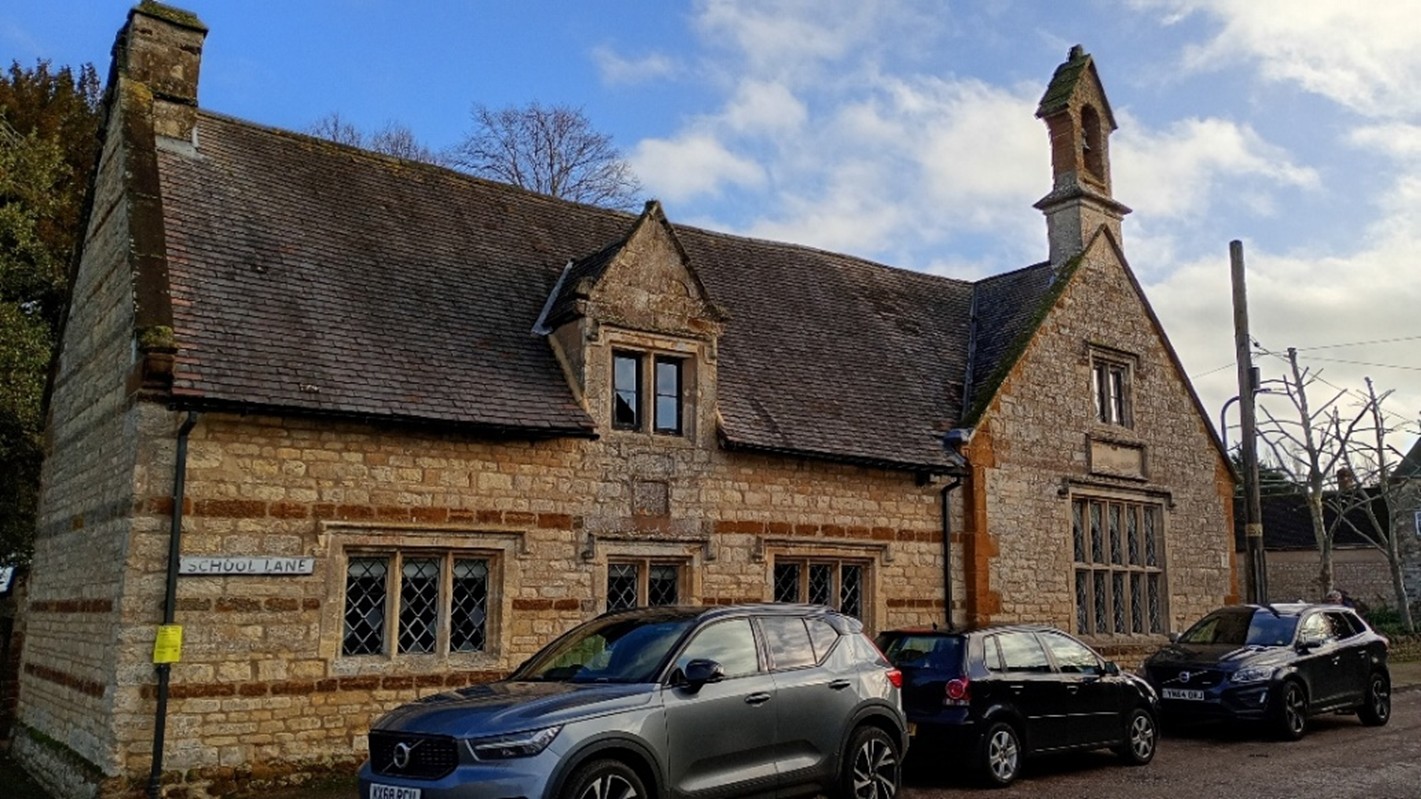
Photograph of the Old School, Abthorpe; taken by Vicky Thorpe January 2026, now the Village Hall
Humphrey and Barbara moved (back) to Olney. From there they moved to Abthorpe, near Towcester, between 1654 and 1658 (youngest son Issac was baptised in Abthorpe in 1658)
In 1662 Humphrey took up the position of Master of the School in the village and continued for about 18 years. He states, in a letter in 1663, that he had been teaching for 35 years, so we surmise from this that he was teaching when the family lived in Only
For a history of the Abthorpe school go to: http://www.abthorpeoldschool.com
When his father took up the position of Master at Abthorpe School Thomas was about 15. He took up an apprenticeship in London to train to be an Upholder (Upholster). It is assumed that he came back to Abthorpe regularly. This is mainly because of the record of his links to their church. He left £200 (approximately £50,000 in 2026) in his will to help aid the creation of a separate (church) living in the parish and annexe the church from Towcester. This would mean that the church would convert from being a chapel of ease to a parish church. There is a very good explanation of this process in the history of The Parish Church of St John the Baptist, Abthorpe, written by Richard Tomalin in 2004:-
www.abthorpevillage.co.uk/wp-content/uploads/2020/12/Abthorpe-History-and-Guide.pdf
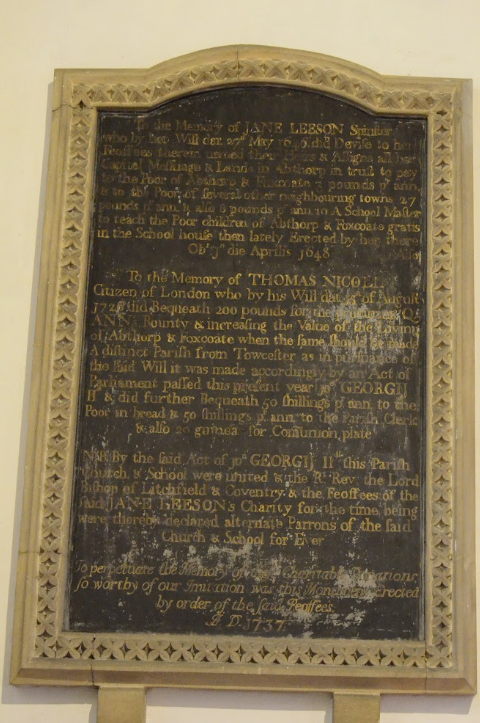
Memorial Plaque Abthorpe Parish Church. Photograph taken by Graham Thorpe January 2026
Thomas also left 20 Guineas towards the purchase of communion plate for Abthorpe church which was bought in 1738 and is still used on occasions today. Additionally, he left money to help establish a Sunday School.
The image to the left is the Memorial Plaque in the chancel of the present Abthorpe Parish Church remembering Jane Lesson and Thomas Nichol who bequeathed to the poor of the village and the then ancient church of the village.
To legally process the change of status of the church it was necessary to have an Act of Parliament drawn up. In addition to the £200 left in Thomas’s will to aid the change of status of the church he also left money for the poor of the village to be given communion bread. The instruction was to charge his “Messuage, Farm, and Lands in Denshanger, in the Parish of Passenham, in the said County of Northampton, with and for the Payment of the annual Sum of Thirteen pounds four shillings of lawful Money of Great Britain, for ever, free and clear from all Taxes and Deductions whatsoever”
You can see the full transcript of this act on the Abthorpe Old School website: –
http://www.abthorpeoldschool.com/uploads/1/3/4/4/134433638/act_of_parliament_-_transcription.pdf

Postcard dated circa 1920s, no known publisher details
From a process of elimination, it is believed that the property Thomas owned in Deanshanger was Williow Farm. The primary clue to this is from the statement “now the property of WILLIAM GOLBY and ROBERT WALL” on the charity plaque in St Guthlacs. There is another clue on the 1765 map drawn up for Reverand Forester where it shows a plot of land in this approximate area belonging to PENN and GOLDBY. Thomas’s niece, Elizabeth married a William Penn and was left Thomas’s property in Deanshanger in his will.
The postcard to the left shows Willow Farm, Willow Green Deanshanger. this copy of the postcard is from Evelyn Hepinstall’s collection in the society’s archive
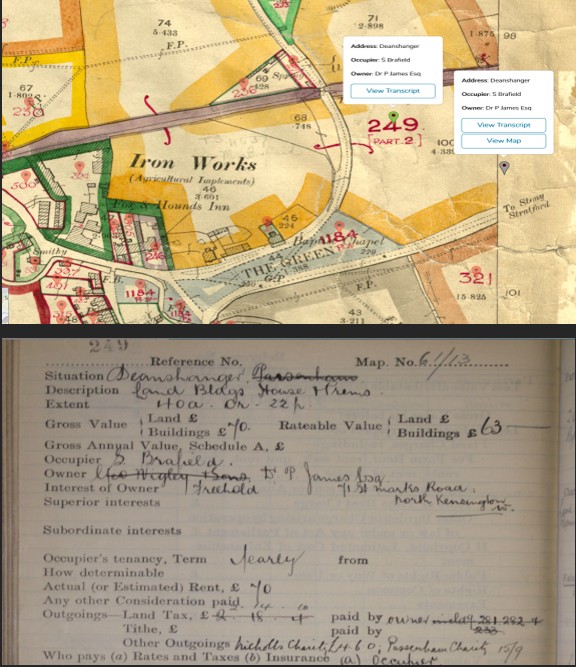
© Crown Copyright Images reproduced by courtesy of The National Archives, London, England. www.NationalArchives.gov.uk & www.TheGenealogist.co.uk
Fast forward to 1910 when the Lloyd George Doomsday Survey was carried out.
The two extracts to the left are from this survey. You can see details of property #249. The land is approximately where Wreschner’s house is and the details of the charge are noted under “Other Outgoings” on the property valuation sheet (2nd image) The occupier is noted as S Brafield. In the 1911 Census Septimus Brafield is listed as being at Willow Farm.
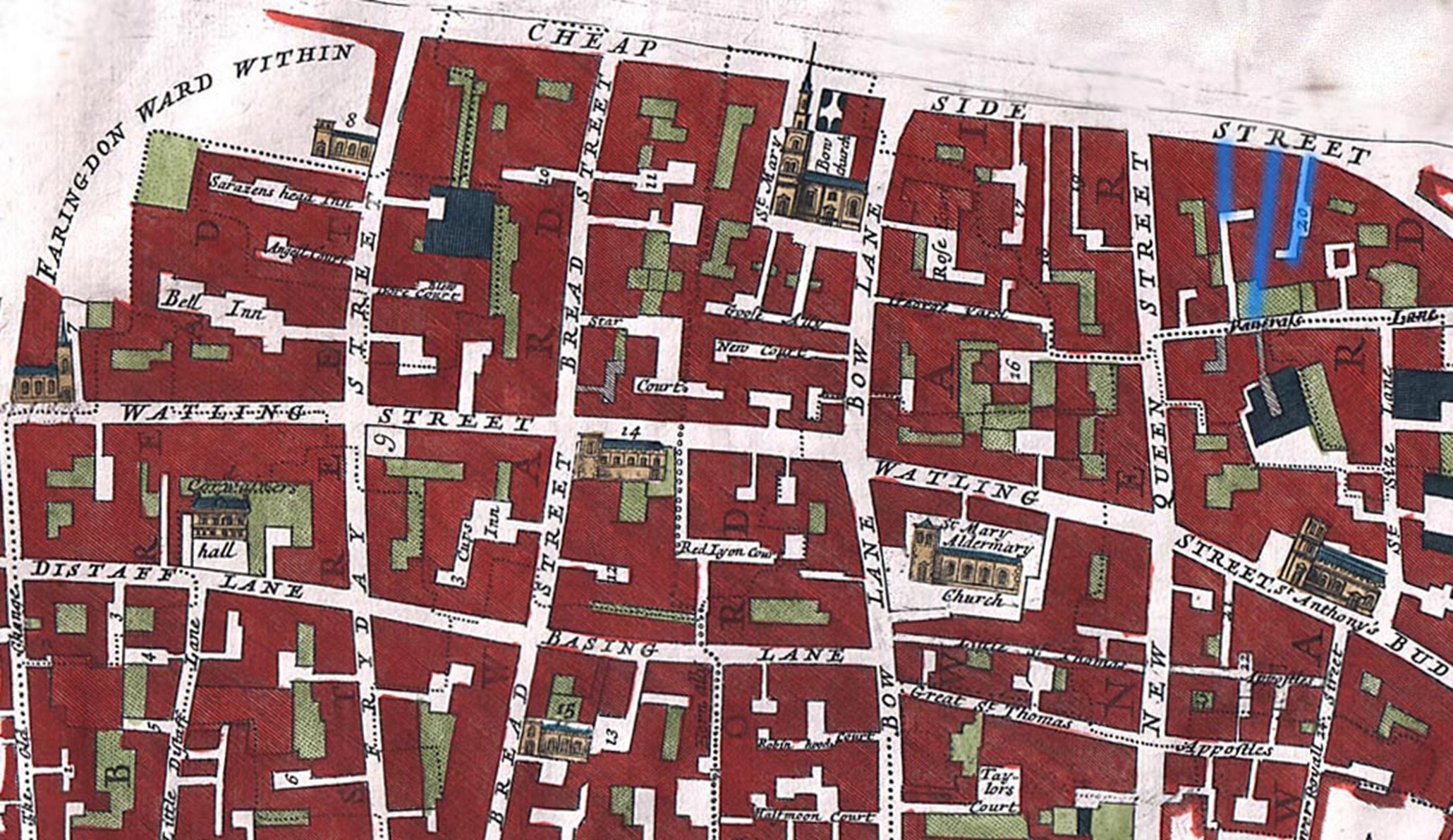
Bread street ward and Cordwainer ward shown on the map of 1720 by John Stow, Public domain, via Wikimedia Commons
To find out more about Thomas’s life let’s take a look at some of the detail of his will to help build a picture:-
We do not believe he married or had any children.
He must have been a very pious man. This is derived from the numerous bequests to charities, churches and faith schools he left money to, in his will. Also, some of the instructions in his will bequeathing to family members, associates and (probably) employees only if they followed the Church of England faith.
He had property in Bread Street, London, an alehouse known as “The Dog” near St Pauls Cathedral churchyard, a property in Bethnal Green, as well as the farm in Deanshanger
He was on the committee of St Bartholomew’s Hospital and the Printing House in Coleman Street, London (near the Guildhall)
He speculated investments in the South Seas Company and Company of Mine Adventurers – you can see from the wording in his will that he was uncertain if there would be a return on his investments!
He is listed in the Dictionary British and Irish Furniture Makers 1500-1914 as being at the Printing House, Swan Alley (off Coleman Street), as an Upholder (Upholster)
One of Thomas’s brothers, John, was the rector of Preston Capes. One of his sons’, also John, was the 2nd Master of the Westminster School, London, at the time of the writing of Thomas’s will and became their headmaster. He was also Canon of Christ Church Oxford and is buried in the cathedral.
Thomas became the Master of The Worshipful Company of Upholders and donated two silver loving cups to them.
Below we can see an photograph of these from the still existent company’s newsletter of 2004 https://www.upholders.co.uk/
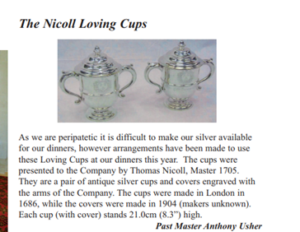
Copyright of The Worshipful Company of Upholders kind permission to use granted by David Ayres, Honorary Archivist.
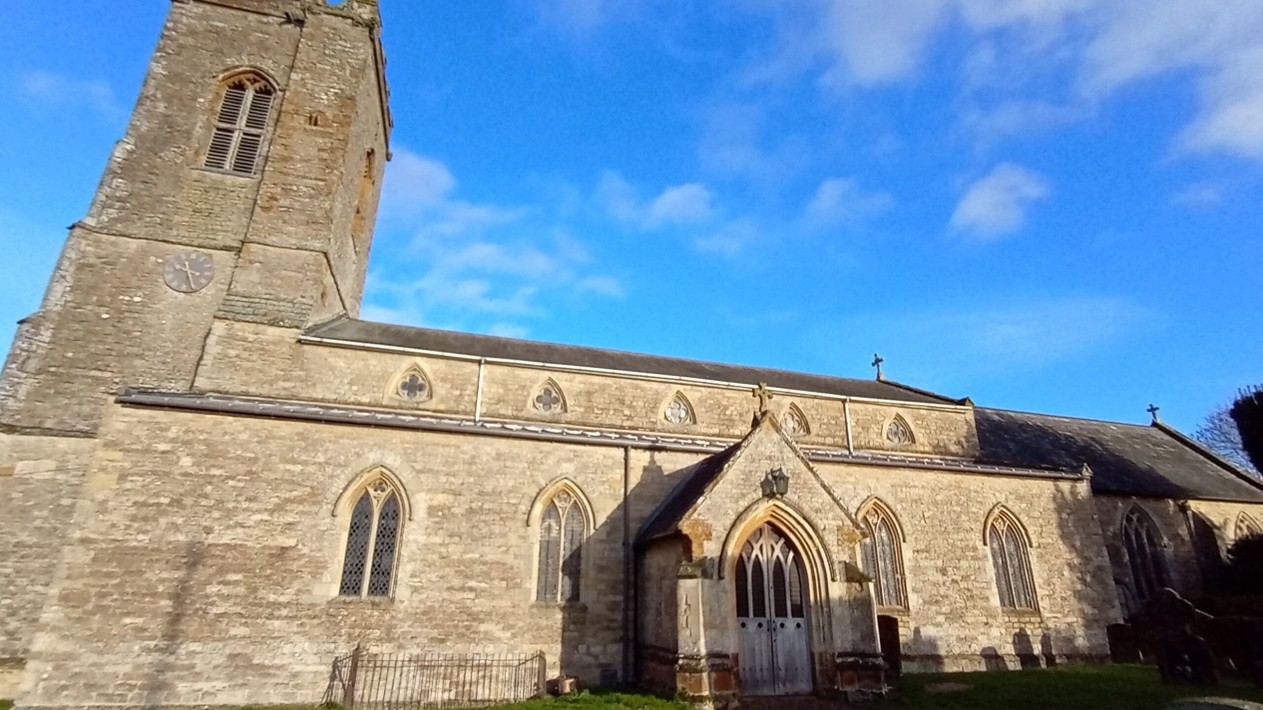
Picture taken by Vicky Thorpe January 2026
Thomas bequests funds in his will to be used for teaching boys of the village of Paulerspury. Thomas mentions relations present in Paulerspury who were to oversee the administration of running the teaching for specifically reading and for providing books. There was to be an intake on a four yearly basis; with a new intake of pupils every four years thereafter. The boys were to be chosen by Thomas’s relatives. We assume that Thomas visited these relations and this lead to his request to be buried in St James the Great Parish Church Paulerspury. He died in 1726 in London and is buried in the chancel this church