
Woburn’s Great Exhibition of 1853
The Great Exhibition of the Works of Industry of All Nations, also known simply as “The Great Exhibition” or the “Crystal Palace Exhibition”, took place in Hyde Park, London, from 1st May to 15th October 1851. It was the first in a series of world’s fairs – public exhibitions showcasing a country’s culture and industry – that became popular in the 19th century. The event was organised by Henry Cole and Prince Albert, Consort of Queen Victoria.
Many famous people of the time attended the Great Exhibition, including Charles Darwin, Karl Marx, Michael Faraday, Samuel Colt, John Mercer, members of the Orléanist royal family and the writers Charlotte Brontë, Charles Dickens, Lewis Carroll, George Eliot, Alfred Tennyson and William Makepeace Thackeray. One of the exhibits showcased include the first public flush toilets invented by George Jennings. They were incredibly popular for showing off the latest inventions and scientific discoveries which were challenging the traditional religious views of creation, nature and the world around us and showing the common man an alternative option.
The London show was wildly successful and was swiftly followed by others – in Cork in 1852; Naples in 1853; New York in 1853 & 1854 and Dublin in 1853. The success and grandeur of the London and European spectacles led to many provincial versions being held up and down the country. Obviously, the scale was nowhere near as large or comprehensive as London, but it is still interesting to see what the local organisers thought worthy of display.
Woburn had created a Literary & Scientific Institution in March 1850. Several local tradesmen were involved and members “would be admitted by payment of 1s. 6d. per quarter, in advance”. A library would be formed and the institution would be opened two evenings each week. Although no ladies were on that first committee, they (very forward-thinkingly) decided that “ladies be admitted as members of this institution by the payment of 1s. 6d per quarter.” Lectures would be given, “upon such subjects as the committee may think fit,” and members would be admitted free. They would have a base in one of the rooms in Woburn Town Hall, then just 20 years old.
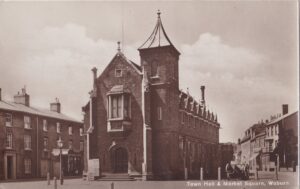
The first of these lectures happened before the end of the month. “The Woburn Literary and Scientific Institution commenced its career on Tuesday evening, March 28th, with a lecture on electricity, delivered at the room, by S. Belling, Esq., surgeon, of Woburn. The lecturer exhibited many experiments showing its nature to be one which yet no one thoroughly understands. The ignition of hydrogen gas issuing from a Florence flask, by means of a spark drawn from the human body, on an insulated stool, was successfully performed, and the force currents of electricity in passing off into the air displayed in the movements of the electrical orrery. Several other interesting experiments finished the evening’s amusement. The room was well filled.”
Before the Great Exhibition in London had even happened, the Woburn Institution had had a lecture on what a good idea it was, from the Woburn Congregationalist minister, Rev. J. Andrews, in December 1850. There must have been a national buzz of excitement about what would be shown there. I’m sure several Woburn inhabitants would have journeyed to see it. Certainly, the Woburn poet George Castleden did, as he later wrote a 21-verse ode about it which was published in the British Banner magazine in December 1851. Sadly, it is lacking in any real detail about what he actually saw that day and is in his usual flowery-arcane verse, filled with references to other obscure works of classical scholars.
A couple of years later, the Woburn Institution decided to its own Great Exhibition, in September 1853. Advertisements for it first appeared in the Bedfordshire Times, Bedfordshire Mercury and Northampton Mercury on September 3rd:
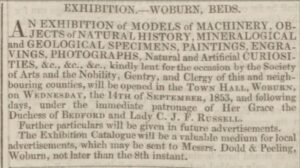
As promised, a week later, they followed up in the press with more details:
“THE EXHIBITION WILL BE OPENED On WEDNESDAY, SEPTEMBER 14, 1853, AT ONE O’CLOCK, AND CLOSE AT SIX. Short Addresses will be delivered on the occasion by LORD C. J. F. RUSSELL AND THE REV. E. BAYLEY. On each succeeding day the Exhibition will open at ELEVEN o’Clock in the Morning, and close at FOUR: and at SIX in the Evening, and Close at TEN. The Exhibition will finally close about TUESDAY, the 27th of September.
TERMS OF ADMISSION:- FIRST DAY, 2s 6s; each succeeding day, MORNING 1s, EVENING 6d; except Saturday Evenings, when the admission will be 3d. SEASON TICKETS 3s; not available the first day, and not transferable. Members of the Woburn Literary and Scientific Institution, and Children under 13, half-price, except on Saturday Evenings.
His Grace the Duke of Bedford has most kindly and liberally given permission that holders of Morning and Season Tickets shall have the privilege of visiting the SCULPTURE GALLERY at WOBURN ABBEY. Visitors wishing to avail themselves of this privilege will be furnished with a Ticket on leaving the Hall.
Any surplus arising from the Exhibition will be given in aid of the Funds of the Woburn Literary and Scientific Institution.
TICKETS to be had of Mr. G. B. CLARKE, Messrs. DODD and PEELING and of Mr. W. HEIGHINGTON, Secretary to the Exhibition Committee.
A Printed Catalogue of the Articles in the Exhibition will be prepared; and Messrs. Dodd and Peeling will have ready a Cheap Edition of their GUIDE to WOBURN ABBEY, which contains a full catalogue of the Sculpture Gallery.”
Sadly, I don’t know of any images of the event with which to illustrate this report. There are three long newspaper reports from before, during and after the event. The first and last of these I have transcribed below in full but given some highlights of the middle one as it repeated many facts from the other two. The Opening was a red-letter day for Woburn. The local aristocracy, gentry, clergy and all other respectable well-to-do individuals would have been present to see Lord Charles Russell, third son of the Duke, launch the event with a speech, along with Rev. Emilius Bayley, perpetual curate at Woburn between 1853 and 1856. The Bedfordshire Times gave this extremely comprehensive report of it on September 17th:
“WOBURN EXHIBITION. Some few weeks ago the members of the Woburn Literary and Scientific Institution decided upon getting up a local exhibition, in praiseworthy imitation of the great prototype, of 1851, and it now affords us extreme pleasure to announce that the labours of the committee of management have been brought to a most successful result. The applications made to the noblemen and gentry of the county, the manufacturers, tradesmen, and cognoscenti of neighbouring and distant localities for contributions have been responded to in the most liberal manner far beyond the expectations generally of the originators, and the Town Hall, lately altered and improved through the liberality of the Duke of Bedford, now contains an extensive and rich collection of articles, illustrative of almost every branch of industry, the arts and sciences, archaeology, natural history, and geology. The exhibition, under the especial patronage of Her Grace the Duchess of Bedford, and Lady C. J. F. Russell, was opened on Wednesday, under circumstances which must have yielded ample satisfaction to those who had toiled unceasingly in its behalf. As the day of opening drew near, the fears of many who at first anticipated a failure were gradually dispelled, and the Literary Society of Woburn, by its spirited efforts, has set a creditable example to larger towns, and proved how much may be accomplished when set about with undivided and well directed zeal.
The ceremonial of opening the Exhibition took place about two o’clock. A few minutes before that time the Duke and Duchess of Bedford entered the building: and their appearance on the raised platform at the end of the room was marked with cordial greetings, Lord and Lady Charles Russell followed and were warmly received. Amongst the company on the platform and in other parts of the room, were the following: Rev. E. Bayley, Mr. W. D. C. Cooper and Miss Cooper; Mr. W. L. Smart and Mrs. Smart: Mr. W. C. Cooper and Mrs. Cooper, Col. Harvey Smith and the Misses Smith; Rev. G. Harter and Mrs. Harter; Rev. J. V. Moore and Miss Moore; Rev. C. C. Bentinck; Rev. E. Carr and Mrs. Carr, Rev. F. and Miss Calcott, Mr. H. Brandreth, Mr. T. Bennett, Messrs. Gascoyen, S. Bennett, &c., &c. The National Anthem having been performed by Mr. Charles Taylor, of London, on a very fine toned harmonium, furnished from the repository of Dodd and Peeling.
Lord Charles Russell then came forward and was cordially received. He said a pleasing duty now devolved upon him in the discharge of which it was possible he should trespass upon their time much longer than had been previously arranged, but in whatever manner he might execute the task assigned him, he hoped it would prove as earnest of his desire, at all times to comply with the request of his kind friends and neighbours (applause). Happily they lived in England – in a land of freedom, where a spirit of inquiry was cherished, and where the people learned to make a difference between the treatment of persons and things. Here instruction was open to all and they who had the will might attain, without check, the highest paths of knowledge. Liberty, came to all alike, and the various classes of society were proud in doing homage to freedom. It was a power which was not kept within the confines of this or that class but all appreciated alike the possession of freedom. It was this happy condition of our social institutions which induced the American Emerson to say, that he knew of no country under the sun were liberty was so fully developed in its different forms. From this circumstance he adds, that a man may perambulate the streets of London with a saddle on his back without exciting undue attention. Such being the case it was natural that this spirit of enquiry should extend and manifest itself in a variety of forms. Here they had the amplest opportunities of surveying the wonders of the universe. The telescope had aided them in the investigation of those wonderful phenomena which they beheld above, whilst arts and science had opened facilities to them for studying the vast resources of the natural world. It was this spirit of inquiry which gave rise to the meeting today. Here people may come without let or hinderance and derive instruction, and learn what may be done with a little perseverance; how an exhibition may be got up, for those who may be said to live from hand to mouth, the art which they have for some time pursued being that of how to make both ends meet (laughter). The present exhibition was got up under peculiar circumstances, and although in a smaller sense, it was intended to have the same tendency as that of 1851, there was certainly a marked difference between them. This exhibition was designed for the benefit of the humblest classes, and any surplus arising from the proceeds would be devoted to the Literary and Scientific Institution of the town. Now as to the causes of this exhibition they were manifold. There was first the existence of the Woburn Scientific Institution, and next, it may have been the result of the Great Exhibition of 1851, and the verdict which was pronounced upon it. The unanimous opinion was that the exhibition presented a full development of the industry of this country, but that it was deficient in the application of art and science. The third cause of this local gathering was, the noble collection of sculpture in the vicinity thrown open for inspection (applause); with these three things if they pleased they might join the famous triangle-dual of Captain Marryat (laughter). To give it the old form of an epigram he might say, “My first is the Literary Institution; my second, the verdict of the Great Exhibition; my third, the noble collection of sculpture, and my whole,” to give it up, “This Exhibition” (hear and laughter). Thus, then, they had arrived at the fact, that this exhibition of the curious in art and nature, had sprung from a society especially formed for mutual improvement, and it was very evident that progress had already been made, and that this greater desire to pursue the onward path must be attended with the like success. In speaking of mutual improvement, he would say, there was a vast amount of rational enjoyment within the reach of all, every one, however deficient in capacity may derive a pleasure from the many sources of knowledge which surrounded him. Just look around that room and see how many instances there were in which the highest enjoyment has accompanied the possession of rarities, and which everyone had it in his power to achieve by following the example. In illustration of this fact he would simply call attention to the eight cases of fossils, telling of the wonders of past ages, the creation and destruction of things and species. That collection was made by one individual, and in one parish of this neighbourhood. Now after that they might hope to hear no more about going from Dan to Beersheba exclaiming all is barrenness, dull, tame and uninteresting. The only dullness was the dullness of perception, and tameness was the consequence of an imperfect study of nature. If such a pursuit was at all unprofitable it was only so to those persons who were unworthy of the pearls which lie scattered in our path (applause). But was this exhibition likely to meet with the verdict of 1851? Well, he thought, that the gallery of sculpture already referred to might, in some measure, supply an answer. The verdict was that there were classes of persons deficient in the artistic element. Now as they enter to view that matchless collection of sculpture, they would find a temple devoted to liberty, the only source of all true greatness (applause). On the left of this was the Temple of the Graces, and these two were united in estimation by all visiting that choice collection of art, ancient and modern. Thence, in spite of the verdict of deficiency of taste, the humblest could not fail to appreciate the beautiful. He would have them go forward to the Temple of the Graces, and, as the inscription told them, approach it with reverence. Here would be found statues of most exquisite beauty and matchless development of form by ancient and modern artists, Here they would see some of the fairest specimens of Grecian rarities of the noblest conception, proving that, although the ancient spirit was destroyed, and her liberty trodden down, she was still the living centre of all that was beautiful in art (applause). Here too could be found some of the choicest productions of Chantory, Thorwaldsen, and Canova, With these advantages he hoped they would be enabled to appreciate the beautiful in art, and while perambulating the gallery, that actual improvement would be obtained by the visitors (hear, hear). No one could be insensible to the improvements which were going forward in the staple manufactures of this country. In application of lace and straw, however, the articles were as much indebted to the wearers, as to the latter to the manufactured articles. This was an apt illustration of mutual improvement, and instruction might be derived from it. The facilities generally for the acquirement of knowledge in the higher branches of instruction were happily advancing, the galleries on the continent as well as in this country were open to students. The study of the beautiful will produce a higher taste, new ideas will be acquired, and knowledge will be obtained more effectually when the parties are brought into mutual activity. He wanted to see a higher class of rational enjoyment for the industrious classes. It had been a bane and a great disgrace that at this time there should exist so many, what he esteemed, brutal amusements. He was not one who disregarded the customs of a country, they were the indices to the character of the people; but he would wish to see them raised to a superior standard by substituting something which could interest and develop their moral nature. He would now only ask them to hold a common sympathy with the object and designs of this exhibition; they would then have new and keener perceptions of the beautiful, and with them bring back new perceptions to the realities of life and its accustomed responsibilities. If this suggestion was acted upon, he thought improvement would be mutual, and that there was not one among them who would not feel cause of thankfulness at the result of this exhibition (applause).
The Rev. E. Bayley said he should only make a few observations in addition to those which had been so well and admirably expressed. He viewed with sincere delight the efforts that were now making on all sides to elevate the condition of the human race, and to procure a higher source of intellectual gratification. In this high and holy purpose, it behoved them to do all the good they were able in its promotion. There were several causes which may have operated in the formation of an exhibition of this nature, originating probably in the Great Exhibition which had been so fittingly alluded to.
There was no doubt the circumstances which attended that extraordinary development of human genius and industry, had given an impetus to society and had awakened an increased desire to extend the boundaries of knowledge. He knew objections had been raised against encouraging the attainments in science and philosophy. It was said they had a tendency to foster pride, to set up spirit of self-complainancy and the exaltation of man’s own nature above that of his creator. Now he did not apprehend there was any danger from such a source, and that the present exhibition, comprising so many objects of utility and beauty, would furnish an answer to the objection he had mentioned. There were two instruments in that room the use of which would prove that so far from pride being fostered by the acquisition of knowledge, that the very contrary of would be the effect. The first was the telescope. Now let any person take the telescope and point it to those countless and vast masses rolling through the firmament; observe the beauty, number, regularity, and immensity of those bodies, which to the naked eye appear but tiny atoms, and then ask himself if the contemplation of those wonders have a tendency to fill him with pride. Would he not be impressed with the vastness of creation and the insignificancy of man, and bring down rather than to exalt the proud spirit (applause). Some may reply that this was man’s instrument, yet they must not forget that he was enabled to form it only by the use of those gifts which an all-wise Creator had given to him. The contemplation of the wonders which were beheld around and above him, they reminded man of his own helplessness and could not fail at the same time to make him wiser and better, and like the sweet psalmist David he would be constrained to exclaim, “When I consider the works of Thy hands, the Moon and stars which Thou hast ordained, what is man that Thou art mindful of him, and the son of man that Thou visitest him.” The other instrument, which was no less calculated to destroy the natural spirit of pride was the microscope. Now let any one place before the microscope the meanest work of God and examine it with the most elaborate and highly finished work of man. Let him take that which may be considered the meanest and vilest thing in creation, and he will discover in its formation the most delicate beauty, the most exquisite perfection in all its parts, and that God, in this insignificant portion, of his works, has shown unmistakable evidence of his creative wisdom. Then examine the most delicate and perfect production of man, and it will be found to be clumsily and rudely executed, without beauty and proportion, though to the naked eye apparently a perfect article. And thus it would be found that the more they examined the works of God the more they would be convinced of the perfection of the wisdom which created them; whilst the more they looked into man’s works the more cause they would find to be convinced of his imperfect condition. There was, however, another object in connection with the exhibition, namely, what profit and advantage would be derived from it? Many may visit it and pass out without deriving any benefit. He hoped, however, that very many would receive both instruction and amusement from the very interesting and valuable collection of objects which decorated the room. In carrying out their observation it was very important to bear in mind the distinction existing between the works of God and the works of man. The latter should never be compared with the power, for while they gave evidence of man’s skill and mental power, it should never be forgotten that the skill and mental power came from God. They had evidence in that room that it was in the power of every person to study the works of creation, and whether they were in that room or abroad viewing the fields clothed in the bloom and loveliness of beauty impressed by nature, he hoped there was not one individual, who, on quitting the scene of contemplation, would not feel that he was made happier (applause). He then concluded by requesting the company, as an appropriate conclusion of the ceremony of inauguration, to join him in repeating the Lord’s Prayer. This having been gone through with becoming solemnity, the company proceeded to inspect the numerous objects.
We cannot attempt anything like a detailed account of the several valuable contributions to the exhibition; to do so we should have to reprint the catalogue. We can, therefore, only allude to them in general terms merely adding that the collection far surpasses our expectations. [I have reformatted the list from block text to make it more readable. Ed.]
First among the contributors is His Grace the Duke of Bedford, who has furnished from his own rich collection a portrait of Her Majesty; the Infant Saviour, copied from Vandyck by the present Duchess of Bedford, busts of members of the House of Russell, an antique vase, early manuscripts, &c., &c.
Lord Charles Russell has contributed several paintings, curious gun, and natural curiosities.
From Mr. W. C. Cooper, of Toddington, there is a fine collection of fossils, geological diagrams, electrotypes, relics, electrical, magnetic, and galvanic apparatus, models of boats and engines, &c., &c.
From Mr. Martin, a cast from Thorwaldsen’s “Night,” several antiquities, impressions of Royal and Municipal Seals, &c.
From Miss Dyke, a collection of Spars and Geological specimens from Derbyshire,
From Mr. M’Kay, a case of specimens illustrative of Woollen manufacture, and some natural productions from the Highlands.
From Mr. J. Green, pictures, models, foreign shawls, natural productions, a model of a three-horse high-pressure engine by Mr. T. J. Green, and coins.
From the Rev. A. D. Morrice, of Heath, cases illustrative of natural history.
From Colonel Gilpin, M.P., a similar contribution, together with some pottery from Pompeii.
From Mr. Haskins, of Bedford, a miniature carriage made from three silver tea-spoons, and a miniature tea service worked in the same metal.
From Mr. J. B. Nowell, of Bedford, an Achromatic Microscope with a case of objects, a case of microscopic instruments, a reflecting stereoscope with views of Duck Mill, eight photographic views in the neighbourhood of Bedford, other photographic and lithography specimens: and from Mrs. Nowell, specimens of the Anglesea limestone, and a pair of Indian moccasins.
From Mr. Young, an electro plating machine and curiosities.
From Mr, W. J. Bird, of Bedford, a Galvano-Magnetic apparatus, an electro-type apparatus, some specimens of electrotypes, and a working model of a vertical high-pressure steam engine.
From the Bedfordshire Archaeological Society, Rubbings of Brasses, and several antiquities.
From Mr C. L. Higgins, of Turvey Abbey, a collection of War clubs, Boomerangs, Paddle-clubs, &c., from the Sandwich, Friendly, Solomon, and Feejee Islands, &c., &c.
From Messrs. Howard, of Bedford, two models of ploughs.
From Mr. Mantel, of Bedford, a case illustrative of the process of manufacturing hair into head-dresses, wigs, &c.: Two articles in the case excited unusual attention; one was ticketed “Ivisable skin parting,” the other “Mementos of departed affection.”
From the Rev. T. Tanqueray, a collection of ornaments and domestic implements of the Kaffirs, [This term is now considered offensive but has been included as a direct quote from the article. Ed.] several productions from Norway and China; also an ants’ nest made out of a music book. It appears the book, supposed to be Jousse’s Preceptor, was thrown into an old cupboard with articles of lumber, and alter some years had elapsed it was found converted into an abode for ants. Nearly the whole of the paper, by some peculiar process, had undergone a complete change in colour and texture; only a small portion of the music remained in its original state, and this, curiously enough, retains the printed title of Home, Sweet Home!
From Mrs. Epworth Luscombe, five water-colour drawings.
From Mr. Usher, of Bedford, Corals, a kettle used by Jolin Howard, and an improved spirit level.
From Mr. Wyatt, of Bedford, a document in the handwriting of John Howard the “Philanthropist,” a collection of autographs of eminent authors, some antiquities, and five specimens of Derbyshire spars and Welsh quartz.
From Mr. G. Hurst, of Bedford, a collection of specimens of raw cotton, specimens of silk weaving, panther and tiger skins.
From Mr. Graham, of Sharnbrook, cases of fossils, minerals, insects, and grasses, collections of spars, enchrinites, &c.
From Mr. J. Stenson, of Northampton, four cases of iron ores.
From Price’s Patent Candle Company, specimens of fruit and oil of the palm tree, and a collection of oils, stearine, candles, and crystalline wax.
From Cogan and Co., London, an interesting collection of domestic implements, churns, syphons, bee-glasses, &c., &c.
From Mr. Marsh, of Thame, a collection illustrative of glass manufacture, copper ores, busts, drawings, and natural specimens.
From the Rev. Mr. Bentinck, a bust, a cast, and a copy of the Portland Vase.
From the London Missionary Society, a large collection of curiosities from foreign countries.
From Mr. Harvey Smith, of Aspley, collections of preserved birds.
From Mr. Whitlock, a chameleon and some natural curiosities.
From Mr. G. B. Clarke, a collection illustrative of natural history.
From the Rev. G. W. Mahon, of Aspley, a collection of curiosities from India and China.
From Mr. R. C. Hurst, of Olney, a collection illustrative of natural history.
From Col. Harvey Smith, a painting and engraving of incidents in the career of Napoleon.
From Mr. Poulton, of Leighton, petrifictions, spars, paintings, and models.
From Mr. Rowbotham, of Leighton, specimens of petrifactions, from Derbyshire.
From Dr. Evans, of Bedford, a working model of a vertical oscillating steam engine, remarkable for its simplicity.
From Major Berkeley Calcott, of Flitwick, a collection of curious relics, two early bibles, Madenpore, &c.
From Mr. T. Harris, of St. Albans, specimens illustrating the manufacture of Berlin Wood, bonnets and hats.
From Messrs Horne, Thornthwaite, and Wood, London, a collection of collodion and albumenized glass pictures, stereoscopic and galvanic apparatus &c.
From Miss Daniels, models of cameos, and natural productions from foreign countries.
From Mr. Morry an antique Bronze found at Canino.
From Mrs. Clay, a collection of wax flowers.
From Mr. W. Farrow, of Louth, collection of natural productions and curiosities.
From the Rev. J. Andrews, Geological specimens.
From Mr. Josiah Clarke, specimens of lace made in Woburn and the neighbourhood.
From Mr. White, of Bedford, busts of two aborigines of Van Dieman’s Land.
From Mr. Willis, of Luton, specimen showing the manufacture of straw bonnets.
From Mr. J. Harbert, Woburn Sands, specimens of pillow-lace of the neighbourhood.
From Mr. Hensman, models of a straw-shaker, the patent corn and seed drill, and a case of medals. From Capt. Erskine, five Boomerangs.
From Mr. Pearson, specimens of Berlin wool and work, papier mâché, muslin flowers, china and jet ornaments, bronzes, &c., &c.
From Mr. Chapman, electro-magnetic machine, and busts.
From Mr. W. W. Kilpin, of Bedford, a glass case containing a variety of electro-plated articles.
From Mr. T. Brown, London, paintings and designs, and chasings in metal.
From Mr. G. Smith, Tavistock, copper, lend, and tin ores, various spars, granites, &c.
Mrs. Collins, specimens of needlework.
From Mr. E. Daniell, of Newport Pagnell, several oil paintings.
From Dr. Barker, of Bedford, two portable electro-galvanic machines.
From Mr. Castleden, pictures, ancient documents, &c.
From Mr. Nixon, specimens of timber perforated by the Teredo Navalis, Barnacles, Fruit of the vegetable ivory, specimens of plate glass, and a cheap iron pump.
From Mr. H. Hall, Model of his method of constructing railways, dried Bowers, manuscripts, &c.
From Mr. R. Gamble, of Berkhamsted, ancient books, pottery, and petticoats.
From Mr. R. T. Stratford, models of screw propellers, Camera lucida, electric cannon, medical battery, &c., &c.
From Mr. D. Clarke, Woburn, oil painting, and curious caddy.
From Miss Inglis, a variety of productions and curiosities from distant countries, case of medallions, garnet rock.
From Mr. H. Goodman, working model of steam engine.
From Rev. Mr. Spurrell, two cases of Brazilian butterflies.
From the Rev. Lord John Thynne, Thorn of the Mimosa, paddle of Ichthyosaurus, Kaffir bracelet [This term is now considered offensive but has been included as a direct quote from the article. Ed.], silk in all its stages, case of toy furniture in buckhorn from the doll’s-house, Hawnes-park, case of wax-flowers.
From Mr. Alfred Brown, London, a statuette of Wellington, and a lithograph.
From Mr. Cook, of Woburn, a case of Australian birds and other productions.
From the Rev. E. Bayley, telescope, microscope, Arab dress, and fossils.
From Ms. J. Holt, London, specimens of ornamental chasing, and an oil painting.
Mrs. J. H. Wiffen, original portrait of Tasso, and portrait of Mr. J. H Wiffen the translator of his poems.
From Mrs. Havart, Indian curiosities.
From Mr. H. Veasey, etchings, paintings, and prints.
From J. Phillimore, several paintings.
From Mrs. Howard, Bedford, copper and iron pyrites.
From Mrs. Hopkins, of Leighton, two ladles made of coins, and some stag’s horns.
From Mr. G. T. Wilson, petrifactions, telegraphic printing, engravings, coins.
From the French Chocolate Company, a case of chocolate manufactured into bonbons, &c.
From Messrs. Huntley & Palmer, of Reading, a case of biscuits.
From Miss Britten and Miss Barlow, specimens of crotchet work.
From Mr. Miller, articles blown in glass.
From Mr. Brittain, of Tingrith, a leaden box found with 100 guineas in it, a silver spoon 500 years old, and coins.
From Mr. Wagstaff, of Leighton, Microscope and object glasses.
From Messrs. Dodd and Peeling, several specimens of book-binding in Morocco, ebony, maple, Woburn-park oak, Bibles, Church-services, specimens of typography, printing press, printing in oil colours, engravings, Pianofortes, Harmonium, Papier Mâché goods, &c.
From Mr. G. Fines, medallion and bronze work.
From Mr. S. A. Bennett, Stockport, a condensing engine, model of a beam engine.
From Mr. W. L. Smart, specimens of marble from Pompeii, Roue, Sicily, and Palermo, lava, models, case of Italian ornament, stone jug, Roman pottery, &c.
From Mr. John Bull, Bedford, a spring quarter clock, eight-day skeleton time-piece, and double-barrelled gun.
From Mr. T. A. Green, case of 23 gold coins, and 51 silver medals, Case of casts of Roman brass medals.
From Mr. Palfreeman, Chinese Pagoda, case of coins, &c.
From Mrs. Freeman, case of coins, agates, petrifactions, and curiosities.
From Mr. J. M. Crispin, Ampthill, two Chinese oil paintings, black letter bible, model of a churn, two old teapots and model of a pump.
From Mr. Handscomb, barometer, thermometers, and musical clock.
From Mr. Harbert, specimens of fancy wood work, glass hive of honey.
From the Stoke Salt and Alkali Works, specimens illustrative of the manufacture of salt and soap.
From Mr. T. Atkins, Oxford, a variety of Philosophical Instruments and natural productions.
From the Society of Arts, London, seventy-two Photographs.
Amongst the contributors of single and smaller specimens we find the names of Miss Martin, Messrs. J. Meridale, W. S. Cooper, C. Woods, George Taylor, W. Horley (Toddington), W. Barlow, Reddall, Evans, Morris, Hannell, Wolfe, Pickering, James Hart, Rogers, Jowers, Cobb, Cole, Clarke, Emery, G. Atwood, and Lucas.
It is our intention to return to this subject in a future number. In the meantime we most heartily recommend the Woburn Exhibition to the attention of the public, feeling confident that it will amply repay the cost of a visit, and that no person will leave the building without having experienced considerable gratification.”
An amazing array! A national newspaper, The Morning Post, picked this up and ran a small piece on 19th September, but did not reprint the speeches or the exhibits list in full. The Lady’s Newspaper and Pictorial Times also made mention of it on 24th September and on the same day, the Northampton Mercury announced that the organising Committee had decided to keep the show open until 4th October due to demand. Schools would be admitted from 4-6pm for 1½d. each if they booked the day before. In the same newspaper, they announced some preliminary attendance figures, saying that, in the first seven days, 3,074 had entered the hall. “Her Grace the Duchess of Bedford, Lord and Lady Charles Russell, Hastings Russell, MP., Col. Hamner, Captain Polhill and Mrs Polhill, W. C. Smart, Esq. and Mrs Smart, W. D. Cooper, Esq., W. C. Cooper, Esq. and Mrs. Cooper and a large number of the ladies, gentry and clergy of the neighbourhood, have honoured the Exhibition with their presence during the week. Through the liberality of the following ladies and gentlemen the inmates of the Union-house and the schools of the vicinity the have had an opportunity of paying a visit to the Hall, viz. H. Veasey, Esq., the Woburn Schools; Mrs Tanqueray, the inmates of the Union-house; Mr Tanqueray, the Tingrith School; Miss Prince, the Wavendon School; Rev J. V. Moore, the Aspley School; Mrs Smart, the Eversholt School.” What the poor destitute inmates of the workhouse made of the opulent items on display and the new modern machinery, I do not know.
The Bedfordshire Times gave a long report on the ongoing show on 24th September. “Since the opening day of its exhibition Woburn has been visited by crowds of visitors, the little town presenting an amount of bustle and animation not experienced within its precincts for very many years past. The affair has been successful to a degree far beyond the expectations of the most sanguine of its originators, and the Literary and Scientific Institution of the town, is likely to reap a substantial benefit from the extensive and varied display of local industry and research, enriched with some extremely fine specimens in the higher branches of art.”
Much was made of the school visits, enabled by sponsorship from various gentry “The entrance of these buds of promise into the building formed an interesting spectacle; the astonishment of the little folks on viewing the multitudinous objects of attraction appeared excessive, and it was amusing to hear the varied and odd exclamations of surprise which now and then escaped them. On Saturday last the building was crowded to overflowing, the visitors consisting of the mechanics of the town and farm labourers of adjoining parishes. Amongst a group of the latter who were admiring Sir E. Landseer’s famous picture, entitled “October – Herdsmen and Cattle,” were two shepherd boys in smock frocks. These juvenile rustics stood with gaze intently fixed upon the cattle and the dog guarding them. After some minutes spent in scrutinizing the form and attitude of the latter, one of them awoke up from his brown study, and slapping his companion on the shoulder exclaimed, “Well, Jim; that be like a dog however”.”
Visits by the poorest local parishioners were also commented on “The most intense anxiety to visit the local attraction has been shown by the poorest and almost destitute persons: as an instance, take the following. One evening a poor girl came up to the door and asked what the charge was for admission. On being asked her age, she said eleven. The party who had the charge of the door being convinced the applicant was several years older said, if she had told the truth she would have been allowed to go in free, but if she had any money she might go in at half-price – threepence. The poor girl seemed rather taken unawares and commenced fumbling for her money. At last she produced a very dirty looking handkerchief tied in a host of knots. After five or six minutes had been expended in unravelling the intricate coil she produced a threepenny piece – and although the last of her store, judging from the animation which suddenly lighted up her countenance, she parted with it us if its possession had been a grievance, and bounded up the steps with the utmost buoyancy and speed.”
The organiser said that, despite the exhibition being “honoured with the visits of well-known thieves”, “no article whatever has been disturbed”. I’m sure those known locally as being somewhat… light fingered… had been watched very carefully while they perused the collections! In fact, the very opposite had happened and once open, the exhibition had grown. “Amongst the recent contributions there is a case from Col. Hanmer containing, with other curiosities, two perfect specimens of the weaver bird as if emerging from their curiously formed nests. In the natural state these nests are fastened to the boughs of trees growing by the side of rivers and lakes; they are shaped exactly like a chemist’s retort and suspended from the head, the long tunnel, forming the entrance, nearly reaching the water. In the passage leading from the side door to the elevation at the end of the room is exhibited a model of Woburn church, the parsonage house, and school, carved in alto relief. It bears date 1825, with the name of S. Townshend. It appears this curiosity was the work of a Woburn artisan, who afterwards went to seek his fortune in London, but proving unsuccessful he was compelled by desperate circumstances to pledge his handiwork for 1s. 6d. Being unable to redeem his property it was at length exposed in the pawnbroker’s window for sale, where it accidentally attracted the notice of a resident of Woburn, who purchased the model, which ultimately found its way into the possession of the present owner.”
A Mr. Brittain, of Tingrith, had sent a curious leaden box, apparently found through a dream, with 100 guineas in it. “The story connected with this singular incident is something like the following. About 100 years ago a female ancestor of the exhibitor dreamt that money was buried in the garden. The first time the old lady took no notice of the vision, but after being visited with it three times, she was induced to go and dig at the spot pointed out and found a leaden box filled with gold coin to the amount mentioned. The gentleman, who related this anecdote in the exhibition room added another still more extraordinary. A century and a half ago, a poor man named Bolt, residing in a humble cottage at Hawthorn-hill, between Ascot Heath and Hollyport, dreamt a dream that he was to go to London to hear something for his good. He related the dream to his wife, who thought it was mere nonsense and advised him not to go. But the old fellow persisted and stumped it to London where he arrived in the morning just as the shopkeepers were taking down the shutters for the day. When near London bridge, his rustic garb attracted the notice of a shopman, who accosted him, “Hollo, countryman, what do you here so early in the morning?”. “I don’t know,”” he said, “I dreamt last night that I was to come to Lunnun to hear something for my good; but I doant know what good it’Il do me coming here.” “You should take no notice of dreams,” said the young, “For I dreamt last night that I was at Hawthorn-hill, a place I never heard of and never was at, and dug under a haw bush where I found a pot of money.” On hearing this, the old man returned home immediately, and on digging under the haw-bush found a silver tankard of gold. With the money Bolt was enabled to take a public-house, and when any respectable person called, he was in the habit of bringing out the tankard, (which had an inscription in Latin), foaming with the home-brewed liquor. On one occasion a party of gentlemen called at the wayside house. As usual the favourite tankard was brought out and placed on the table. The vessel was carefully examined by one of the party who having deciphered the Inscription, asked the landlord if he knew what was on the tankard? No, he did not; it had never concerned him. “Listen then, and I will put the sense in rhyme” – Underneath where this pot stood, There is another quite as good. The same day the old man again dug under the hawbush, and had the good fortune to find another pot of gold, exactly under the spot where he dug out the first. This treasure was the making of the whole family, and the successors of the original Bolts are known and respected as substantial yeoman. The bush still stands in the middle of Hawthorn-hill, it is somewhat remarkable in appearance, bat comparatively few are acquainted with the mysterious circumstances connected with the silver tankard extracted from beneath its roots, filled with gold.”
A curious tale that I haven’t been able to locate elsewhere. Further additions to the show also included:
“From Mr. Bensuson, of London, Vaucher’s patent woven hose for conveying fluids, girls’ and boys’ dresses from Algiers, Albanian jacket, Algerine shoes, Yatagan from Algiers.
From Mr. W. Furrow, of Woburn, a single-barrelled air pump, three air jars and hand glass, a transferer and jet, Marsh’s apparatus for detecting minute quantities of arsenic, samples of tea and coffee from different countries, stand of chemicals.
From Mr. Cobb, Woburn, a clock showing the time at London, Vienna, Jerusalem, Petersburg, Bengal, Peking, Denmark, and Boston.
From the Rev. T. Tanquerey, Tingrith, a weapon found at Harlington, a fine specimen of Samian ware, Roman pottery found at Harlington, figure carved out of bone of a sea horse found at Harlington, supposed to be a Danish chessman.
From Mrs. Smith, of Bedford, shade containing three elastic boots, two elastic boots in boxes, two pairs of Smith’s Royal Symmetrical Corsets.
From Dodd and Peeling, letter weighing machine, press for stamping address, initials, &c.
From Mrs. Havart, Woburn, Indian cabinet, Indian work-box, two Bengal jars. Fossil shells, rich copper ore and teeth found at Lidington, by Mr. T. Bennett.
From Mr. C. R. Day, Woburn, model of Nelson’s Monument, wax figures, moccasins worked in the back woods of America, basket from Calcutta containing a variety of shells, octagon rosewood table with fancy marble top, representing birds at fountain.
From Dr. Evans, of Bedford, model of Barle’s bed for fractures of the lower extremities or diseases of the spine, and of Dr. Sankey’s elastic bed tor the prevention of bed sores in fever cases (a substitute tor the water bed), model of a hospital bed.
A series of specimens illustrative of the manufacture of flint glass from Apsley and Co., London.
From Mr. Shaw, Woburn, Mosaic bracelet, the Ruscrea brooch brought from the Dublin Exhibition, interior of the old House of Commons, framed in oak saved from the fire.
From Mrs. W. L. Smart, a case of beautiful ornaments, consisting of 2 coral bracelets, 1 lava from Vesuvius, 1 coral brooch, 1 malachite brooch, 1 malachite brooch and bracelet, &c.
A neatly executed pen and ink drawing by Rev. C. Brereton, of Bedford. Portrait of Captain Penny, the Arctic navigator, &c.”
After extolling the virtues of Woburn Park and the Sculpture Gallery again, the piece helpfully lists the organising committee: “Mr. Farrow, Mr. Ward, Mr. Young, Mr. Edwards, Mr. Evans, Mr. Phillimore, Mr. Stratfold, Mr. George Clarke, Mr. Gilby, Mr. Sergeant, Mr. Peeling, and Mr. Heighington, the two latter filling the offices of treasurer and secretary.” The show catalogue could be purchased for 3d. on entering the building or at the neighbouring booksellers Dodd and Peeling, who, after the event, advertised that they had a ‘corrected edition’ of the catalogue for sale, which included the opening speeches etc. No copies of either such booklet exist in current public archives – I live in hope of an example appearing one day.
The Bedfordshire Times of 8th October reported on the closing ceremony:
“WOBURN. CLOSING OF THE EXHIBITION. The ceremony of closing the exhibition took place on Tuesday. From the commencement to the final close, occupying 18 days, it was visited by upwards of 7,000 persons. There was no flagging in the interest excited in the early part of the opening of the exhibition and the curious variety of its contents appeared to be constantly presenting new features to the frequent visitors for examination to the last moment. More than a thousand persons availed themselves of the opportunity, afforded by the kindness of the Duke of Bedford to visit the sculpture gallery at Woburn Abbey, which is considered one of the most interesting collections in the kingdom. The receipts far exceeded the expectation of the originators, who find themselves in the possession of a balance of more than £100. To speculate upon the practical results of this local demonstration would be only insulting the understandings of the members forming the committee. The parties who commenced and closed their efforts so successfully, have too much good sense to trifle away the surplus thus expectedly placed in their hands. It is fortunate that the Woburn Literary and Scientific Institution has such a President as Lord Charles Russell, whose intelligent mind, refined taste, and social qualities are placed at the disposal of his more humble neighbours. Under the guidance of his lordship, assisted by other gentlemen, there’s no doubt that the future prosperity of the Institution will be secured by a wise and judicious disposal of the good fortune so opportunely placed within its reach.
We will now very briefly record the closing scene of the exhibition. The Duke and Duchess of Bedford arrived shortly before four o’clock, the time fixed for closing. In a few minutes the hall began to fill. Amongst the company we observed Lord Charles Russell, President of the Literary and Scientific Institution, Lady C. Russell, Lady John Thynne, Mr. A. C. Thynne, Hon. Mrs. Whitbread, Col. Gilpin, M.P., and Mrs. Gilpin, Mrs. and Miss D’Lautour, Mr. W. C. and Mrs. Cooper, Miss B. Hamilton, Rev. G. A., Mrs,, and Miss Burnaby, Rev. E. Bayley, Rev. E. H. and Mrs. Carr, Rev. J. V. Moore, Rev. C. C. Bentinck, Mrs Hugh Jackson and Miss Moore, Miss Parker, Rev. W. Hienson, Incumbent of St. Mark’s, London, Rev. E. Luscombe, Rev. T. Erskine, Rev. G. Maule, Mrs. and Miss Baring, Rev. J. Andrews, &c. Lord Charles Russell came forward on the platform and said as preliminary to the present proceeding, would he call upon the Secretary to read the report of the Committee.
Mr. Farrow then read as follows:- “It is not of course possible to give a full detail of receipts, expenditure, and balance in connection with the exhibition, yet the committee feel it due to the friends who are present on this occasion to present a brief statement of its rise and progress. In the report of the Literary and Scientific Institution for the year ending January last, the attention of the new committee was earnestly directed to the want of additional accommodation, consequent on the increase of the library and other property of the institution. An application was shortly afterwards made to His Grace the Duke of Bedford for assistance; the committee have only to point out to their reading-room, fitted up with every requisite, and to the improvement which has been made in this room, to show how kindly this application was complied with, they have much pleasure in adding that the increased attendance during the short period the room was opened before the exhibition has been very considerable. As the time approached for the opening the room the question arose as to the most appropriate manner of doing it, the committee having in view the possibility of improving the finances of the institution at the same time; and one of the objects contemplated in the union of country institutions with the Society of Arts being the holding of local exhibitions, it was decided to make the attempt. Her Grace the Duchess of Bedford and Lady C. Russell were kindly pleased to patronize the undertaking, and to this the committee must attribute a great portion of their success. Articles have been sent by more than 150 different individuals, and are numbered in the printed catalogue up to 850. Several articles sent in after the second edition of the catalogue was printed could not be inserted. The committee have had only one serious disappointment in not receiving articles promised – the omission is most unaccountable, as the reply to their circular contains the following passages: “May every success attend your undertaking, and that your laudable exertions may receive the appreciation and thanks of the working classes, whose mental darkness and serious ignorance is the duty of all honest Englishmen to remove. I am aware that many persons object to give themselves any trouble in assisting to develop truth and elevate mankind. Such persons are neither worthy the name of Englishmen nor their country in which they live. I believe property has its rights, but it also has considerable duties as well. I shall therefore give you my hearty co-operation in this great and good work.” The articles were put into the catalogue on the faith of this letter, and numbered 698 to 702.
Amidst such a mass of material it is scarcely possible to make a selection for special reference without appearing to make an invidious distinction; but the committee cannot avoid calling attention to the beautiful collection of geological specimens, occupying one side of the room, and regret they have not been able to arrange for a popular lecture on geology in connection with them. The beautiful specimens of photographic processes lent by the Society of Arts, which were exhibited during the first fortnight, have had to be forwarded to another institution, but there are yet remaining some very fine specimens of the art, and the committee are desirous of drawing especial attention to them, as they are in hopes of having a lecture upon this subject during the present session by the Rev. C. Hartshorne, which they have no doubt will be exceedingly interesting.
The total number of visitors to the exhibition has been 7,200; this includes the whole of the occupants of Woburn Union, and the children from the schools at Woburn, Aspley, Eversholt, Tingrith, Wavendon Great and Little Brickhill, Bow Brickhill, Lidington, Potsgrove, Ridgmount, Sheep Lane, and the boys working for the Duke of Bedford in various departments, together 866, these were admitted between four and six o’clock in the afternoons, at 1½d. each. The total receipts have been £174.4.11d. The largest amount received on one day was on Monday, the 19th of September, when £18.6.6d. was taken for 754 visitors. The greatest number visiting the exhibition in one day was 843, on Saturday, the 24th, It is worthy of remark that 523 of these passed through the room during the four hours from 6 to 10, chiefly of the working classes, and without any confusion or mischance. These numbers and amounts are far beyond the most sanguine expectations of the committee; £100 bas been paid into the hands of Mr. Green, the treasurer of the institution, and there is reason to hope that the balance will more than defray the expenses.
The committee take this opportunity of presenting their most grateful thanks to His Grace the Duke of Bedford for his many kindnesses to the exhibition, and more especially for the privilege of admission to the sculpture gallery at Woburn Abbey in connexion with this exhibition, which has added greatly to the interest and also to its success; to Her Grace the Duchess of Bedford and Lady Charles Russell for their kind patronage and assistance; to the 150 ladies and gentlemen who have entrusted them with articles for exhibition, and to the thousands who have honoured them with their presence. The committee are glad to be able to state that up to this time they are not aware of having lost a single article, and that accidents, such as breaking glass, &c , have been as few as could be expected. They have also great pleasure in announcing that several valuable articles have been presented towards the formation of a museum. Prices Patent Candle Company have given the stand and bottles containing & series of specimens of their manufacturing processes. Dr. Lee, of Hartwell. Park has sent geological specimens found on his estate, and promises more if wished for. Mr. Cooper has kindly promised some of his duplicate specimens; Mr. G. B. Clarke, a peacock now on the shelf in the reading-room, the cocoons and silk, raw silk cocoons and moths in a case on one of the tables, a stag’s head; Mr. Young, a gunflint saved from the fire at the Tower. Mr. Evans, several plastic casts of eminent characters; and Mr. Pickering has given the two pairs of Westmoreland clogs, not for the museum but for sale in aid of the funds. Mr. John Green and other gentlemen have also signified their intention to furnish contributions.
The report was well received. That portion of it, delivered with a peculiar stress of the voice, alluding to the burst of patriotic steam from the enthusiastic lover of the “working classes” and its curious results, excited much laughter. Lord C. Russel said: We have just heard read a report that I may designate as interesting in its details, and most appropriate in its tone, – modesty and merit being invariably connected. But it were on our part an overstepping the modesty of nature, were we to pass in silence and without notice the committee, whose exertions have brought this exhibition to so favourable an issue; they need not our thanks, their rewards are of a more substantial character – the success of their undertaking, and the rich relics of a well spent hour. By indeed their labours do not close with the close of our exhibition; they then recommence or enter on a more critical phase. I am not now about to trouble you with any homily on the dangers of prosperity; but when I tell you that the surplus which the committee have now to dispose of amounts most unexpectedly, to more than three times the annual income of the society, I think you will agree with me that they have no light task to perform, and that they are fully justified in calling upon you to join our ranks and assist us in our day of difficulty. We shall have to consider whether we may not considerably add to our already useful library, and if to any extent, then surely this will be subject for further care and thought. And again, whether we may not undertake a museum, the nucleus of which this exhibition has formed; whether we may not enrich ourselves with philosophical apparatus; whether we may fund our property, or whether on the broader basis of a Literary and Scientific Mechanics’ Institution, we may now try, that which has once here failed, namely, a morning reading-room. Surely these are subjects worthy of your consideration, and which you, as calm spectators of our proceedings, may more prudently decide on, than they who have been warmed by exertion and flushed by success (bear, hear). But you will not keep aloof from us, – you who have nobly elected and suggested that this exhibition should close with “God Save the Queen,” and have volunteered your services in the song, you on this occasion, and in this christian land, will not fail to remember that in a far higher strain than any National Anthem, the Brotherhood has been authoritatively and indissolubly connected with God and the King. Then when the last strain of your loyal melody shall have died away, the doors of this hall be closed, no longer patent to sight or sense, then it will arise to a better and more lasting form, and that because you “Love the Brotherhood” (applause.)
The National Anthem was then sung, several ladies of the neighbourhood taking the lead, the company bearing part in the chorus. Mrs. Gilpin kindly presided at the pianoforte. The Company gradually dispersed, casting many a lingering look at the beautiful objects which still adorned the hall, and at half-past five the doors were finally closed to the public. The following shows the number visiting the exhibition each day, and the money taken at the door:”
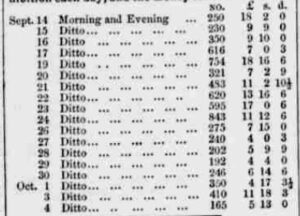
Online inflation calculators estimate £175 in 1853 would be worth nearly £30,000 now.
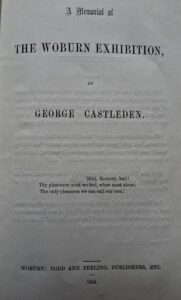
In May 1854, Dodd & Peeling also published a little booklet by Woburn’s resident local poet and writer, George Castleden, entitled, “Memorial of the Woburn Exhibition 1853”. He had attended both the opening and closing ceremonies and supplied some items for it. He describes a few of the exhibits and recounts stories that are very similar to those outlined above in the newspapers – was he the original author of the press reports? He certainly wrote extensively for the newspapers around that time. He also mentions he had been to the Great Exhibition in London in 1851 and looking down from a gallery within, he had seen some of the exiled members of the French Royal family there.
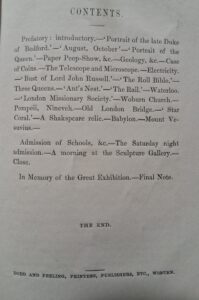
One of the exhibits he mentioned was the barrow and spade used by the Duchess of Bedford in turning the first soil for the new Bedford to Bletchley Railway line in 1846, which passed through nearby Woburn Sands, once called Hogstye End. Of this amazing advance in transportation, he wrote: “We imagined the incredulous stare of some of our “market-house ancients” if, standing at our elbow, we had called their spectacled orbs to this barrow and spade and said The Duchess of Bedford had used them in the formation of a London Road to which we are obliged to go down to “Hogstyend!”, that this road is made of iron, that passengers wide awake, travel upon sleepers, and are whisked by steam to London in as short a time as in slow days and dark hours, it took, with breakfast and the encasement of overalls, top coat and kerchief to prepare for the same important journey by The Wellingboro Bold, Northampton Light or Heavy Leeds.”… the names of three the famous coach firms of the day which were swiftly made redundant by this much faster rail travel.
The last reference I can find specifically to the Woburn Literary & Scientific Institute in the online newspapers was in a December 1888 Leighton Buzzard Observer:
“WOBURN. A lecture was given in the Town Hall on Friday evening, the 30th ult., on behalf of the Literary and Scientific Institute, by Mr. Henry Blackburn, of London, author of “Academy Notes,” &c., entitled “Pictures of the Year,” which was illustrated by beautiful dissolving views, showing some of the most popular pictures from all the leading artists of the day. The Rev. H.W. Southey took the chair, and there was large and appreciative audience. After that, it seems to have been subsumed into the general Bedfordshire Literary and Scientific Institute. I wonder how many of their exhibited items still exist?
Page last updated Apr. 2026